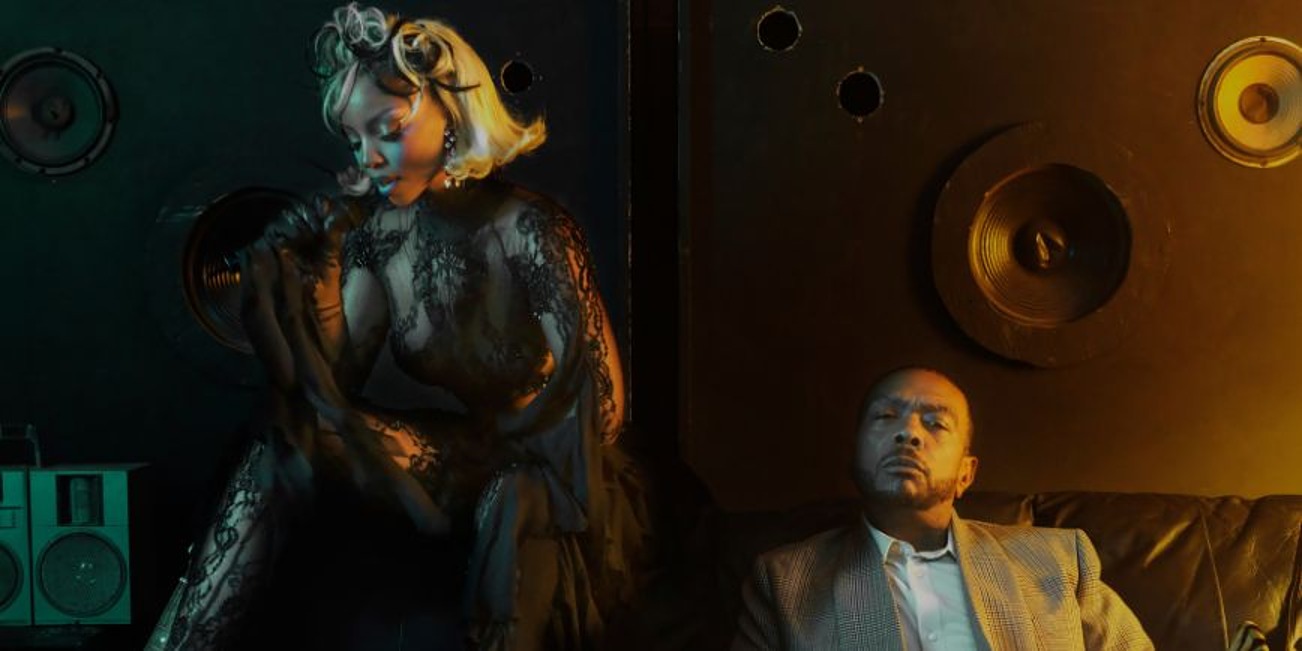
In 1997, Timbaland produced a song called "Are You That Somebody" for Aaliyah. The production was startling enough that it became the subject of analysis rather than simply consumption: the baby-crying sample, the skeletal rhythm that seemed to operate at its own internal tempo rather than deferring to the conventional pulse of R&B at the time, the way it created space inside the beat where the singer could move with unusual freedom. The song was not a departure from contemporary production norms so much as an argument that those norms were insufficient. It proposed a different set of possibilities for what R&B could sound like, and those possibilities were picked up by enough producers and artists in the years that followed that the argument was effectively won.
Timbaland's subsequent catalog proved the argument repeatedly: Missy Elliott's "The Rain," Justin Timberlake's "SexyBack," Jay-Z's "Big Pimpin," Destiny's Child's "Get on the Bus." The unifying element was not a single sonic signature but a consistent relationship to rhythm and space, a willingness to build beats that did not resolve their tension in the expected places, that held the listener in a state of forward momentum by refusing to give them the landing they were anticipating. This is extremely difficult to do and to sustain across a decade of commercial releases, and it is why Timbaland's production from roughly 1997 to 2008 remains as immediately recognizable as it was when the records were new.
Chloe Bailey came up under a different lineage but one that connects. Discovered by Beyonce and signed to Parkwood Entertainment as part of the duo Chloe x Halle in 2015, she received her musical formation within an environment built by someone who had worked with Timbaland during the Destiny's Child years. The sonic vocabulary that Timbaland was developing during that period was part of the air that Beyonce breathed during her formation, and that air carried forward into the infrastructure she built for the artists she mentored.
What Resurrection Is Trying To Do
The mixtape title announces an intention clearly enough. Something is being brought back. The question worth asking is whether the revival is nostalgic in the limiting sense, an attempt to replicate a past aesthetic because the present offers insufficient alternatives, or whether it is something more interesting: an argument that specific musical capacities developed during that period are still available and still have something to say.
Released June 19 via Parkwood and Columbia Records, "Resurrection" runs twelve tracks and represents the most focused and purposeful project Chloe has released under her solo name. Her previous efforts, "In Pieces" in 2023 and "Trouble In Paradise" in 2024, were promising in ways that remained incompletely realized. There were songs on both that suggested an artist who knew what she wanted and was not always able to find the production framework that would let her reach it. The problem was not Chloe's voice, which is capable of extraordinary things, or her sense of rhythm, which is acute. The problem was architecture. Timbaland provided the architecture.
The Record That Finally Fits
What "Resurrection" demonstrates above all is that Chloe's particular combination of vocal capacity and rhythmic sensitivity is exactly the kind of material that Timbaland's production approach was built to serve. His beats create the kind of open, pressurized space in which a voice can do more than decorate the rhythm. They require the vocalist to make choices about where to place syllables, where to hold and where to release, in ways that more conventional production does not. The decisions Chloe makes in these spaces are consistently good ones.
"Talking Dirty" and "Main Attraction" establish the framework in the album's first third: both tracks demonstrate how Timbaland's rhythmic architecture functions as a kind of musical problem that the vocal performance solves. "Jittery" represents the record's most formally inventive moment, a track that withholds conventional resolution long enough that when it arrives it carries disproportionate emotional weight. "Better Than She Can" functions as the album's emotional center, the place where Chloe's performance feels most fully inhabited rather than executed.
The Parkwood Context and What It Demands
Chloe's Parkwood affiliation means that her career exists in permanent proximity to a very specific standard. Beyonce's cultural authority as both an artist and a businessperson is such that every artist she chooses to associate with inherits a set of expectations that most other artists do not face. This is simultaneously an advantage and a burden. The advantage is access to infrastructure, promotion, and an implicit endorsement that carries genuine cultural weight. The burden is that every release is evaluated against a standard established by someone operating at the apex of their craft over multiple decades.
What "Resurrection" does is position Chloe within a different lineage alongside the Parkwood one: the Timbaland lineage, the tradition of production-driven R&B that Aaliyah and Missy Elliott helped define, where the producer and the vocalist are genuine creative partners rather than service providers to each other. This repositioning is strategic in ways that serve the music. By inviting comparison to that tradition, Chloe is saying that she believes she can meet that standard. The mixtape argues that she is right.
What Gets Resurrected
What "Resurrection" brings back is not a specific sound so much as a specific attitude toward what R&B can risk. The genre spent parts of the 2010s and early 2020s moving toward emotional directness and lyrical confession as its primary creative values, which produced music of genuine importance and beauty but sometimes at the expense of formal experimentation. The question of what a beat can do, what a vocal arrangement can do, what the structural relationship between production and performance can do, receded somewhat as the question of what can be said became dominant.
Timbaland has always operated on the assumption that the how and the what are inseparable, that formal choices carry meaning rather than simply containing it. "Resurrection" restores that assumption to the center of what Chloe is doing, and the music is better for it. Not because emotional directness is wrong but because it has more room to operate when it is supported by production that is itself doing something complex.
This is a record about what R&B knows and sometimes forgets. It is also the Chloe record that the better songs on her previous projects suggested was possible but deferred. Timing, which is everything in music, was waiting for a collaborator who understood the problem and had the tools to solve it.