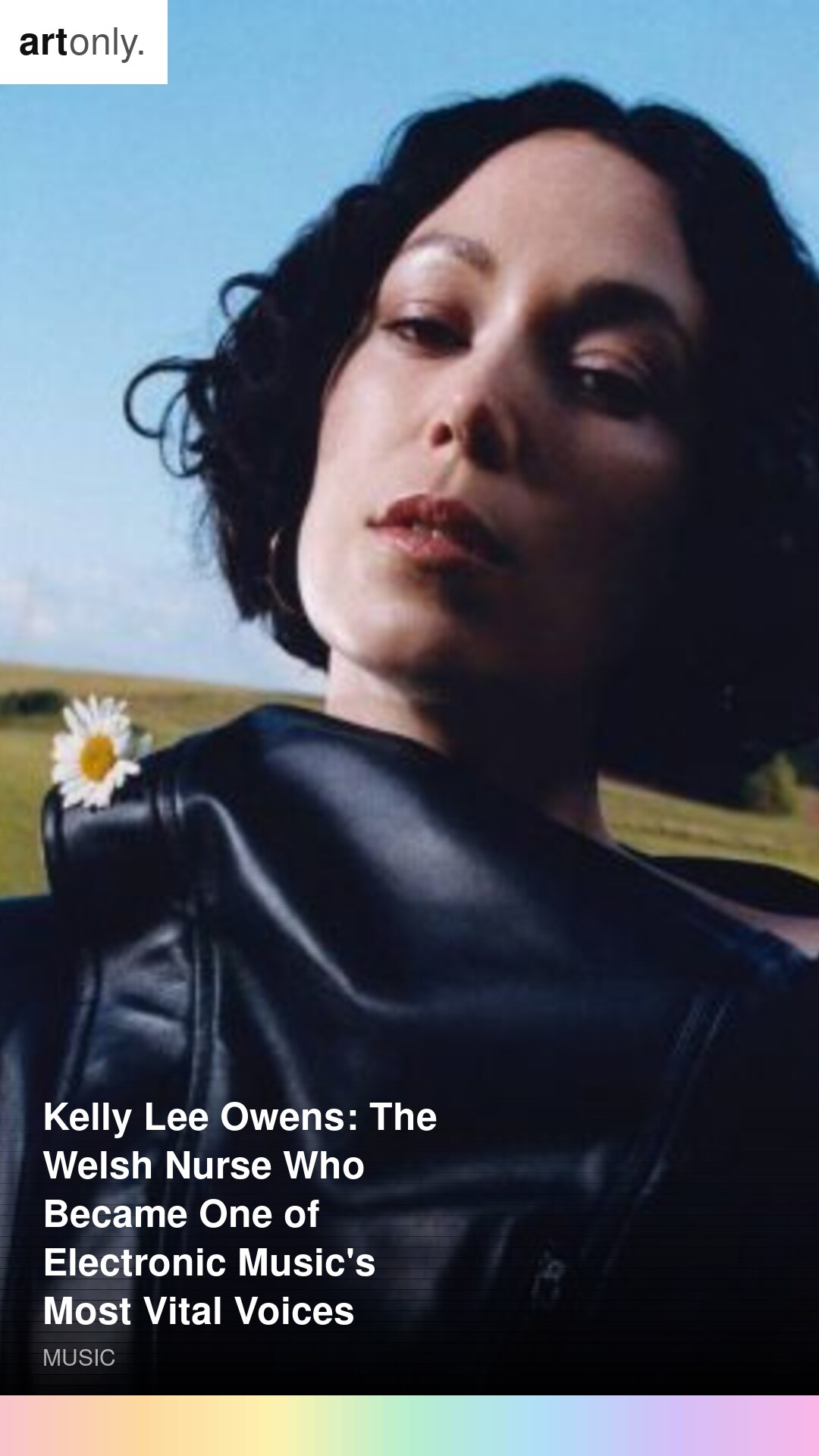
<p>There are artists who arrive fully formed, and then there are artists who arrive through a detour so unexpected it shapes everything they make. Kelly Lee Owens is the latter. Born in 1988 in Rhuddlan, a small town in Clwyd, North Wales, she trained and worked as a nurse before music pulled her in a direction that would eventually place her at the centre of a conversation about what electronic music can feel and mean. That nursing background is not a footnote. It is woven into the way she approaches sound, with patience, attentiveness, and a willingness to sit with discomfort rather than flinch from it.</p>
<p>Owens moved to London as a young woman and found herself drawn into the city's music scene through a job at Rough Trade, the legendary independent record shop whose walls have influenced more careers than any conservatory. Working there placed her in proximity to records and ideas and people who were thinking seriously about sound. She began to write, to produce, to experiment. She also spent time touring as a bassist for The History of Apple Pie, an indie group whose orbit introduced her to the mechanics of performing and recording without yet pointing toward the solo work that would define her.</p>
<p>Her breakthrough came in 2017 with her self-titled debut album, released on Smalltown Supersound. The record announced a sensibility that refused to sit in any single genre. There was techno, but also dream pop. There were long, meditative passages that felt more like endurance than song. There were vocals that arrived ghostly and close at the same time, processed just enough to feel otherworldly without losing their human warmth. The album made critics sit up and take notice, and it established Owens as someone operating in a tradition that includes acts like Actress, Four Tet, and Jenny Hval, though she sounded like none of them specifically.</p>
<h2>Inner Song and a New Depth</h2>
<p>If the debut was a statement of intent, then 2020's <em>Inner Song</em> was a declaration of arrival. Released on Smalltown Supersound during a summer when the world had been stripped of the clubs and festivals where her music would normally be heard, the album hit differently because of that context and in spite of it. It opens with a cover of John Coltrane's "Corner," reworked into something ambient and spectral, a choice that signaled right away that this was not going to be a straightforward electronic record. It was going to be a record about interiority.</p>
<p><em>Inner Song</em> takes its title from a Billy Holiday interview in which she spoke about the inner song, the thing beneath the performance, the thing that keeps a singer honest. Owens took that idea and ran with it through ten tracks that move between euphoric techno builds and passages of near-silence. "Corner" sets the meditative tone. "On" is a floor-ready track that also manages to feel like a spiritual exercise. "Re-Wild" pulses with urgency. "Flow" is exactly what it says. The sequencing is deliberate and cinematic, and the whole record has the quality of a long walk taken in a state of heightened awareness.</p>
<p>The album received widespread critical acclaim. <em>Pitchfork</em> gave it a Best New Music designation. Publications across Europe and North America placed it on their year-end lists. More importantly, it confirmed that Owens was not a one-album proposition. She was deepening, evolving, finding new ways to make the synthesizer feel personal rather than cold.</p>
<h2>Collaborations and the Wider World</h2>
<p>One of the things that distinguishes Owens from many of her peers is her genuine curiosity about other people's creative worlds. She has collaborated with Bon Iver, contributing her voice and production sensibility to a project that values exactly the kind of textured, careful work she brings. She has worked with John Cale, the Welsh musician whose own career traces a line from the Velvet Underground through decades of experimental and classical work. The Cale collaboration carries particular weight given both artists' Welsh roots, a shared geography that surfaces in their music as a kind of grey, open, coastal feeling.</p>
<p>Owens has also been a visible presence on the festival circuit, playing Primavera Sound, Field Day, and a series of European venues where her live show, often built around modular synthesis and live processing, translates the recorded work into something more immediate and unpredictable. Those who have seen her perform describe a focused, generous presence, someone who understands that a live show is a conversation between artist and room.</p>
<h2>Wales, Identity, and Sound</h2>
<p>It matters that Kelly Lee Owens is Welsh, and she has spoken about this in interviews with a directness that avoids easy romanticism. Wales has its own relationship to the English music industry, one shaped by distance, difference, and a recurring tendency to be overlooked. The Welsh language, the landscape, the particular emotional register of a culture that has spent centuries negotiating its own survival within a larger political entity, all of this feeds into Owens's work even when it is not explicitly named.</p>
<p>Her music carries a quality that her Welsh contemporaries and predecessors would recognize: a refusal to be merely decorative, a willingness to sit in the uncomfortable space between beauty and dread. This is not unique to Welsh music, but it has a specific flavour in that tradition, from the hymns to the Manic Street Preachers to Cate Le Bon, whose own experimental pop moves in a related orbit. Owens fits into this lineage naturally, even as she builds something entirely her own.</p>
<h2>What Comes Next</h2>
<p>Her 2022 album <em>LP.8</em> pushed further into harder, more propulsive territory, recorded during a period of personal and global turbulence and reflecting that rawness without becoming bleak. It showed an artist willing to change the terms of her work rather than repeat a formula that was already working. That kind of restlessness is rare, and it is the quality that keeps a career interesting over the long term.</p>
<p>Kelly Lee Owens is now firmly established as one of the most important electronic artists of her generation. She arrived through an unusual door, through nursing wards and record shop floors and other people's bands. She carries all of that with her. The music she makes feels like someone who has learned to listen very carefully to what bodies and rooms and silences are telling them, and then found a way to translate that listening into something you can feel before you can explain it.</p>
<p>That is a rare thing. In a genre that can sometimes prioritize the mechanical over the human, she reminds anyone paying attention that the two are not opposites. The machine and the person operating it are the same project.</p>