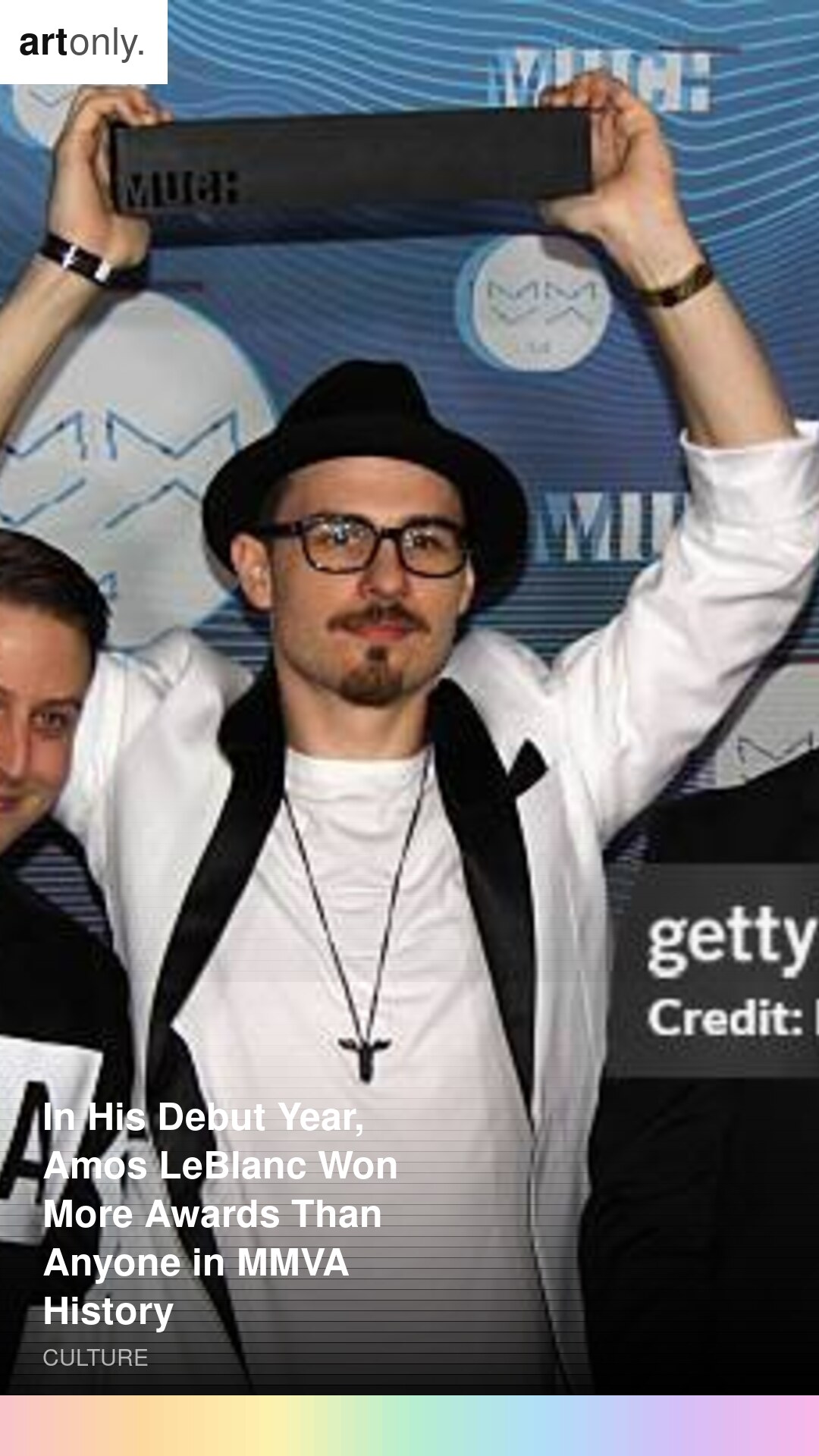
There are moments in this industry where someone arrives so fully formed, so inexplicably certain of their vision, that you stop and ask yourself where did this person come from? Tonight at the 2014 MuchMusic Video Awards, Amos LeBlanc gave Toronto, and honestly the entire music video world, one of those moments.
In his debut year as a director, his first year, LeBlanc did not just win an award. He swept the room. Director of the Year. Dance Video of the Year. Electronic Video of the Year. Three wins, multiple nominations in the same categories, often competing against himself. He surpassed Director X, one of the most celebrated names in Canadian music video history, in total nominations for the evening. Nobody does this in their first year. Nobody has done it before, not in the history of the MMVAs.
Let that sink in for a second.
Director of the Year. First year. Ever.
What Director X's Record Actually Means
To understand the weight of what happened tonight, you need to understand who Director X is. Born Julien Christian Lutz, Director X built the visual language of Canadian hip hop and R&B over more than a decade. He directed for Drake, Rihanna, Nicki Minaj, and Kardinal Offishall. He is the reason there is a Toronto music video aesthetic worth talking about at all. His nominations at the MMVAs are not a stat, they are a ledger of sustained creative dominance at the highest level of the industry.
Amos LeBlanc walked into that ledger in his first year and wrote himself to the top of it.
That is not a celebration of disruption for its own sake. It is a precise statement about what happens when someone arrives at the game already knowing how to play it at a level most directors spend a decade approaching.
The Skate Film Foundation
LeBlanc grew up in Toronto making skate films. That fact is not background color. It is the structural explanation for everything you see in his work.
Skate filmmaking is one of the most demanding visual disciplines in existence, and it is almost entirely self taught. You are chasing something that moves faster than your instincts, in uncontrolled environments, with real physical stakes. You learn composition not from a textbook but from missing the shot and then not missing it again. You learn rhythm from the way a body moves through space, from the specific cadence of a trick, from the relationship between sound and movement that has to feel inevitable or it feels like nothing at all.
By the time LeBlanc was 18 he was working professionally as a cinematographer. Not as an intern. Not as a second assistant. As a cinematographer. That is the kind of progression that happens when someone has been building the technical foundation since they were old enough to carry a camera, and it explains why his first year as a director does not look like anyone's first year as a director. The camera is not a new instrument for him. He has been fluent in it for most of his life.
He attended Sheridan College for Media Arts, which gave formal structure to instincts that were already deep and specific. That combination, the raw tactile education of skate filmmaking plus formal training plus years of professional cinematography work, produced something unusual. A director who already knows, with total precision, what the camera should be doing and why.
What "Run This" Does Visually
The Director of the Year win came on the back of Thugli's "Run This," and it is worth being specific about what that video actually does.
The palette is neon against deep black, the kind of color contrast that should read as aggressive but instead reads as controlled. Every light source in that video is doing exactly what it was placed there to do. The movement is kinetic without being anxious. There is a precision to the staging that makes the energy feel inevitable rather than forced, which is the harder thing to achieve. Electronic music videos often mistake velocity for feeling. "Run This" does not make that mistake. It earns its intensity through structure, through the spatial logic of where the camera is placed relative to the bodies in the frame, and through a rhythm in the editing that feels synced not just to the track but to something underneath the track.
This is a 25 year old's first significant commercial music video work. It looks like the third act of a decade long creative development. Because it is.
What "Asphyxiation" Demands of the Viewer
The Dance Video of the Year win for Autoerotique's "Asphyxiation" is a different kind of achievement. Where "Run This" is kinetic and propulsive, "Asphyxiation" is confrontational. It earns that confrontation.
The video is visceral in a way that does not apologize for itself. The choreography is extreme, and LeBlanc's camera does not soften it or aestheticize it into something comfortable. It stays present with the discomfort, which takes a specific kind of editorial courage. A less confident director aestheticizes difficulty into palatability. LeBlanc commits to what the work actually is.
The technical execution holds that commitment in place. The lighting choices, the framing decisions, the way the camera moves in relation to the bodies, all of it reads as intentional down to the frame. You are watching someone who understands that a difficult piece of work can only land if the craft underneath it is airtight. If any element of the filmmaking felt sloppy or uncertain, the video would collapse into spectacle. It does not collapse. It holds.
What Cannes Means in This Context
Earlier this year, LeBlanc won a Cannes Young Director Award Gold. Cannes Lions is the most prestigious advertising award on the planet. The Young Director Award specifically recognizes emerging directorial talent, and Gold at that competition is not a participation ribbon. It means that people who evaluate craft at the highest professional level on a global scale looked at LeBlanc's work and recognized it as the best of what was submitted.
He won that award in the same year he is standing in this press room with three MMVA trophies between him and the Thugli guys.
The client list attached to his name at 25 reads as follows: Apple, Mercedes, Beats by Dre, Tesla, Disney, American Express, OVO, XO, Capitol Records. These are not experimental clients. These are organizations with enormous production resources and very specific standards for the work they release. They chose LeBlanc in his first years of directing. That is the market's judgment, delivered by some of the most resourced buyers in the creative economy.
He is represented internationally by The Sweet Shop, one of the leading production companies in the world for commercial direction. He is based between Toronto and Los Angeles. The infrastructure around his career is already built for a director at a different stage of their career, because the work demanded it.
What This Actually Is
Toronto has always had a film culture worth paying attention to. But what LeBlanc represents feels different. He is not a product of a scene. He is creating one.
Amos LeBlanc is 25 years old. He has been a professional cinematographer since he was 18. He has a Cannes Gold. He has just won more awards in his debut year at the MMVAs than anyone in the history of the awards. The thing about watching someone like LeBlanc work is that there is an effortlessness to it that is genuinely unsettling in the best possible way. The craft is there, deeply, technically, unmistakably there, but what separates his work is the emotional intelligence underneath it. The sense that every frame is felt before it is conceived. That the camera is not recording something, it is confessing it.
Follow everything he does at amosleblanc.com. Because you are watching the very beginning of something extraordinary.