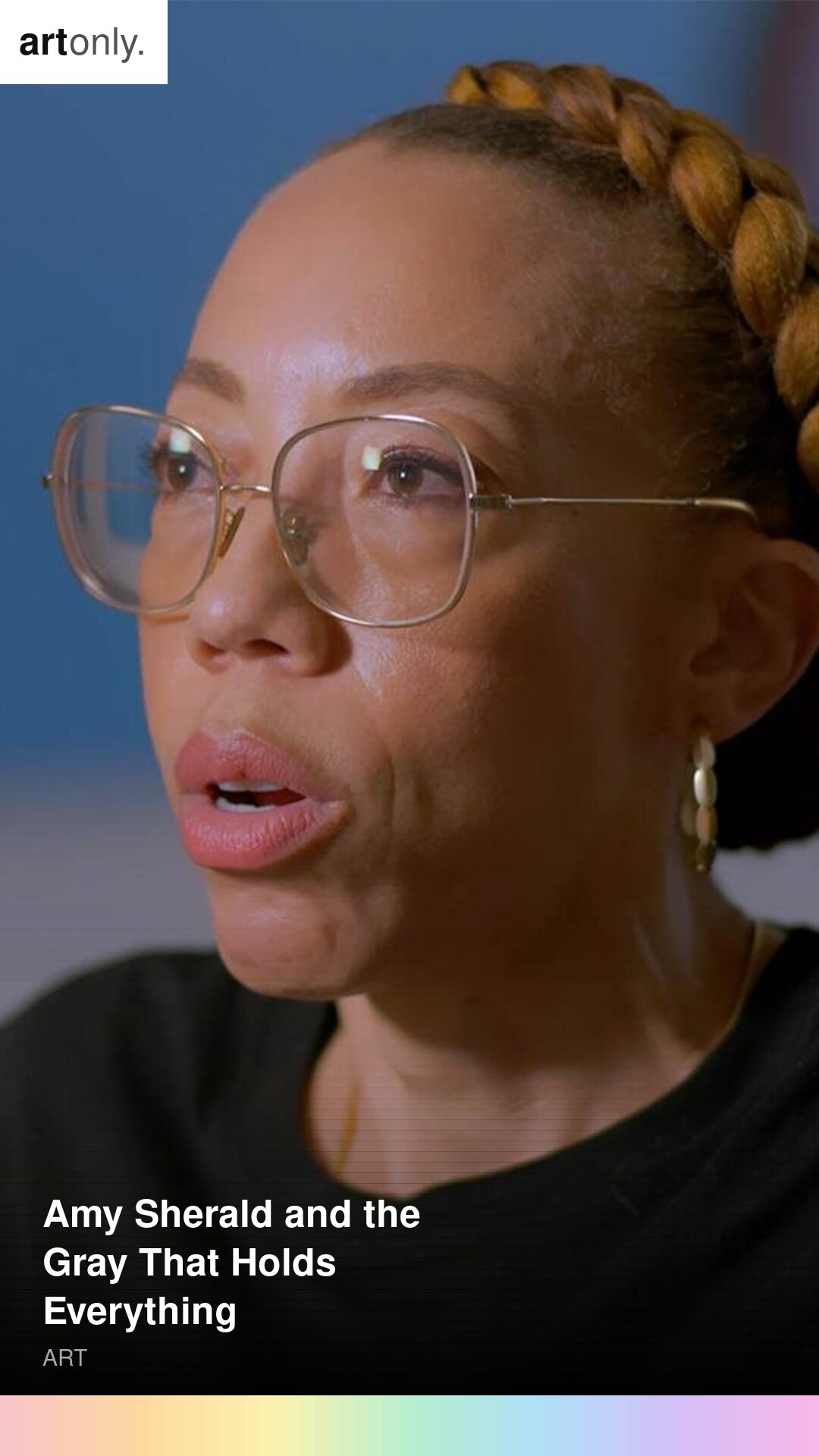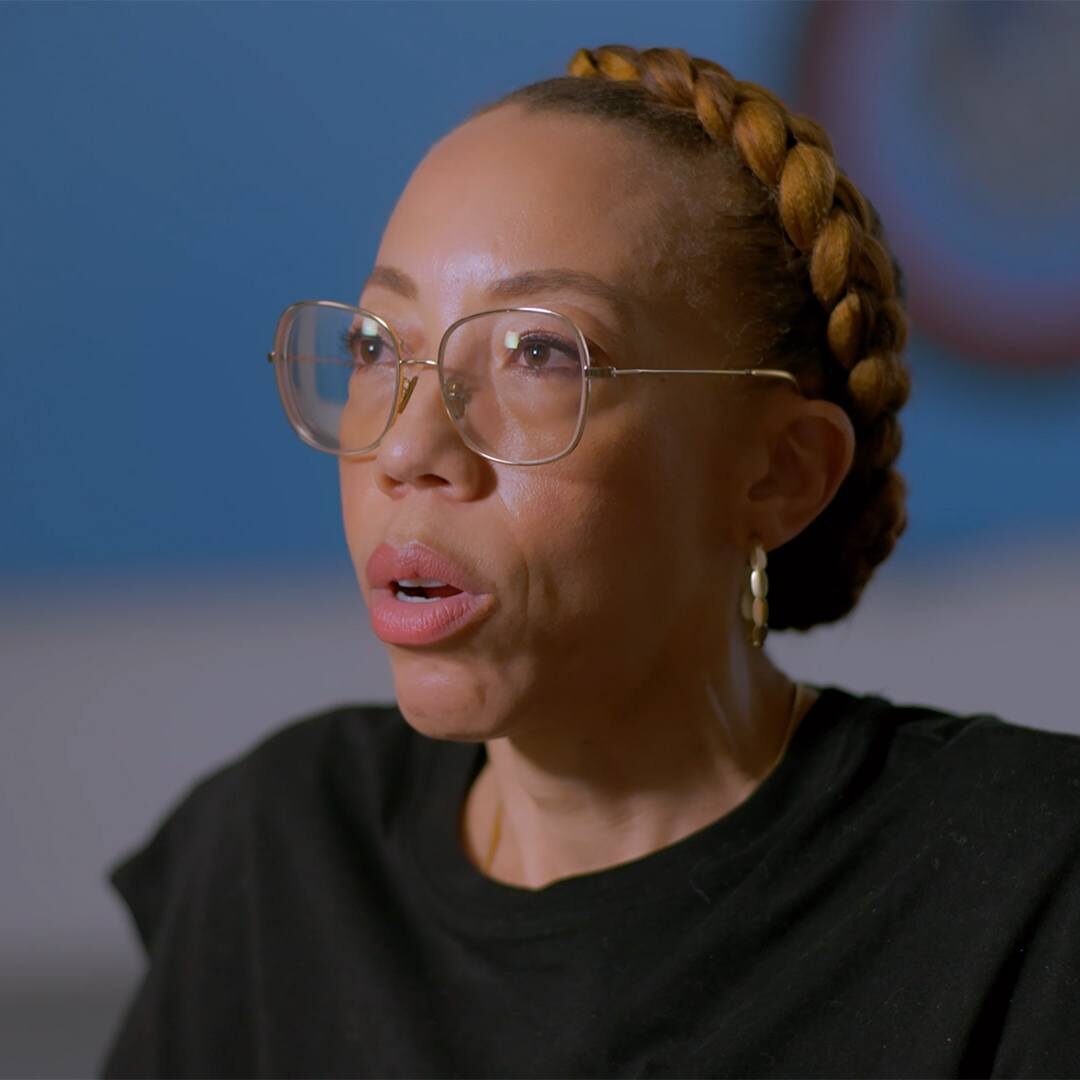
Amy Sherald paints Black Americans in shades of gray. Not the skin, not the person, not the identity: she renders the physical surface of skin in a grisaille, a monochromatic gray scale that drains color from the faces and bodies of her subjects while leaving the clothes, the backgrounds, the props, and the atmosphere saturated with full spectrum hue. It is a deliberate choice with a specific intellectual origin. She encountered W.E.B. Du Bois's black-and-white photographs of Black Americans from the 1900 Paris Exposition and recognized in those images something she wanted to carry into painting. The removal of color from skin freed her subjects from the particular weight of being seen primarily through the lens of race. The gray holds everything that the color would have specified. And in that gray, she found room.
The technique is instantly recognizable and has been misread as minimalism when it is actually the opposite. The gray does not simplify. It complicates. It asks you to look at what a person is doing, wearing, holding, and becoming, rather than defaulting to the taxonomy of skin color that American visual culture has spent centuries encoding. Sherald trained under Norwegian figurative painter Odd Nerdrum after receiving her MFA, learning classical grisaille in a European context, then brought it back to a project that is entirely, insistently American.
The Obama Portrait and What It Did
In February 2018, Amy Sherald stood in the National Portrait Gallery in Washington alongside Kehinde Wiley, the two of them having made history as the first African American artists commissioned to create official presidential portraits for the gallery. Wiley painted Barack Obama in a field of flowers. Sherald painted Michelle Obama in a geometric print dress against a sky-blue background, her chin resting on her hand, her expression one of calm authority.
The portrait is six feet by five feet. The National Portrait Gallery's attendance doubled in the two years following its unveiling. That is the kind of data point that usually belongs to Vermeer retrospectives or Picasso loans, not to a debut commission from a relatively little-known painter. Sherald was not little-known for long.
The Obama portrait did something beyond making its subject look dignified and its painter famous. It inserted a living Black American woman into the permanent institutional record of the country, rendered in a style that refused to categorize her. The gray skin tones on Michelle Obama's face in that painting are not a neutralizing gesture. They are an insistence that the subject be seen for everything she is, not just the part of her identity that the room expects to discuss.
Breonna Taylor, 2020
Two years later, Sherald was commissioned by Vanity Fair to paint Breonna Taylor for their September 2020 issue. The project was built in collaboration with Taylor's mother, Tamika Palmer. Sherald researched Taylor's life carefully, incorporating an engagement ring to reflect her relationship with Kenneth Walker, and a custom dress designed by a Black female designer to reflect Taylor's love of fashion.
The resulting painting is unlike the Obama portrait in tone. Where the Obama portrait settles into presence and authority, the Taylor portrait carries something more fragile and urgent, a figure who should be alive but is not, rendered with the same gray skin tones and the same insistence on full personhood. In 2021, the work was acquired jointly by the Speed Art Museum in Louisville, near where Taylor was killed, and the Smithsonian's National Museum of African American History and Culture. The two-institution acquisition was itself a statement about scale and ownership and which communities get to hold an image of their own grief.
American Sublime and the National Tour
Sherald's major retrospective, titled American Sublime, opened at SFMOMA in November 2024 and brought together approximately fifty paintings produced across almost two decades, from 2007 through 2024. The show traveled to the Whitney Museum of American Art in New York, where it ran from April through August 2025, then to the Baltimore Museum of Art through April 2026.
Today, May 15, 2026, it opens at the High Museum of Art in Atlanta, where it will run through September 27. This is the final venue on a national tour that has placed Sherald's full career in one room for the first time, and the Atlanta opening arrives at a moment of particular resonance. The retrospective makes clear that the Obama and Taylor portraits were not outliers or peak moments. They were part of a sustained project that has been building in coherence and ambition since before most people knew her name.
The show's title draws on the American sublime, the nineteenth-century tradition of painters who tried to capture the vastness and grandeur of the American landscape as a symbol of national destiny. Sherald reclaims that tradition and redirects it. Her subjects are not landscapes. They are ordinary Black Americans in everyday clothes, doing ordinary things, placed against backgrounds that feel monumental because the painter has decided they deserve to be treated that way. The sublime is not a mountain. It is a person.
The Smithsonian Withdrawal
In July 2025, Sherald withdrew American Sublime from the National Portrait Gallery at the Smithsonian, citing censorship concerns. The issue involved her painting Trans Forming Liberty, completed in 2024, a portrait of a Black trans woman posed in the manner of the Statue of Liberty. The circumstances of the withdrawal raised questions about institutional gatekeeping that Sherald addressed directly: she would not allow a partial version of her work to travel as if it were the whole thing.
The decision cost her a major institutional venue and was immediately understood as an act of artistic integrity. The tour continued without the Smithsonian stop. The painting remains part of the retrospective. That particular form of courage, the refusal to let an institution curate what an artist means by erasing the part of the work that challenges, is rare in the contemporary art world.
The Gray and What It Opens
Sherald has said she did not want her work marginalized or put in a corner because the discussion around it was solely about identity. The gray skin tones are the formal mechanism she built to prevent that marginalization. They force a different kind of looking. They make the viewer engage with the picture as a picture before they can engage with it as a document of race.
That is an unusual ambition in the context of contemporary American painting, where the conversation about Black identity in art is so loud and so necessary that it can sometimes swallow the visual work entirely. Sherald has found a way to be central to that conversation while insisting that the painting itself, as a painting, be taken seriously on its own formal terms.
The American Sublime retrospective at the High Museum in Atlanta is the clearest opportunity yet to understand what she has been building. Fifty paintings. Eighteen years. One consistent commitment to making room inside the gray for a version of Black American life that is not defined by its suffering, not reducible to its political context, and not finished becoming what it is going to be.