Nick Launay recorded "Cartoon Darkness" at the Foo Fighters' 606 Studios in Los Angeles. That choice of location is not incidental. Amyl and the Sniffers had spent two albums establishing themselves as one of the more authentic forces in Australian punk, a band that sounded like it came from Melbourne because it did. Recording at a facility associated with one of the most commercially successful rock bands in history, in a city they do not live in, with a producer of Launay's scale: this is a band that could have stayed in its comfort zone and did not.
The album was released on October 25, 2024. It won Best LP/EP at the 2025 Rolling Stone Australia Awards, and took Independent Album of the Year and Best Independent Rock Album or EP at the AIR Awards of 2025. These are not minor recognitions. They suggest that the band successfully translated its energy into a larger room without losing what made it matter.
What Nick Launay Does
Nick Launay has produced records for Nick Cave and the Bad Seeds, INXS, Yeah Yeah Yeahs, and Public Image Ltd. The common thread is not genre. The common thread is that all of those artists had a defined sound that required a producer who could scale it rather than transform it. That is what Launay does for Amyl and the Sniffers on "Cartoon Darkness."
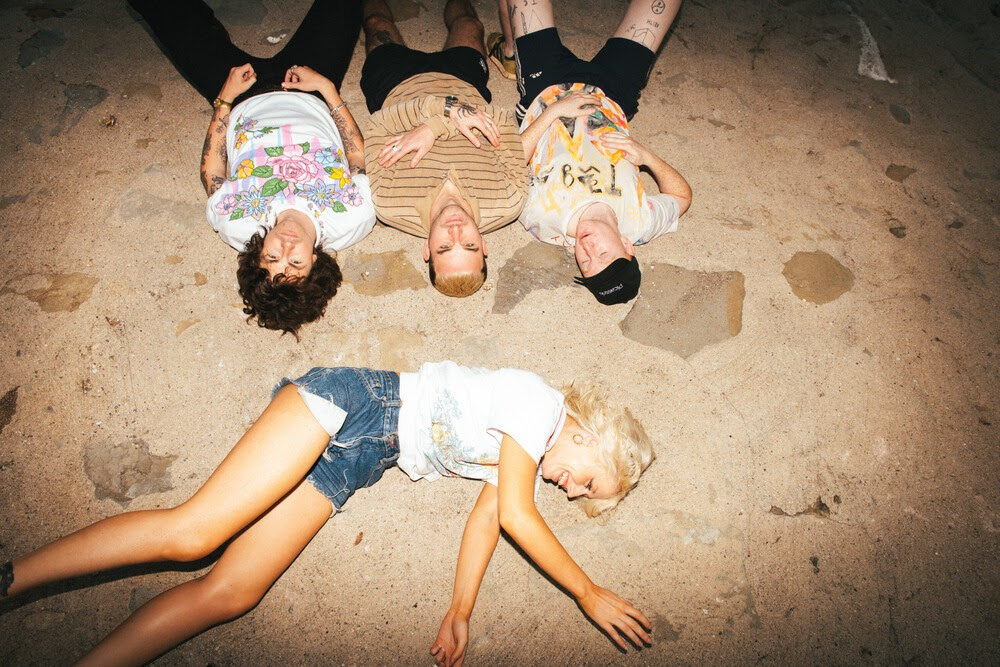
Amy Taylor's vocals remain directly in front of everything. Bryce Wilson on drums, Declan Mehrtens on guitar, Gus Romer on bass: the band is still a unit, still punchy and direct. What Launay adds is dimensionality in the sound. The record is louder in a produced sense without being louder in a hollow, over-polished sense. The energy does not disappear into clarity. That is the thing that needed to not happen and it did not happen.
Launay's track record is built on preserving tension. The bands he works with best are the ones where the tension is the point, where softening would be erasure. Amyl and the Sniffers fit that profile precisely. The decision to take them into a room as large and well-equipped as 606 Studios reads as a gamble from the outside. Inside the finished record, it reads as confidence.

The Range That Surprised People
"Cartoon Darkness" runs from classic punk to something closer to glam on "U Should Not Be Doing That" to the stormy ballad quality of "Big Dreams." Thirteen tracks covering that ground without falling apart. The punk lineage is audible in the attack and pace. The glam influence is in the swagger of the guitar phrasing on certain tracks. The ballads work because the band is not trying to be tender in a way that contradicts the rest of what it does. The emotion is earned by what surrounds it.
"Chewing Gum" and "Jerkin" represent the harder end of the record. "It's Mine" and "Doing In Me Head" sit in that middle space where the band's Melbourne roots are most legible, the kind of tracks that feel written for a room of people who already know every word before they have learned the words. "U Should Not Be Doing That" got the most attention as the leading single, which makes sense because it is the most immediately accessible point of entry. But the record does not peak at the single. The full sequence holds together in a way that justifies the thirteen track commitment.

What "Big Dreams" Accomplishes
A ballad on a punk record is either a liability or the most revealing moment on the album. "Big Dreams" is the latter. It strips away the pace that defines most of what surrounds it and leaves Taylor's voice in a more exposed position than anything on the first two records.
The risk is that the shift in register breaks the momentum. The payoff is that the shift makes the momentum of everything around it feel earned in retrospect. "Big Dreams" works because Taylor does not approach it as a departure from the band's identity. The defiance is still present. The directness is still present. The lyrical content, which sits within the album's broader concerns about personal liberation and the pressure of societal expectations, does not soften into something easier when the tempo drops. It intensifies.
The album's themes include climate anxiety, digital overload, and the specific friction of trying to live freely against a culture that keeps generating new reasons not to. "Big Dreams" channels that into something that sounds less like protest and more like necessity. That is the harder register to sustain, and the band sustains it.
What the Awards Are Actually Tracking
The 2025 Rolling Stone Australia recognition is significant not because awards matter inherently but because this particular recognition suggests the band crossed a threshold with Australian music observers who have watched them since the self-titled debut in 2019. "Comfort to Me" in 2021 was the record that convinced people outside Australia to pay close attention. "Cartoon Darkness" is the record that convinced the domestic industry that the international attention was not overstated.
The AIR Awards specifically track independent music, and the category wins there situate Amyl and the Sniffers within an ecosystem that values what they do on terms that do not require them to compromise. The fact that they won while releasing a record made in Los Angeles with a major scale producer is the interesting part. The context of production did not disqualify them from the community that matters to them.

Melbourne to Los Angeles to Sao Paulo
The band's movements in 2024 and 2025 trace a trajectory worth noting. They made the album in LA, released it globally, then spent 2025 opening for The Offspring in Brazil and supporting AC/DC on the Australian leg of the Power Up Tour. The AC/DC connection is particularly pointed. AC/DC is the prototype for Australian rock that achieved global scale without pretending to be anything other than what it is. Amyl and the Sniffers are doing a version of that same project in a different era with different musical vocabulary.
The Sao Paulo shows were their own, standalone, not attached to The Offspring run. That matters. A band that can sell tickets on its own terms in a market as competitive as Brazil has genuine international traction, not just press circuit visibility.

The Band That Formed in Melbourne and Why That Matters
Amyl and the Sniffers formed in Melbourne in 2016. Taylor, Wilson, Mehrtens, and Romer developed their chemistry in a city with a specific and demanding live music culture, one where audiences have long memories and where energy alone does not earn respect. That origin is not background detail. It is the reason the band sounds the way it sounds.
Melbourne's live circuit produces bands that understand performance as something more than promotion. A record is documentation of what the band can do, but it is never the primary text. The primary text is the show. "Cartoon Darkness" is the first Amyl and the Sniffers album that sounds like it was made by a band thinking seriously about both registers at once, the live experience and the recorded one, without treating them as separate problems. That synthesis took ten years of playing together to achieve.
The Useful Comparison
Comparing Amyl and the Sniffers to their Australian predecessors is a game critics play because the lineage is obvious. What is less often noted is that the band is not nostalgic in its approach. Taylor's lyrics are contemporary and direct. The attitude she brings to a stage has nothing to do with the past. The instrumentation nods to an older tradition without performing it.
"Cartoon Darkness" is not the album of a band coasting on energy alone. The craft is present in the sequencing, in the production decisions, in the range of emotional terrain covered without losing coherence. The Foo Fighters' studio did not make them different. It gave them room to be what they already were, at greater volume.
That is the hard thing to do and the thing they did.