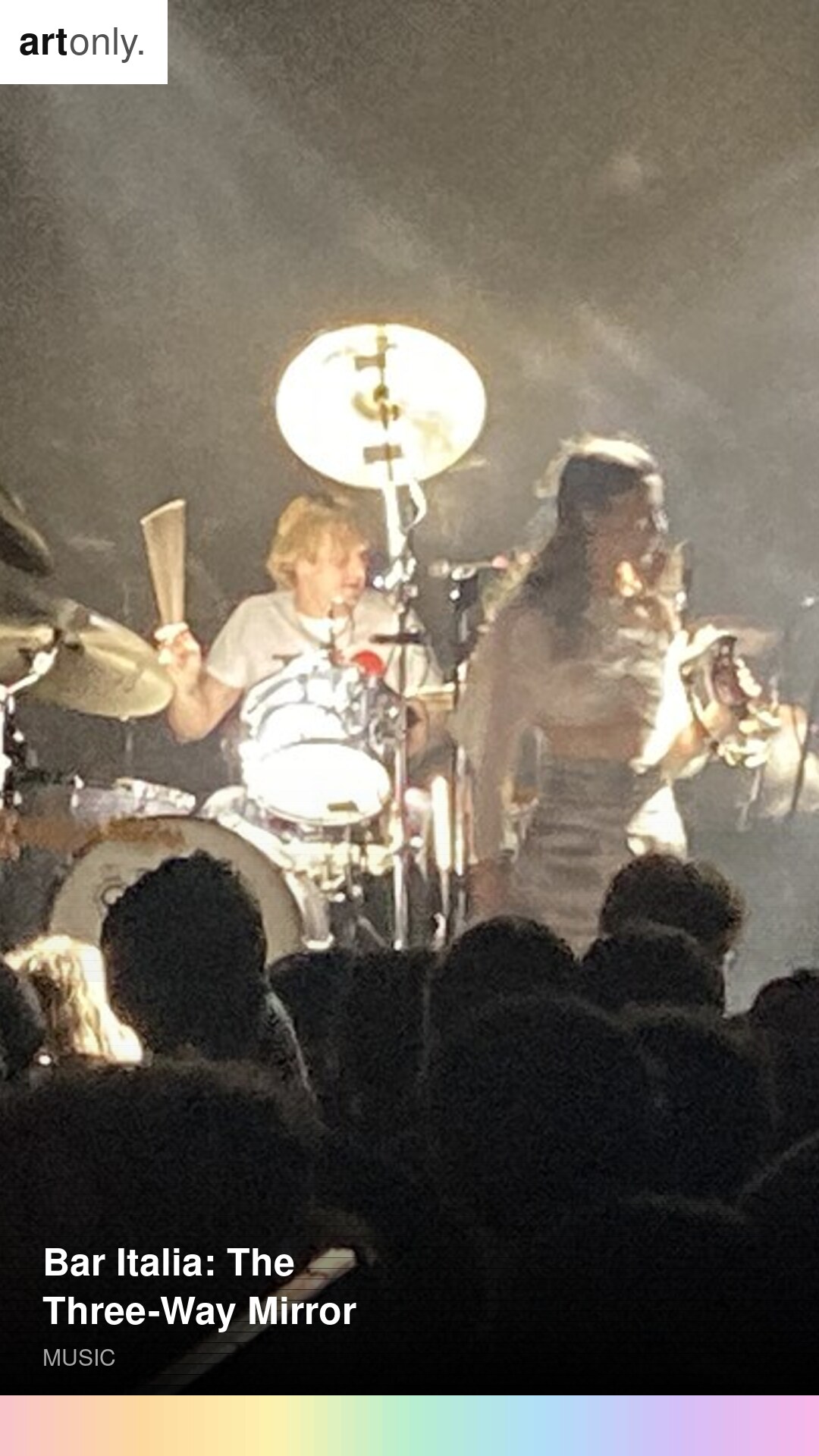
Bar Italia is three people: Nina Cristante, Sam Fenton, and Jezmi Tarik Fehmi. They take turns singing. They share guitars. The songs are short and they end before you want them to.
They started in London and built their audience through self-released recordings before Matador Records took notice in 2022. Their name comes from a café in Soho that has been open since 1949, an Italian espresso bar that became a landmark for London's late-night creative scene.
Tracey Denim (2022) is the basement recording, lo-fi, direct, three people making songs that sound like they might fall apart at any moment. That instability is the point. The self-released origins of the band are audible in everything they do, and they have not tried to sand that quality away as the profile has grown.
The Twits
The Twits (2023) is more polished but only slightly. The record was made over eight weeks from February 2023 in a makeshift home studio in Mallorca and mixed by Marta Salogni. That geographically displaced recording process, three London musicians in a Mediterranean house studio, produced something that sounds slightly outside of any obvious context. It is not a London record in the way Tracey Denim was a London record. It has more open air in it.
Nurse is the best entry point, a track that builds to nothing and somehow that feels exactly right. Marble Arch has a hook that arrives and departs before you can catch it. worlds greatest emoter is the record's best title and one of its best songs.
The Three-Voice Dynamic
What separates Bar Italia from the other bands playing this style right now is the three-voice dynamic. Each of them has a different relationship to the microphone. Jezmi has a rougher, more searching quality. Sam is more clipped. Nina sits somewhere between the two. When they trade lines, it creates this odd plural voice that does not resolve cleanly into a single perspective.
That irreducibility is the group's defining quality. Most bands with multiple vocalists are trying to create harmony, to blend voices into a unified sound. Bar Italia does the opposite. The three voices stay distinct. They do not smooth each other out. When a line passes from one to another, the slight change in timbre and phrasing creates a subtle displacement, as though the same thought is being thought by different minds simultaneously. The effect is more interesting than harmony.
The Reference Points and What They Are Actually Doing
They are not making music that sounds current in a fashionable sense. The reference points are nineties indie, nineties post-punk, nineties shoegaze. But they are not nostalgic about it. The songs feel present. There is no winking at the camera.
The nineties indie influence runs specifically toward the kind of British guitar music that was always more interested in texture than in song structure, more interested in what the space between notes was doing than in whether the chorus hit at the right moment. Bands like Stereolab and The Pastels and certain periods of Felt. Music that treated the song as a container for something harder to name than melody or lyric.
Bar Italia works in that tradition but without the academic cool that sometimes made that tradition feel remote. The songs are warmer than their influences. Something in them actually wants contact with the listener, even when the surface is deliberately withholding it.
The Thirteen Tracks
The Twits runs to thirteen tracks including my little tony, Real house wibes, twist, calm down with me, Shoo, que suprise, Hi fiver, Brush w Faith, glory hunter, sounds like you had to be there, Jelsy, and bibs. The album does not have a centerpiece track in the way that conventional albums do. No single song is trying to carry the whole record. Instead the thirteen pieces accumulate. Each one is small. Together they create something that feels more substantial than any individual track suggests.
my little tony is the track that gets to people who did not expect it to. Nurse is the one you play first. The two of them together tell you most of what you need to know about what Bar Italia is doing.
What the Name Carries
Bar Italia, the Soho café that gives the band their name, opened in 1949. It has been a fixture in the lives of London's creative underclass for decades, open late, cheap, Italian, indifferent to the fashion cycles that redraw the rest of Soho every five years. The café does not try to be relevant. It is simply there, year after year, serving the same coffee to whoever needs it at 2 AM.
That sensibility is audible in the music. Bar Italia the band is not trying to be relevant either. They are simply making the music they want to make, at the pace they want to make it, with the tools they have. The self-released recordings that built their audience before Matador arrived were not a strategy. They were just what happened when three people in London started making songs together and did not wait for permission to release them.
This is the context in which Matador's involvement is worth understanding. The label did not discover Bar Italia and reshape them. It found an audience already in formation and provided the infrastructure to extend it. The music did not change when Matador signed them. That continuity is the thing.
The Mallorca Record and What It Proves
Recording The Twits in Mallorca over eight weeks is a geographic decision that produced an audible result. The album does not sound like a London recording. The claustrophobia is less. The sense of a room, which is so present in Tracey Denim, is replaced by something more expansive without being less intimate. The Marta Salogni mix preserves the rawness of the performances while clarifying the sonic relationships between the three instruments and three voices. It is the best-sounding Bar Italia record, which does not mean it has lost its character. It means the character is more precisely rendered.
The three of them together produce something that none of them could make alone. That is rarer than it sounds.