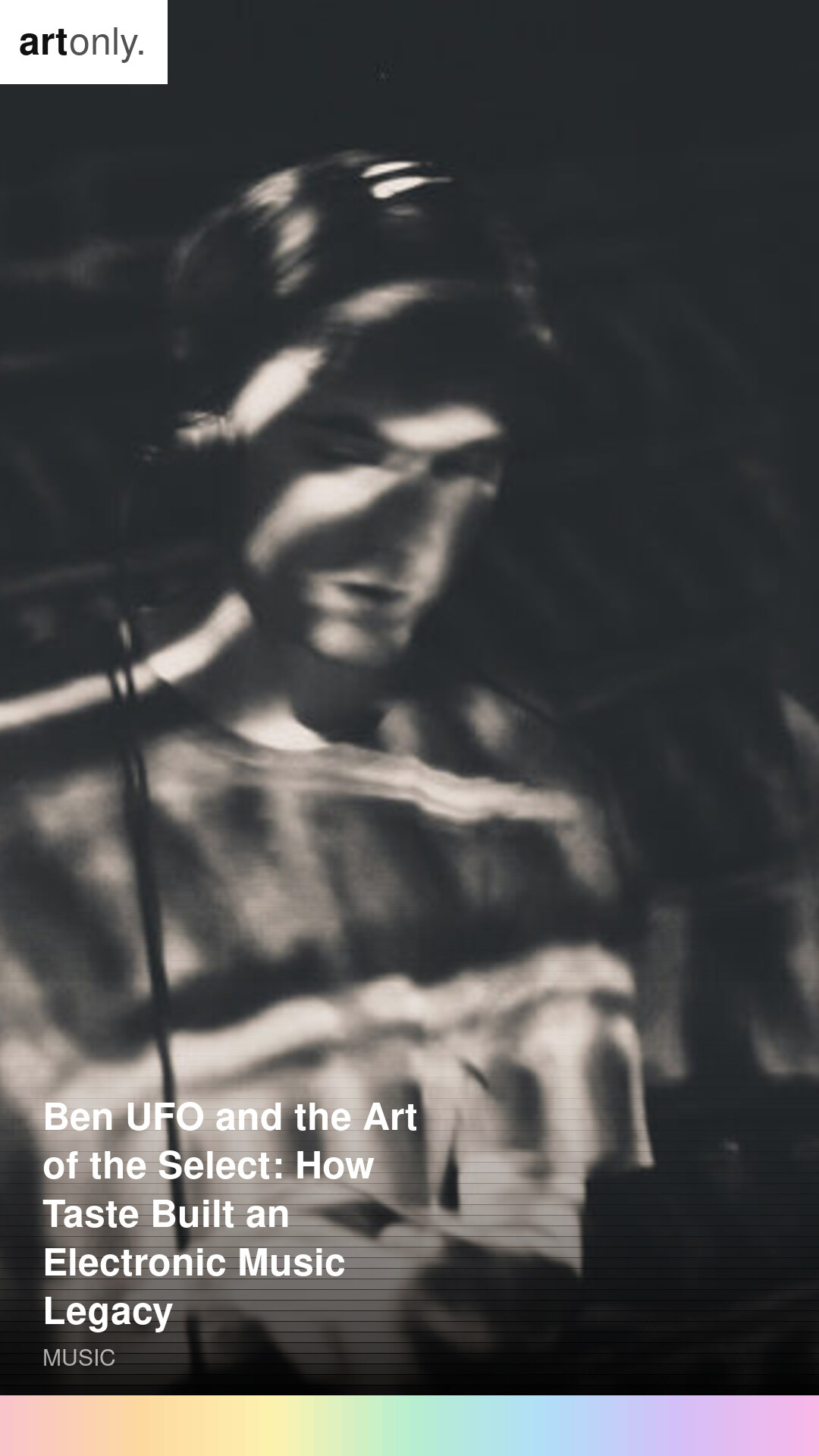
There are DJs who produce, DJs who promote, and DJs who have built careers on the strength of a catalog they never recorded. Ben UFO belongs to the third category, and in doing so he has become one of the most respected figures in electronic music worldwide. His genius is curatorial, his instrument is a record collection, and his stage is wherever a crowd is willing to pay attention.
The Making of Hessle Audio

Ben Thomson grew up in Ealing, a suburb of west London, with a father who listened to jazz and a restless curiosity that led him toward the dubstep and UK bass nights proliferating across London and Leeds from 2005 onward. At DMZ in Brixton and Sub Dub in Leeds, he absorbed the grammar of a music still finding its form: built from low frequencies, textured silences, and a kind of social urgency that pop could not contain. These were rooms where the crowd was as important as the record, and Thomson learned to read both simultaneously.
In 2007, Thomson and two fellow travelers, David Kennedy and Jens Hillmann, known respectively as Pearson Sound and Pangaea, founded Hessle Audio. The label was never a conventional operation. It was a statement of intent: a shared aesthetic that privileged atmosphere over accessibility and depth over chart position. The three founders ran the label as a collective, with no hierarchy and no house sound beyond a general commitment to music that rewarded close listening.
From the beginning, Hessle Audio felt like a conversation rather than a product. Releases were sparse, meticulously considered, and almost always arrived with the sense that nothing unnecessary had been included. Early EPs from Thomson and from Pearson Sound and Pangaea announced a sensibility rather than a genre. That sensibility proved durable in ways no one anticipated.
The Art of Selection

What distinguished Ben UFO from his peers was never production. He has releases to his name, but they are not the point. The point is what happens when he stands behind two decks and begins to move through a record collection that spans techno, house, UK bass, jungle, drum and bass, garage, and everything adjacent. His mixes feel like essays. They build arguments over the course of an hour or more, making unexpected connections and arriving at conclusions that seem inevitable in retrospect but could not have been predicted from the opening track.
This kind of curation is harder than it looks. Most DJs work within a genre or a tempo range. Ben UFO works across both. The skill is not just knowing which records exist but understanding which records can speak to one another, which transitions carry emotional weight, and which moments of contrast will unlock something in a crowd that predictability never could. He has described his approach as rooted in the same instinct that drives a thoughtfully assembled playlist or a carefully edited film: the intuition that the right material in the right order creates meaning that none of the individual parts could produce alone.
Fabriclive 67 and the Long Game

His Fabriclive 67 mix, released in 2013 through the fabric London mix series, demonstrated this philosophy on record. The compilation, running 72 minutes, moves between two dozen tracks with a sense of inevitability that conceals enormous craft. Reviewers reached for the word seamless and then realized the word was insufficient. The mix does not merely flow. It breathes.
Fabriclive 67 arrived at a moment when the distinction between club music and electronic music had become blurred to the point of meaninglessness. The popularity of EDM had flooded the market with music designed for maximum immediate impact: anthemic drops, predictable structures, and a relationship with the crowd based on spectacle rather than trust. Ben UFO's mix was not a rebuke to any of that directly. It simply did something else entirely, and in doing so it reminded listeners that something else was possible.
The tracklist ranged across UK bass tracks, house music from Chicago and further afield, instrumental grime, garage, and moments that resisted categorization altogether. The mix argued, without making the argument explicit, that genre boundaries were a convenience for retailers rather than a description of how music actually works. Listeners who followed the mix to its end arrived somewhere they had not expected to be, which is the definition of a worthwhile journey.
The Dancefloor as Philosophy

To understand Ben UFO, it helps to think carefully about what a dancefloor is. In the dominant model of festival culture, a dancefloor is a venue for shared spectacle: everyone faces the stage, everyone responds to the same cue, everyone experiences the same peak at the same moment. This is not without value. But it is a limited model of what music and community can do together.
The dancefloor that Ben UFO has helped sustain since 2007 operates differently. It is a space where individual journeys and collective movement coexist. Where one person might be drawn into a track because of its rhythm and another because of its texture, both find themselves in the same place at the same moment, engaged with music that rewards different kinds of attention. This pluralism is not accidental. It is the whole point. The nights he has played with Pearson Sound and Pangaea under the Hessle Audio name became known for producing this quality reliably, which is far harder than producing it once.
Why Ben UFO Matters Now

In an era when algorithmic recommendation has made it easier than ever to find more of what you already like, the selector who challenges that tendency has a specific and irreplaceable value. Ben UFO does not give crowds what they expect. He gives them what they are ready for, which is a more demanding and ultimately more rewarding proposition.
His continued presence in DJ booths in 2025 and 2026 has felt more necessary rather than less. As electronic music fragments further into microgenres and streaming platforms reward familiarity over surprise, the argument for a DJ who thinks across the entire history of the music and refuses to be constrained by it grows more urgent with each passing season. Hessle Audio has continued to release quietly essential work. And Ben UFO continues to play sets that feel like they could only happen in real time, in front of a crowd, in a room where the only thing that matters is what comes next.