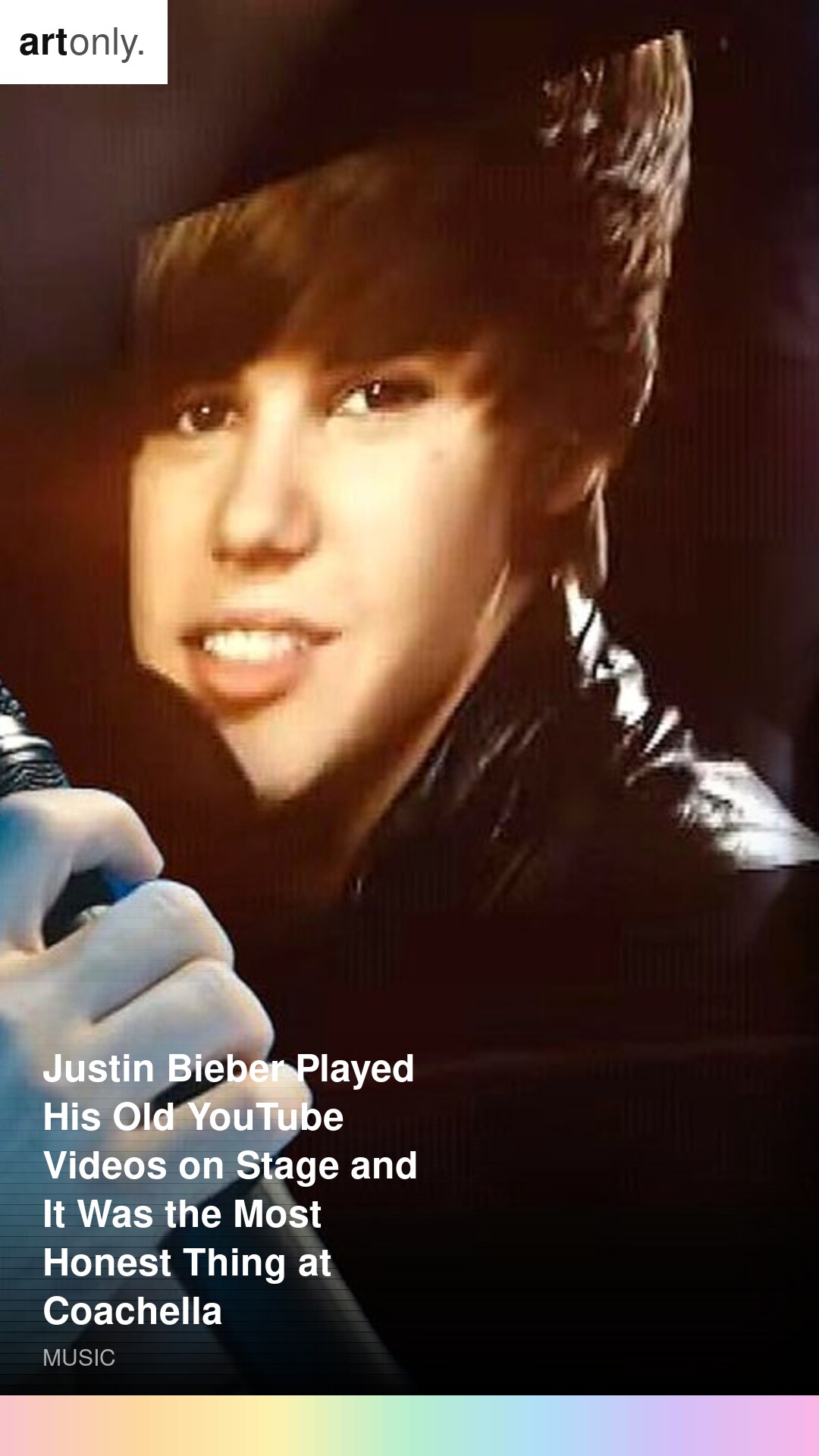
Saturday night, 11:25 PM. The main stage at Coachella. Justin Bieber, the most streamed Canadian artist in history, a man who has sold out stadiums on every continent, whose face has been on more magazine covers than most people will see in a lifetime, opened his laptop and pressed play on a YouTube video of himself at thirteen years old, singing "Baby" in a recording studio with Ludacris.
And the entire field went silent.
The Laptop Moment
Let's be clear about what happened here. This was not a nostalgic montage played during a costume change. Bieber stood center stage in a pink SKYLRK hoodie, laptop open on a stand, and narrated his own origin story through the videos that made him. "Baby." "Never Say Never." The Usher audition tape. Each one played on the massive screens behind him while he watched along, occasionally singing over his younger self, sometimes just standing there letting the cognitive dissonance wash over 100,000 people.
Katy Perry was visible in the VIP section, visibly emotional. She wasn't alone.
The YouTube section was not purely sentimental theater. Bieber owns a complicated relationship with the recordings that launched him, and the decision to stream those early videos from YouTube rather than play them from masters was a deliberate workaround rooted in the realities of music ownership. He doesn't control those early recordings the way he controls his recent work. So he found another way to include them, one that happened to make the intellectual property subtext visible to every person in attendance. Playing your formative work off a laptop, on a public video platform, at the biggest festival in the country, because that's the only way you legally can, is a more pointed statement about the music industry than most artists manage in a full album.
The first half of the set was dedicated to the SWAG and SWAG II material, the recent albums that represent Bieber's most artistically ambitious work, produced largely with Mk.gee, who joined him onstage for "Daisies." The songs are textured, warm, deliberately imperfect in a way that his earlier pop machinery never allowed. They sound like someone who has lived through enough to stop pretending.
What SWAG Actually Represents
SWAG was nominated for Album of the Year at the 2026 Grammy Awards, which is worth sitting with for a moment. That nomination did not arrive because the album is polished or commercial in the way Bieber's catalog once was. It arrived because the album is genuinely strange in the best way, full of structural decisions that feel more indebted to bedroom recording culture than to the Max Martin assembly line that defined his peak chart years. Mk.gee's production work has a tactile quality, a sense of room and breath that SWAG captures better than almost anything released at that level of mainstream visibility in the past decade.
Playing that material at Coachella, before the YouTube section, established the terms of the evening. This was not a legacy act running through the hits. The new work came first, presented with full confidence, demanding to be heard as the primary statement. The YouTube videos that followed were framed as context, not conclusion.
The Week Before Indio
The Coachella set did not arrive without a preview. On April 4th, eight days before the main stage appearance, Bieber played an intimate show at the Troubadour in West Hollywood, a venue that holds roughly 500 people and carries decades of Los Angeles music history. The contrast was deliberate. The Troubadour set was a closed rehearsal space compared to the Empire Polo Club, and the proximity between those two performances, the 500-seat room and the 100,000-person field, underlined exactly the kind of perspective that made the laptop moment at Coachella land as hard as it did.
He also performed across both Coachella weekends, which extended the conversation the set started. By the time weekend two arrived, the response from weekend one had already circulated enough that audiences arrived knowing what to expect from the YouTube portion. That foreknowledge did not diminish it. If anything, the second weekend crowd was more prepared to receive it as the deliberate artistic statement it was, rather than the genuine surprise it had been the first time.
The Guest Parade
The second half became something else entirely. Kid Laroi appeared for "Stay," which in a festival context still hits like a freight train. Dijon came out for a devastating duet on "Devotion" that felt like it belonged in a much smaller room. Then Tems and Wizkid materialized for "Essence," and the field transformed into something that felt more like Lagos than Indio.
Each guest felt intentional rather than gratuitous, a curated conversation between Bieber and the artists who represent where popular music is actually heading. The Tems and Wizkid pairing in particular recontextualized the entire headliner slot. Coachella's main stage has historically centered a particular kind of American or British rock and pop legacy. Bringing "Essence" to that stage, with its original collaborators, was a quiet but firm argument about whose music deserves that platform in 2026.
Dijon's appearance was the most underreported moment of the night. "Devotion" is not a festival song by any conventional measure. It is slow, intimate, and emotionally demanding in a way that most artists would not risk on a stage that size. It worked because the crowd had already been primed by the YouTube section to receive vulnerability as a feature rather than a liability.
Why This Set Mattered
There is a version of Justin Bieber that Coachella could have gotten, the victory lap, the greatest hits package, the safe $10 million bet. Instead, he used the biggest stage in American festival culture to be genuinely vulnerable. The YouTube videos weren't a gimmick. They were a confrontation with what fame does to a person, delivered to an audience that grew up consuming that fame in real time.
The people in that field were largely the same generation that watched those YouTube videos as children. They were not watching a stranger's archive. They were watching a document of something they participated in, a collective memory of a pre-teen on the internet becoming, through the machinery of the industry, something almost incomprehensibly large. Bieber standing there in a pink hoodie watching himself at thirteen was also a mirror held up to everyone who clicked play back then.
Hailey was in the crowd. The pink hoodie was from his own line. The laptop was just a laptop. And for forty-five minutes in the middle of a set that could have been anything, Justin Bieber was just a kid from Stratford, Ontario, watching himself become something he never asked to be.
It was the most human moment Coachella has produced in years.
Follow Justin Bieber on Instagram: @justinbieber