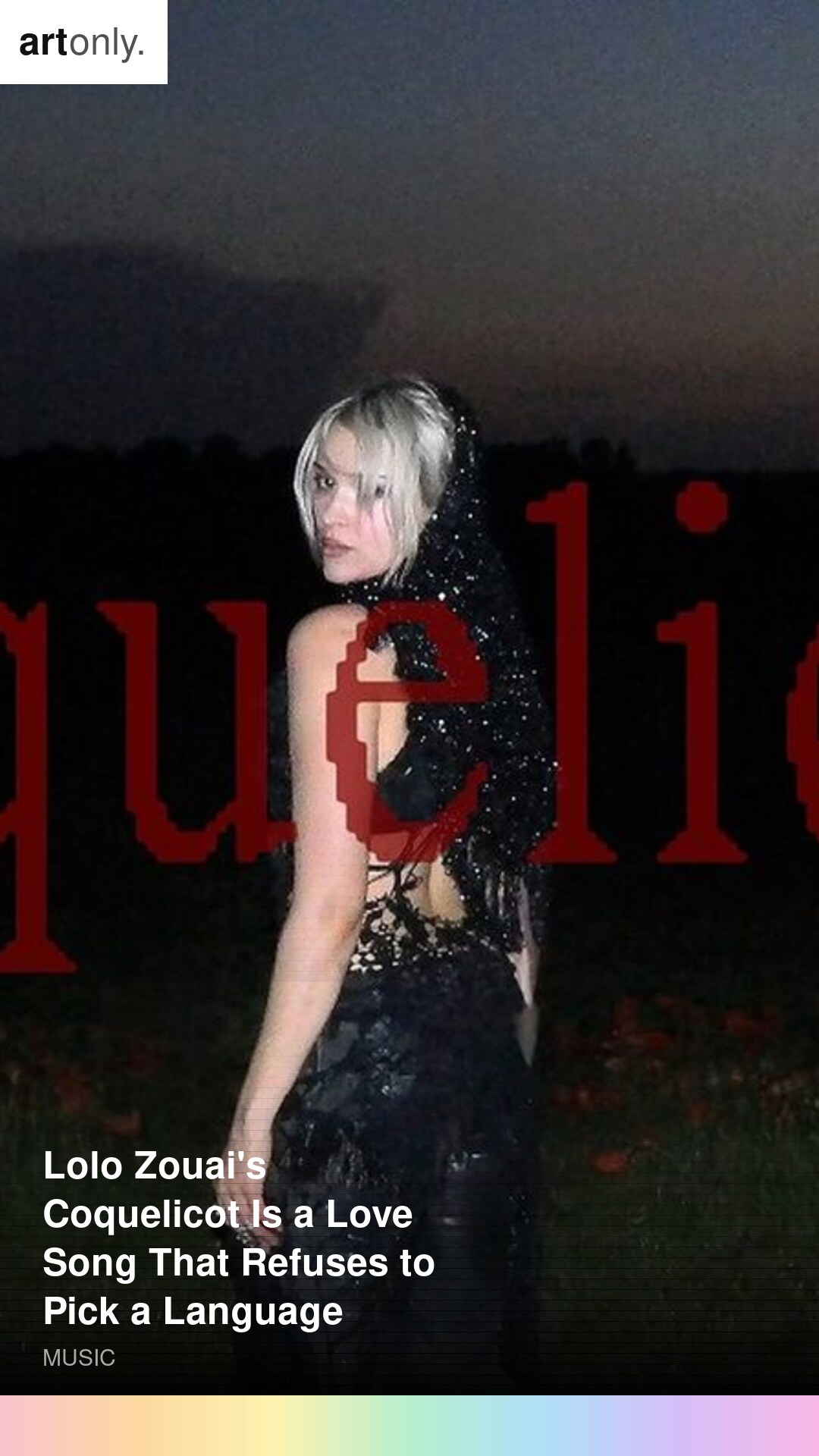
The word coquelicot means poppy in French. It is also one of those words that sounds exactly like what it describes: bright, sharp, fleeting. That Lolo Zouai chose it as the title for her collaboration with French rapper Disiz tells you something about the register she is working in. Reverie, her third album, arrived April 24, 2026, and "Coquelicot" is its most explicit statement of intent: this is pop music that lives between languages, between continents, between the version of yourself you show in English and the one that only surfaces in your mother tongue.
The Geography of Sound
Zouai was born in Paris to French-Algerian parents, raised in San Francisco, and has spent her career navigating the space between those coordinates. Her 2019 debut, High Highs to Low Lows, established her as a sharp writer of R&B-inflected pop with a specific emotional vocabulary: jealousy, ambition, the vertigo of overnight success. The follow-up, PLAYGIRL in 2022, pushed into more explicitly French-language territory. Reverie is the record where the bilingualism stops being a feature and becomes the foundation.
The album's fourteen tracks move through French, English, and touches of Arabic, reflecting Zouai's Algerian heritage alongside the French and American poles of her upbringing. "Coquelicot" opens with Zouai in English over a sparse, rolling beat. Then the switch: "Des allees des retours / Le manege et puis on se laisse" and the song opens up. It is not code-switching as novelty. It is code-switching as structure, the way a song changes key to create emotional lift. The French verses carry a weight and an intimacy that the English verses deliberately withhold. The two languages do not do the same thing. They carry different emotional freight from the same life.
Other singles follow the same logic. "Les Mots" with Dinos builds a French-language R&B track around the specific musicality of French phrasing, the syllable stress patterns that make French hip-hop cadences sound nothing like their American counterparts. "Lemon Squeeze" with Lous and the Yakuza lands in a more confrontational register, the two vocalists trading lines with a charged energy that turns the track into something closer to a duel than a duet.
Disiz and the French Connection
The collaboration with Disiz is not incidental. Disiz, born Serigne M'Baye Gueye, is one of French rap's most cerebral and respected voices. He has spent two decades navigating the tension between commercial accessibility and artistic integrity, between his Senegalese heritage and his French identity. Having him on a Zouai track signals something about the seriousness of her French-language ambitions. This is not a pop star dabbling. It is a conversation between two artists who understand what it means to carry multiple identities inside a single song.
The curatorial impulse across Reverie's features, choosing collaborators who bring their own weight rather than simply adding a name, extends to Dinos and Lous and the Yakuza. Each guest arrives with their own cultural position and their own artistic intelligence. The album is better for requiring them to bring those things rather than simply providing hooks.
The Bet Worth Making
Bilingual pop has a long history of being treated as niche: something appreciated by bicultural listeners but too complicated for mainstream consumption. Bad Bunny shattered that logic in Spanish. Rosalia complicated it further by refusing to choose between flamenco and reggaeton. Zouai's bet is quieter but no less ambitious: that a French-American woman can make a record that moves between languages with the same fluency that she moves between R&B, pop, and electronic production.
The album arrives at a moment when French music's international reach is stronger than it has been in decades. Zouai is working in that expanded context while staying rooted in her own particular story: the San Francisco childhood, the Paris heritage, the Algerian family history, the specific experience of becoming an adult between those worlds. The word coquelicot: bright, sharp, fleeting. The color stays long after the flower is gone.
On the French-American Music Space
The space between American and French pop has been occupied by artists who typically pick a side: either they lean into the American market and suppress the French roots, or they commit to the French market and accept the smaller international reach. Zouai refuses both choices, which is a harder commercial position and a more honest artistic one. The Algerian heritage adds a third coordinate that complicates any easy synthesis between the first two. Three cultural identities are not two plus one: they multiply the possible combinations and make each identity more vivid by contrast with the others.
San Francisco as origin is also doing something. The Bay Area's history of musical bilingualism, of Latin, Asian, and Black American music traditions mixing and transforming each other, produces a particular kind of ear: comfortable with multiplicity, resistant to the demand that music stay in its lane. Zouai is a product of that environment as much as of her family heritage, and the record she's made reflects both.
Reverie is the record that fully inhabits the space it was always building toward. It doesn't sound like a compromise between two markets. It sounds like a world with its own weather, its own logic, its own particular light. That is what the best bilingual music achieves: not translation but creation, not the bridge between two places but a third place entirely.
Reverie lands at the intersection of three musical traditions without compromising any of them. French pop has a specific melodic sensibility, American R&B has its own rhythmic language, and the North African musical heritage has a modal logic that is distinct from both. Zouai moves between all three not as a tourist but as someone who belongs to each. The album is the proof of that belonging. The production throughout is careful and warm: synths that carry the weight of late-night feeling, percussion that swings without declaring itself, mixing that keeps the vocals present and the layers close. There is no maximalism here. Everything is at the right distance from everything else.