The Installation That Became the Blueprint

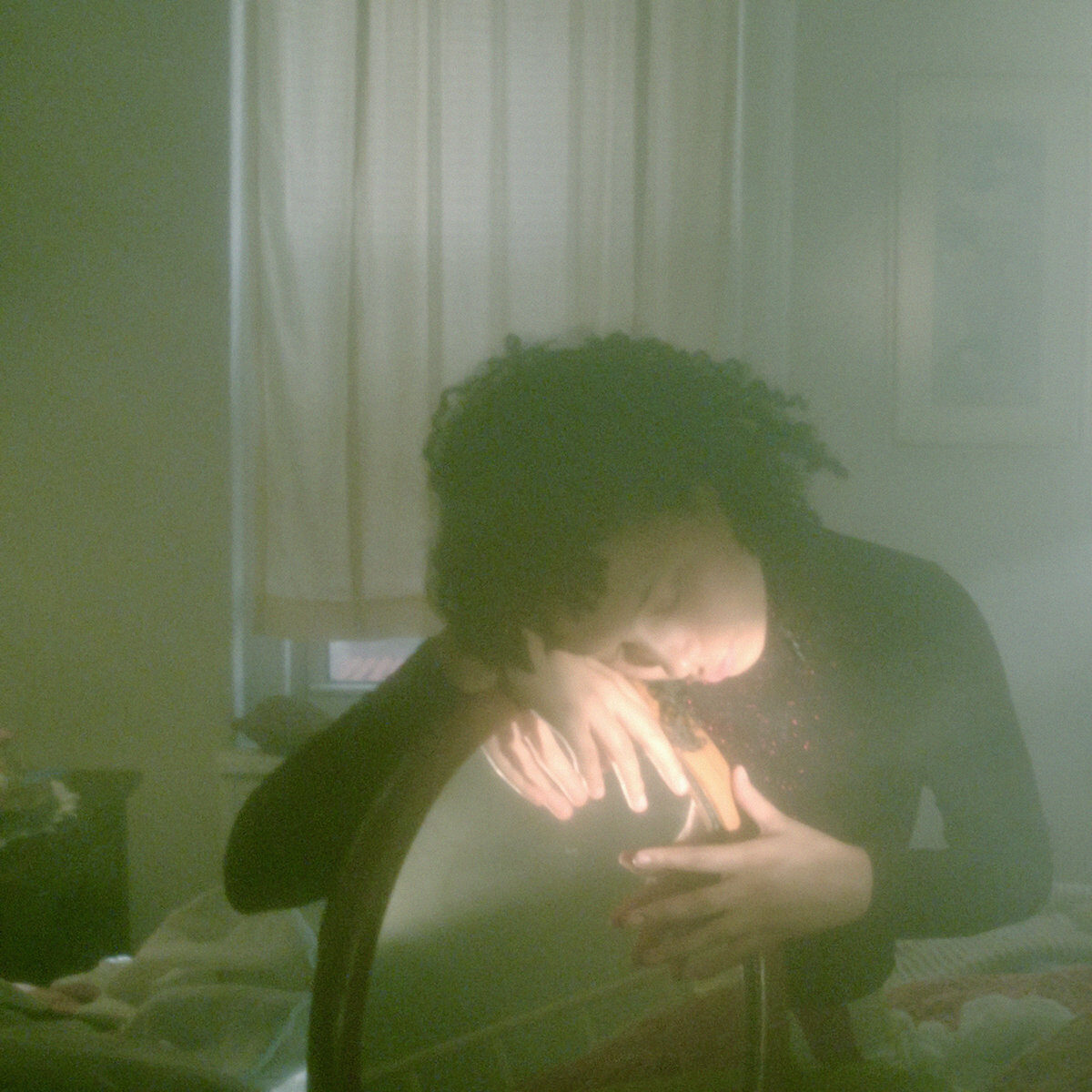
Le Bon told coproducer Samur Khouja she wanted Michelangelo Dying to sound the way Colette Lumiere's installation "Recently Discovered Ruins of a Dream" looked and felt. That installation depicts a woman lying beside a mirror in a chamber draped with pink fabric. The album cover is drawn directly from it. This matters because it is not a design decision. It is a method statement. Le Bon constructs records around a felt quality rather than around development or resolution, which is why the album does not move forward so much as it opens outward, section by section, into something larger than its starting point. The installation became the sonic brief, which means she started with a visual experience and worked backward to the sound that could replicate it.
How Saxophone Becomes Structure

Saxophonist Euan Hinshelwood has worked with Le Bon since Reward, her 2019 album that received a Mercury Prize nomination. On Michelangelo Dying, his playing does not function as melody. It functions as mass and surface: a second presence occupying the same space as the primary voice without responding to it or competing with it. That is a compositional choice with a specific and measurable effect. The saxophone lines feel structural rather than ornamental. They give each track a third dimension, a depth that would collapse without them. Most records use saxophone as color. Le Bon uses it as architecture, and the difference is audible in every track where Hinshelwood appears.
The Records She Made for Other People

Le Bon produced St. Vincent's All Born Screaming, which won a Grammy in 2025. She also produced Devendra Banhart's Flying Wig and albums for Wilco. Her production work imports the same spatial thinking she applies to her own records: she creates an environment in which an artist's material can exist rather than an interpretive frame that directs how it should be received. Khouja anchors the process structurally while Le Bon operates by intuition, a division that requires complete trust in both directions. That combination produces records that feel simultaneously rigorous and unresolved in the best sense of both words. St. Vincent's All Born Screaming sounds like no other St. Vincent album. That is the effect of a producer who is more interested in what an artist has not yet made than in refining what they have already done.
John Cale Sings on One Track and That Tells You Something

John Cale sings on "Ride." Cale cofounded the Velvet Underground in 1965. He produced Patti Smith's Horses in 1975 and made Paris 1919 in 1973. His presence on Le Bon's record is not a legacy feature. It is a confirmation of a lineage. Artists who use music as a primary medium for ideas that other arts have not figured out how to contain tend to find one another. Le Bon does not sound like Cale. They share a refusal to let formal decisions follow commercial expectation. That refusal has produced some of the most durable records made in the last sixty years, and it is what places Le Bon in that company without apology or qualification.
Singing in Welsh Inside a Record Industry That Never Asked For It

Le Bon was born on March 4, 1983, in Penboyr, Carmarthenshire. She sings in both English and Welsh. The Welsh language in her records is not a political gesture and not a novelty. Welsh vowel patterns sit differently against instrumentation than English ones do. They draw attention to the physical act of producing sound rather than to the semantic weight of specific words. That gap between how language sounds and what it means runs through every record Le Bon has made, including the entirely English ones. Michelangelo Dying, recorded across Hydra, Cardiff, London, and Los Angeles and finished in the Joshua Tree desert, carries that tension in every section. The geography of its making is not background detail. It is present in the texture of the record itself.
The Album That Treats Loss as a Set of Rooms

Near the end of his life, Michelangelo burned many of his drawings and unfinished works. Le Bon has framed her album around the experience of losing yourself completely inside love and the specific violence of recovering a self afterward. That subject is not unusual. The formal choice is. Le Bon does not tell this story in sequence. She renders it as a set of rooms with different temperature and different light. Each track is a space you enter and leave on its own terms. "Ride," with Cale, has the weight of a room occupied for decades. The earlier tracks feel like rooms where something just ended. Seven albums in, without repeating herself once, Le Bon has made a record that argues the spatial over the sequential. Records that feel like places survive longer than records that tell you where they are going and arrive.