The Discovery Problem
Every few years the international art world 'discovers' a city or a region that has been producing significant art for decades and congratulates itself on its discovery. The city or region in question is invariably not Eurocentric, invariably has a cultural infrastructure and artistic tradition that predates and exceeds the moment of discovery, and invariably finds the discovery simultaneously useful and slightly embarrassing.
Dakar has been through this cycle more than once. The Dak'Art Biennale has been running since 1992. That makes it one of the oldest and most consequential contemporary art biennials in the world, older than many of the events that the international art press treats as benchmarks. It takes place in a city that is a genuine cultural capital in music, in visual art, in literature and philosophy, that has been producing significant work for generations. The Négritude movement was born in Paris but had Dakar as one of its spiritual homes. Léopold Sédar Senghor, the poet-president, built institutions here. These are not minor footnotes. They are the foundation of a continuous tradition.
The international art world keeps discovering Dakar with a freshness that suggests the previous discoveries did not stick. The gallerists and collectors and critics who make the trip, who attend the biennale, who write the emerging scene pieces, tend to arrive with the energy of explorers and leave before understanding that the exploration was unnecessary, that there was nothing to discover, that there was only the experience of encountering something that was already fully itself.
The discovery narrative is not neutral. It requires that the discovered place be understood as dormant before the arrival of outside attention. Dakar has never been dormant.
What the Biennale Actually Is
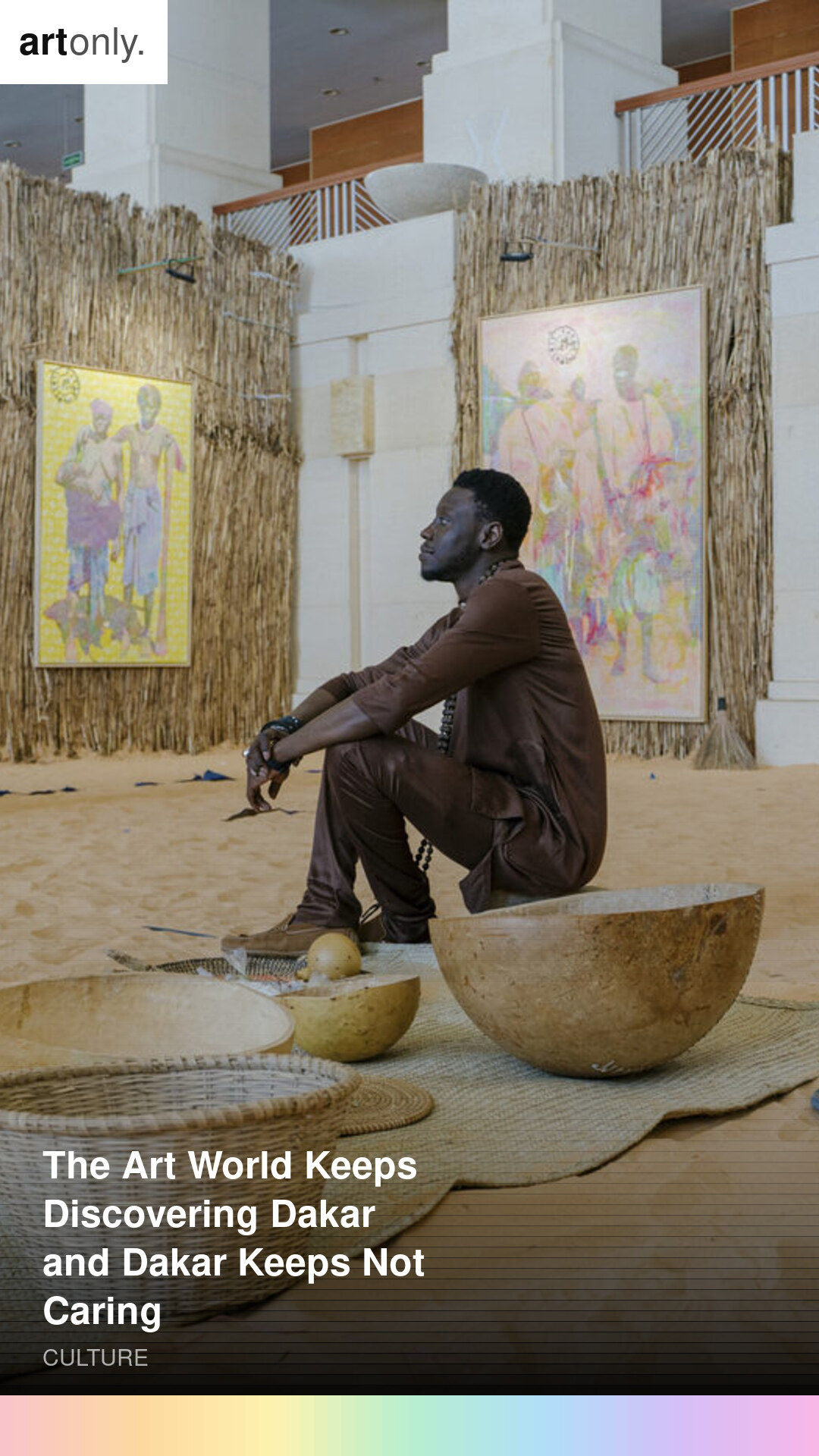
The 15th edition of Dak'Art opened in November 2024, curated by Salimata Diop under the title The Wake, L'Éveil. The exhibition brought together 58 artists from 33 countries, including seven African American artists, and was structured across four chapters: Swimming in the Wake, Dive into the Forest, Float in the Cloud, and Burn. The theme addressed the enduring legacy of slavery and its impact on contemporary society. The exhibition was originally scheduled for May 2024 and was postponed to November because of the presidential election in Senegal.
That postponement matters. Dak'Art operates inside Senegalese political life in a way that a European or American biennial rarely does. It was moved because the election took precedence. The art was secondary to the civic moment. That relationship, between artistic production and public life, is constitutive of what Dakar's cultural scene actually is, and it is one of the things that outside observers most consistently miss.
The four chapter structure of The Wake was not decorative. Swimming in the Wake, Dive into the Forest, Float in the Cloud, Burn: that sequence is an argument. It moves from survival to immersion to transcendence to transformation. The curatorial logic engages the history of the Atlantic slave trade not as a wound to be displayed but as a framework for understanding the present. That is a more sophisticated curatorial position than most European biennials have managed on related subject matter.
What Dakar Is
Dakar's art scene is not an emerging scene. It is a mature scene with its own histories, its own debates, its own generational tensions, its own relationships to African modernism and to the Wolof visual traditions that exist beneath and alongside it. The artists working here are in conversation with each other and with the global art world on their own terms, not as satellites of the international centers.
The work being made in Dakar draws from materials and methods and ideas that are specific to this place. The quality of light is particular. The colors of the city are specific. The histories of Senegal as a center of French colonial administration and then of postcolonial intellectual life produce pressures and textures that cannot be replicated elsewhere. These specificities produce work that cannot be made anywhere else, and the international art world's tendency to treat it as interchangeable with Global South art misses the point entirely.
The textile-based work that references the trading history of the region is one example. West Africa has textile traditions going back centuries, and the contemporary artists working with those materials are not revivalists. They are using inherited methods to address current conditions, the movement of goods, the movement of people, the question of who owns the patterns and what it means to sell them internationally. The video work engaging with contemporary Dakar's relationship to its own modernization is another register entirely, one that has no obvious parallel in European or American contemporary art. This is not a complaint. It is a description of genuine difference.
The Négritude lineage matters here too. Senghor and Aimé Césaire developed a philosophy of African cultural identity that was at once a response to colonialism and an assertion of something positive, not merely a negation of European supremacy but an insistence on the value of African intellectual and aesthetic traditions. That framework has been criticized, refined, and complicated by subsequent generations of Senegalese thinkers and artists. The result is a depth of critical self-awareness about questions of identity, diaspora, and cultural production that most art scenes, including well-funded Western ones, have not had to develop in the same way.
The Not Caring
The not caring in my headline is slightly unfair. The artists and institutions in Dakar care deeply about international visibility, about access to global markets, about being able to participate in the conversations that international visibility enables. What they do not care about is the discovery narrative, the framing of their work as something freshly found rather than something that has been here all along.
There is a dignity in this indifference to the discovery frame. It refuses the hierarchy implicit in the idea that significance arrives from outside. It insists on a history that the discovery narrative ignores.
Dakar does not need to be discovered. It needs to be listened to on its own terms. That is a different thing and it requires a different kind of attention.
The artists at and around Dak'Art were not waiting for international validation. They had made things and were making things and would keep making things whether the gallerists from New York and London came to look or not. The confidence this represents, the ability to make without the external frame of legitimization, is something that Western contemporary art scenes, dependent as they are on market and institutional validation, have often struggled to maintain.
What the Discovery Gets Wrong
The discovery narrative makes two errors simultaneously. It mistakes the discoverer's ignorance for the discovered place's novelty. And it treats visibility in international art markets as the measure of artistic significance, which means it imports the values of those markets into its assessment of work that was made entirely outside them.
Senegalese art history does not begin with the first time a collector from Basel paid attention. The institutions Senghor built, the debates about African modernism that took place in Dakar in the 1960s and 1970s, the generations of artists who worked through those debates and produced their own responses and complications, all of that happened without requiring outside validation. It was sufficient to itself.
The art world keeps discovering Dakar. Dakar keeps making work. These are separate processes. The discovery is about the discoverers. The making is the thing.