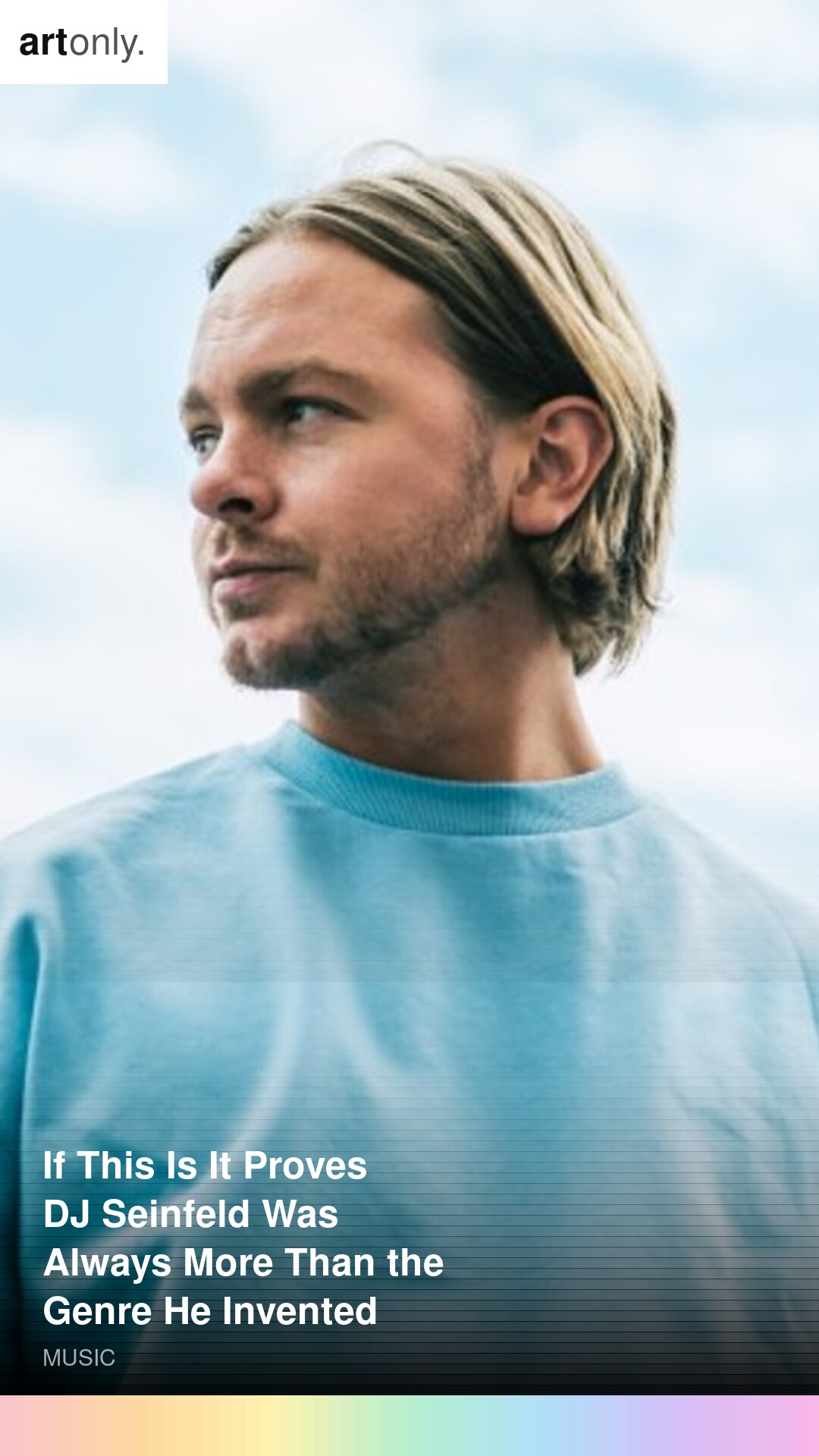
The Accident That Became a Career
Armand Jakobsson made "Time Spent Away from U" in 2017 in a state of heartbreak, in Malmo, on equipment he had borrowed and barely knew how to use. The record landed online with almost no context, arrived in the midst of a moment when a certain strain of lo-fi house music, warm and hazy and nostalgic for something that had never quite existed, was developing its own small infrastructure of listeners. The name he used, DJ Seinfeld, was a joke, the kind of thing you put on a release that you do not expect anyone to hear. Hundreds of thousands of people heard it. The genre he became associated with, lo-fi house, mushroomed outward from that moment and produced a decade's worth of imitators. He had not set out to start anything. He had made something private and public at the wrong time, or the right time, depending on how you measure these things.
The problem with being identified as the originator of a movement is that the movement becomes your context. Every subsequent record Jakobsson made was evaluated partly in relation to the thing he had accidentally created. Did it develop the lo-fi house sound? Did it depart from it? Was the departure justified? The critical frame around his work, even when the work itself moved elsewhere, kept pulling back to 2017. "Mirrors" in 2021 was received largely through this lens. The question animating the critical reception was not quite what the album was but whether it had moved far enough from what he was known for.
"If This Is It" does not ask this question. It is the record of an artist who has decided to stop explaining himself, and the confidence of that decision is audible in every track.
The Shape of Restlessness
The album's central theme, as Jakobsson has articulated it, is restlessness. Not as pathology but as orientation. "If This Is It is about reflecting on the past without dwelling in it, and finding harmony in restlessness," he has said. This statement sounds like it belongs in a press release, and it does belong in a press release, but it also describes something real about the music. The twelve tracks on this record do not stay still. They move between nostalgic house, UK garage, 2000s trance, and moments of ambient softness, not as a survey of genres but as the expression of an artist who has genuine fluency across these forms and no particular allegiance to any of them.
What holds the record together is not genre coherence but emotional coherence. There is a quality of longing running through the whole thing, a persistence of feeling that sounds like nostalgia but is aimed at something other than a specific past. It is nostalgia for the condition of feeling intensely, which is perhaps the only nostalgia that survives scrutiny. The synthesizer pads that anchor several of the central tracks have the warmth that his early work was praised for, but deployed here with more structural intention. They are not mood. They are argument.
The Collaborators and What They Bring
The features on "If This Is It" are chosen with evident care. SG Lewis, who has been navigating a similar negotiation between credibility and accessibility in his own career, appears on a track that shows what Jakobsson can do when the production is in conversation with a vocalist who understands the emotional register. Confidence Man, whose whole project is about the intersection of serious craft and irresistible energy, brings something that disrupts the record's contemplative surface in ways that are useful rather than gimmicky. TS Graye, ARY, Moyka, Dan Whitlam, and just lil each occupy their particular moments without the record collapsing into a features showcase.
This matters because collaborative electronic music often loses coherence in proportion to the number of voices involved. The album becomes a compilation. "If This Is It" does not do this. The collaborators are inside the sonic world Jakobsson has built rather than arriving in it from outside. The consistency of the production aesthetic, the specific quality of the synthesis, the way the record controls dynamics, creates a container that the guests occupy rather than distort.
UK Garage and What It Asks
The presence of UK garage and UKG in the album's DNA is not incidental. These are forms built around a particular kind of emotional directness, around beats that ask the body to respond before the mind has had time to decide, around vocal cuts that operate through truncation and implication rather than full statement. They are also forms with a specific history, rooted in south London, in a particular moment in British popular culture, that any artist approaching them from outside needs to approach with some awareness of what that history involves.
Jakobsson, Swedish and working from a tradition that received UK garage as an import rather than a domestic form, handles this with appropriate care. He does not reproduce the genre but responds to it, takes its structural logic and builds with it rather than imitating its surface. The result sounds genuinely informed by the form rather than merely influenced by it. The distinction is the difference between an artist who has listened carefully and one who has borrowed casually.
After the Accident
The question of what happens after you accidentally become the defining figure of a genre is a genuine career question and "If This Is It" is the most persuasive answer Jakobsson has yet given. You build. You take what the accident taught you about what sound can do emotionally and you develop it toward something that could not have been predicted from the starting point. The restlessness that produced the early work becomes the subject of the later work. The yearning that made "Time Spent Away from U" so unexpectedly resonant is now understood well enough to be shaped.
This is a third album in the fullest sense: the record where the artist's project becomes legible on its own terms, no longer containable by the history of what produced it. The accident is still there, as foundation, as the material that has been worked. But it no longer explains the work. The work explains itself.