The Surprise
The surprise was not that the Barbie film was good. It was that it was about something. Major studio blockbusters are allowed to be entertaining, are allowed to be funny, are allowed to be well-crafted spectacles. They are very rarely allowed to have ideas, not decorated with ideas, not gesturing toward ideas, but actually organized around a set of things the film is genuinely trying to think through.
Barbie had ideas. The ideas were about feminism and the inadequacy of the frameworks available for understanding feminism, about what it means to exist as a female archetype in a culture that has very specific and contradictory requirements for women, about the impossibility of being both perfect and real. These are not new ideas. The film makes them feel new by treating them with a kind of sincerity that studio blockbusters don't usually risk.
Greta Gerwig co-wrote the script with Noah Baumbach and the combination of Gerwig's emotional intelligence and Baumbach's structural facility produces something that feels both genuine and constructed, both a personal vision and a well-engineered machine. The balance is difficult to maintain and they maintain it through most of the film's runtime.
What the Pink Aesthetic Was For
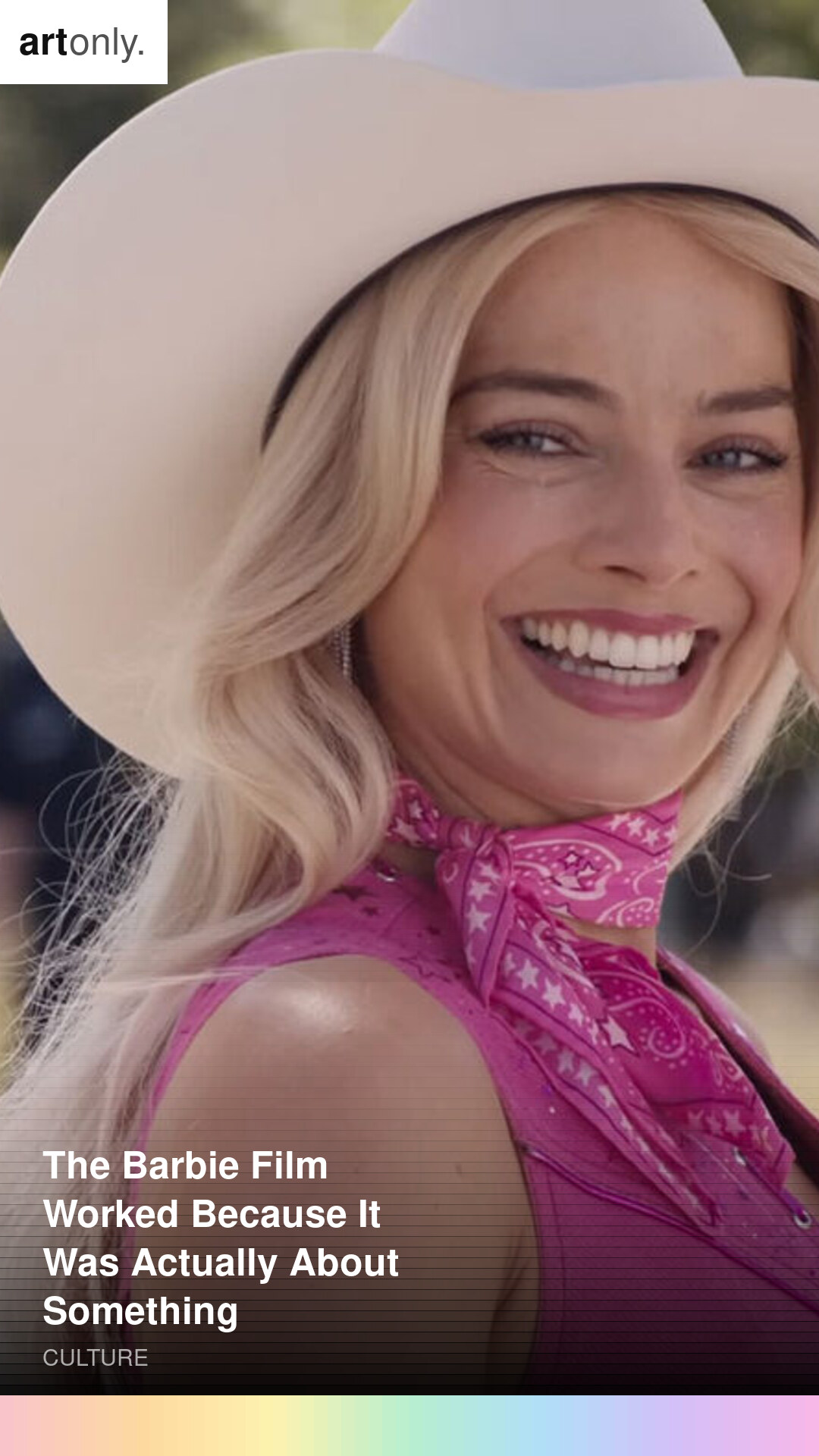
The decision to commit completely to the aesthetic, the pink world, the fantasy architecture, the costumes that read as costume throughout, was a formal decision that made the ideas possible. By making the artificiality explicit and enormous, Gerwig created a space in which the ideas about artificiality and ideal femininity could be articulated without the defensive maneuver of pretending to realism.
This is an old formal strategy, heightened artifice as a way of talking about things that realism makes difficult. The melodrama tradition did it. Camp has always done it. Gerwig understood that Barbie required this mode and committed to it at a scale that most filmmakers couldn't access or wouldn't attempt.
The production design by Sarah Greenwood is among the best work in mainstream cinema in recent years precisely because it commits without reservation. Barbieland is not a satirical approximation of a plastic world. It is a fully realized version of one, photographed seriously, lit to make the artifice legible rather than ridiculous. The pink is not a joke. It is a formal argument.
Margot Robbie and Ryan Gosling are both doing something interesting in the film, not acting in the conventional sense but performing performance, being aware of the quality of Barbieness and Kenness while simultaneously being fully in the emotional reality of their characters. The double consciousness required for this is non-trivial.
The monologue. America Ferrera's monologue in the third act, about the impossibility of being a woman, is the most directly stated version of the film's ideas and the moment where the balancing act between entertainment and argument becomes most visible. Some people found it too much. I found it exactly enough, the argument stated plainly, just once, before returning to the formal sophistication of the rest of the film.
Gosling's Ken
The critical consensus settled on Gosling's performance as the surprise, and the surprise is real. Ken as a character is a brilliant structural move. He is the figure through whom the film can examine what masculinity looks like when it is stripped of its cultural authority, when it cannot rely on the system that has historically organized itself around its comfort. His journey through patriarchy, arriving at it, being seduced by it, then losing it again, is the comedy and the critique operating simultaneously.
Gosling plays this without a wink. He is sincere about Ken's sincerity, which is what makes the comedy work. A more knowing performance would collapse the whole structure. His willingness to be completely inside the joke, genuinely committed to a character who is the butt of a joke he cannot see, is the craft.
The Cultural Moment
The film became a cultural moment in ways that the marketing understood were possible before the audience did. The Barbieheimer phenomenon, the double feature with Oppenheimer that the internet turned into a collective event, was a piece of genuine cultural spontaneity that the studios then amplified, and the combination of the two films felt like something larger than either film deserved by itself.
But the cultural moment around Barbie specifically, the way it generated discussion that extended far beyond the film, the way it became a referendum on what mainstream cinema was allowed to do, was real. People had genuine feelings about it, genuine arguments about it, genuine experiences of being seen or not seen in it.
That's a rare thing. Most mainstream films generate reactions rather than feelings. This one generated feelings. I think that's because it actually cared about the ideas it was playing with.
The conversation around Barbie, the arguments, the hot takes, the backlash to the hot takes, the discourse machine consuming itself, is itself interesting data about where we are culturally. That a film organized around feminist ideas could generate this much conversation in this many directions says something about the current state of both feminism and cinema.
But the film is still there, under all the conversation. It was about something. That remains true regardless of what the conversation did with it.
The Standard It Sets
The success of Barbie, both commercially and critically, creates a problem for the studios that is also an opportunity. The film demonstrated that audiences will show up for mainstream entertainment with genuine intellectual content, that the choice between ideas and box office is not the forced trade-off that studio logic has assumed. The question is whether this lesson gets absorbed or whether Barbie gets treated as an anomaly, a once-in-a-decade accident of timing and talent that cannot be replicated.
I expect it to be treated as an anomaly. I hope to be wrong.
What the film demonstrated is that the formal ambition and the commercial ambition are not in opposition, that a studio film can have a genuine aesthetic vision and still make over a billion dollars. Gerwig and Baumbach built the machine carefully enough that both things were possible simultaneously. The lesson is there for any studio that wants to learn it. Whether any studio will is a different question.