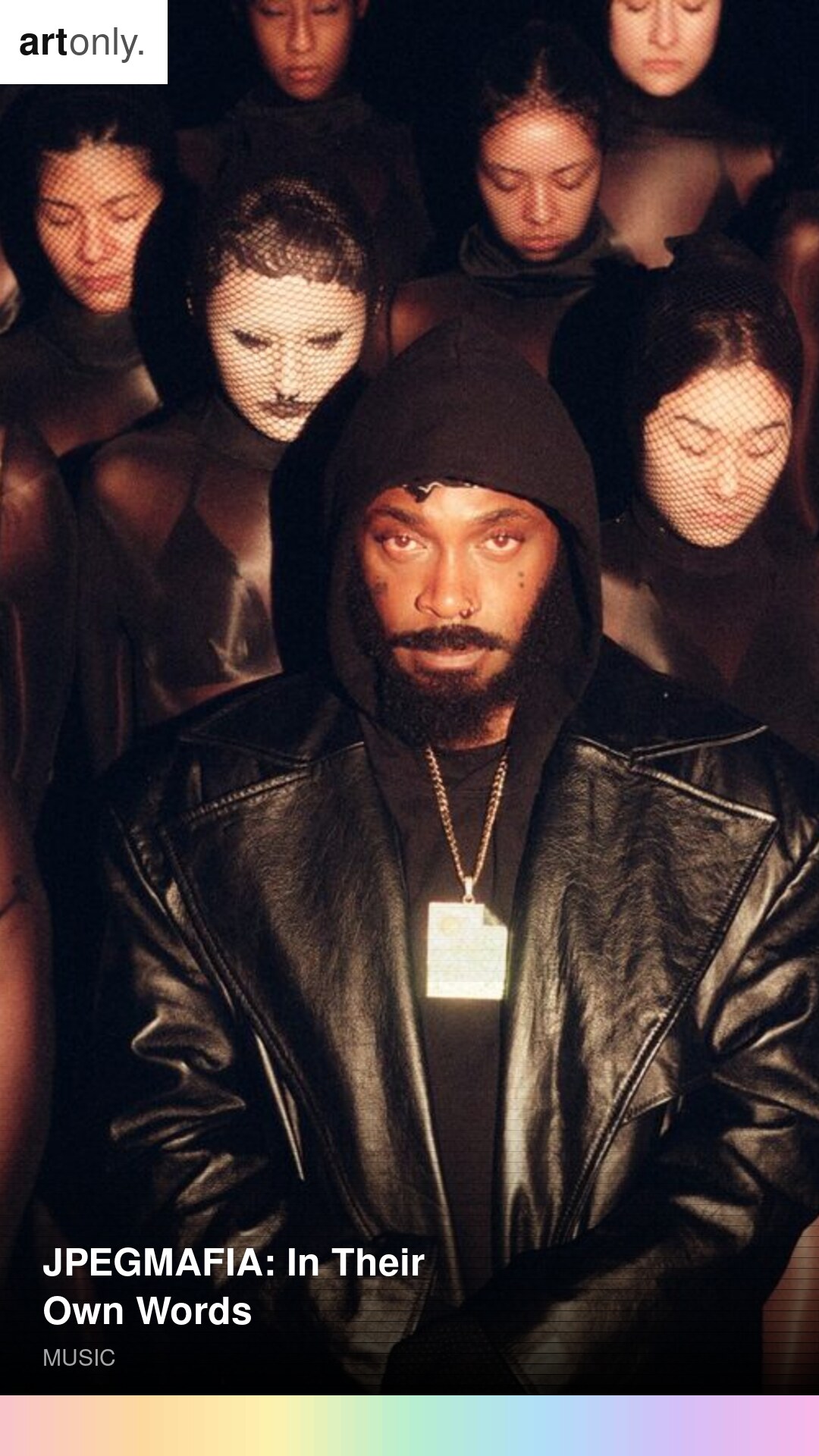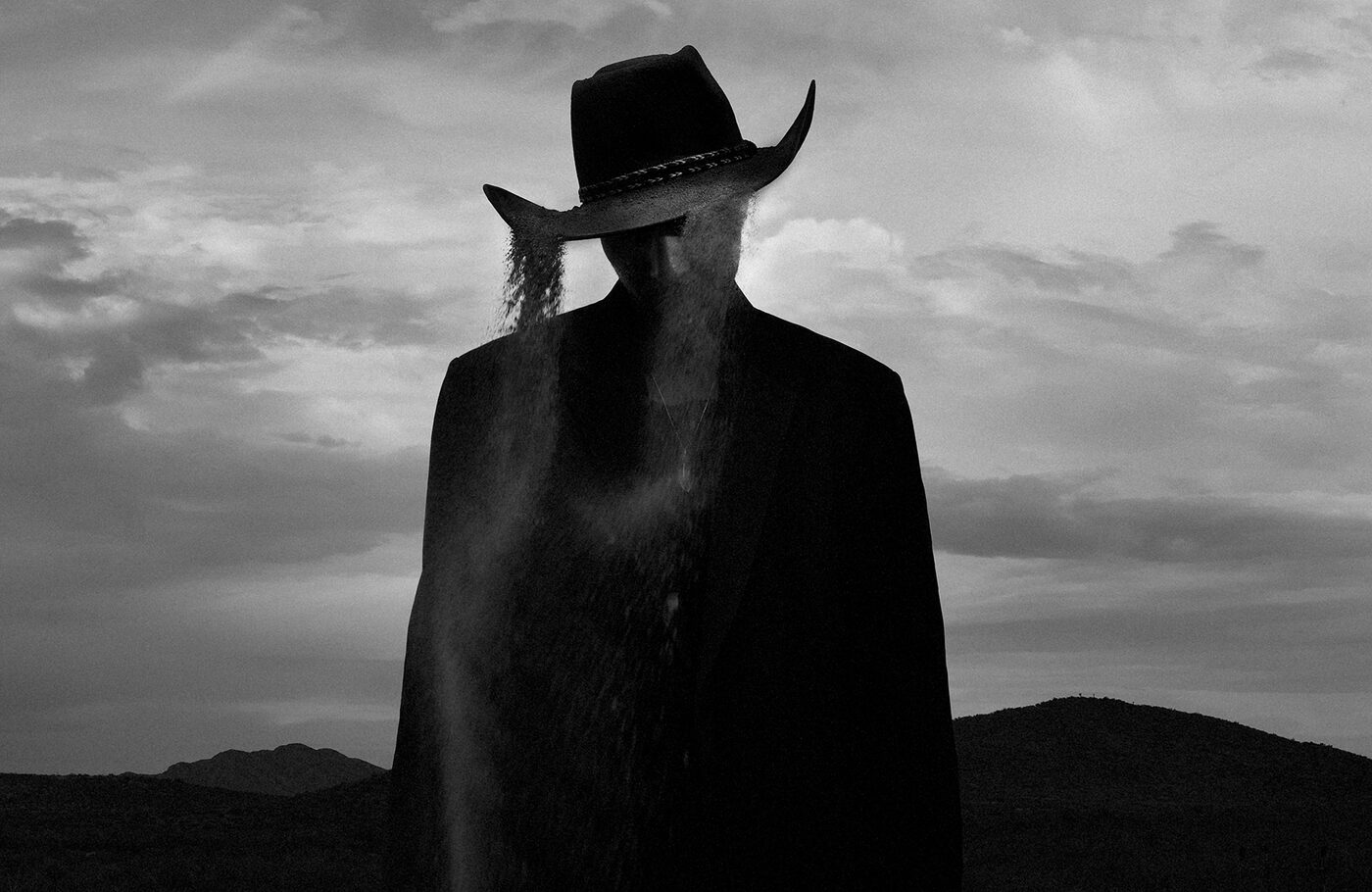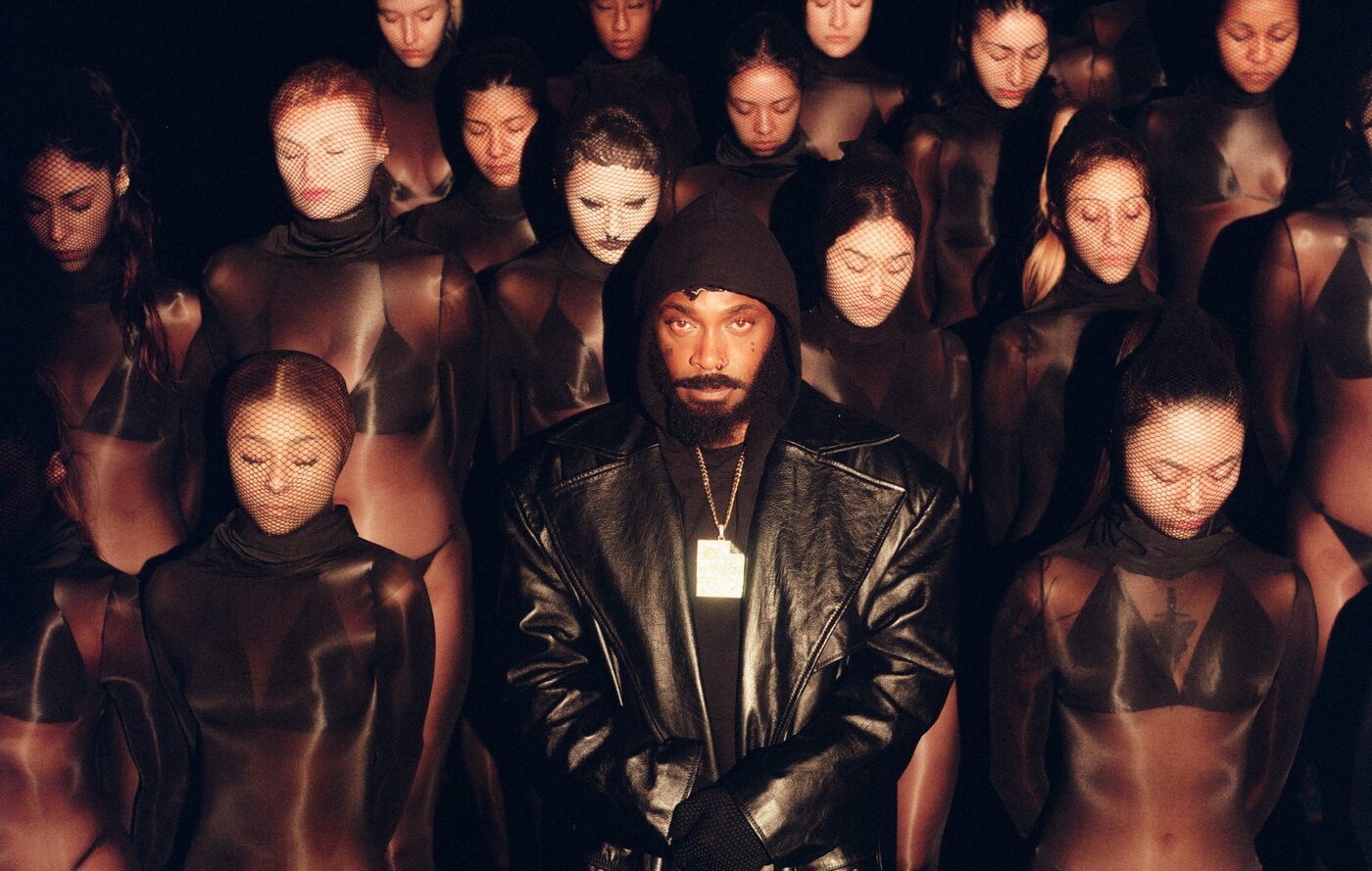
JPEGMAFIA, born Barrington DeVaughn Hendricks in New York and raised in Flatbush before moving to Alabama at 13, recorded 93 songs for "All My Heroes Are Cornballs" before selecting the 18 that made the final album. That discipline, filtering an enormous volume of material through an unmistakably personal aesthetic, has defined his practice across every record since. Working entirely alone, writing, producing, mixing, and mastering his own material, he built one of the most singular catalogs in contemporary hip-hop without major label infrastructure or outside production help.
ArtOnly: Your entire catalog is self-produced and self-directed. You have talked about spending 15 years working before anyone noticed. What kept you going?
"I'm not trying to be different, I am naturally different. People apply a try-hard attitude to get everyone to like them or think they're different, which is odd to me because they don't understand that some people just aren't like them." (NME, November 2021)
"No one helped me with shit. So, like everything I have, I literally slaved away for 15 years before anybody cared." (NME, November 2021)
The years of obscurity were not a detour. They were the practice itself, accumulating without an audience, getting more precise with each record. His music from that period has the quality of something made entirely for internal reasons, which is exactly what it was. When nobody listened, he kept going. When people eventually did listen, nothing about his practice changed.
ArtOnly: You enlisted in the Air Force at 18, serving in Iraq, Kuwait, Germany, Japan, and North Africa. How did that period shape your relationship to music?
"I didn't have any fucking money. That was the only option. Either [join] or I'm just gonna be dead." (Loud and Quiet, November 2019)
"Something about it made me feel calm or some shit. It still does." (Loud and Quiet, November 2019)
He received an honorable discharge after reportedly refusing to stay silent about abuse within his chain of command, a parallel to how he operates in the music industry: he will work within a structure until the structure demands something he will not give. Music was the interior life that survived the Air Force intact. He came back with years of solitary production behind him and a vocabulary for the chaos he had moved through.
ArtOnly: Your production pulls from an enormous range of sounds. How do you describe the process from inside it?
"The possibilities are infinite. I have, like, a weird bath of sounds. It's like making a cake or something." (Loud and Quiet, November 2019)
That image holds because it resists both mystification and false modesty. A cake has a method, a set of materials, a transformation that happens through combination. "All My Heroes Are Cornballs" works exactly that way: Bjork samples processed beyond recognition, anime theme fragments, pitched-down voices, and rhythms that sound excavated rather than programmed. He has also talked about what the album title actually means: "All my Heroes are Cornballs is just a blanket statement about we're all human, or something like that." (Loud and Quiet, November 2019) It is a record that refuses to treat any source or genre as elevated above any other.
ArtOnly: You have said rap does not receive the same institutional respect as other musical forms. How does that reality shape the work?
"They don't respect rap. They group us all together like it's one thing, but we're not one thing. We're not monolithic." (Clash Magazine, January 2020)
He said this in January 2020, and it remains accurate. The institutional reluctance to take hip-hop seriously as a compositional form, rather than as a social phenomenon or a market category, produced in him not a desire for validation but a determination to demonstrate what the form could do. He has also spoken about scoring: "I want to score video games and score animes. I really, really wanna score music." (Clash Magazine, January 2020) That ambition is consistent with how he already works. His albums have an internal scene logic, a sequencing and texture that reward sustained attention the way a well-composed soundtrack does.
ArtOnly: "SCARING THE HOES" with Danny Brown in 2023 felt like a statement about the potential of the underground. What were you trying to build with that record?
"I want to master my domain. I have a domain in experimental hip-hop that is my own. I've created a lane that's just my own, and I want to double down and set myself in stone. This is my thing. You can't do this thing." (Stereogum, March 2023)
"I had this idea, I wanted to unite the underground. It's like a spirit bomb." (Stereogum, March 2023)
The Dragon Ball Z reference is precise. In the series, a spirit bomb draws energy from every willing participant into a single concentrated release. "SCARING THE HOES" operates that way: noise, rap, free improvisation, and internet humor feeding into something with no obvious antecedent. The album charted on the Billboard 200 without a single commercial concession, which is the proof of concept he was describing.
ArtOnly: What do you actually want from a listener who comes to the music?
"I really want to make something that tears you out of yourself." (Stereogum, March 2023)
"Finishing the album is like raising a kid or some shit. You raise it and now it's 18 and you're like, 'Get the fuck outta my house, bro.'" (Billboard, September 2019)
"I don't want anyone to expect anything from me. I just want them to know that I'm gonna put 1,037% into whatever I do." (Billboard, September 2019)
The framing of completion as expulsion is telling. Once the work is done, he releases it entirely, which is probably why each record lands with such independence from the one before it. He has described his early years plainly: "I've been the n, a with 50 views on YouTube, I've been the n, a with three downloads on Bandcamp." (Billboard, September 2019) He did not aim for a larger audience while building from that position. He aimed for a more precise version of what he was already making.
What Hendricks has built, over a decade and a half of solitary production, is a catalog that cannot be mistaken for anyone else. The stage, he said in 2021, is where "no one can edit me." (NME, November 2021) His records have always been that place too. No edit, no compromise, no explanation needed. "Ultimately," he said at the end of a conversation about "SCARING THE HOES," "no matter what you say about me, just say the beats were hard. Just don't forget that." (Stereogum, March 2023)