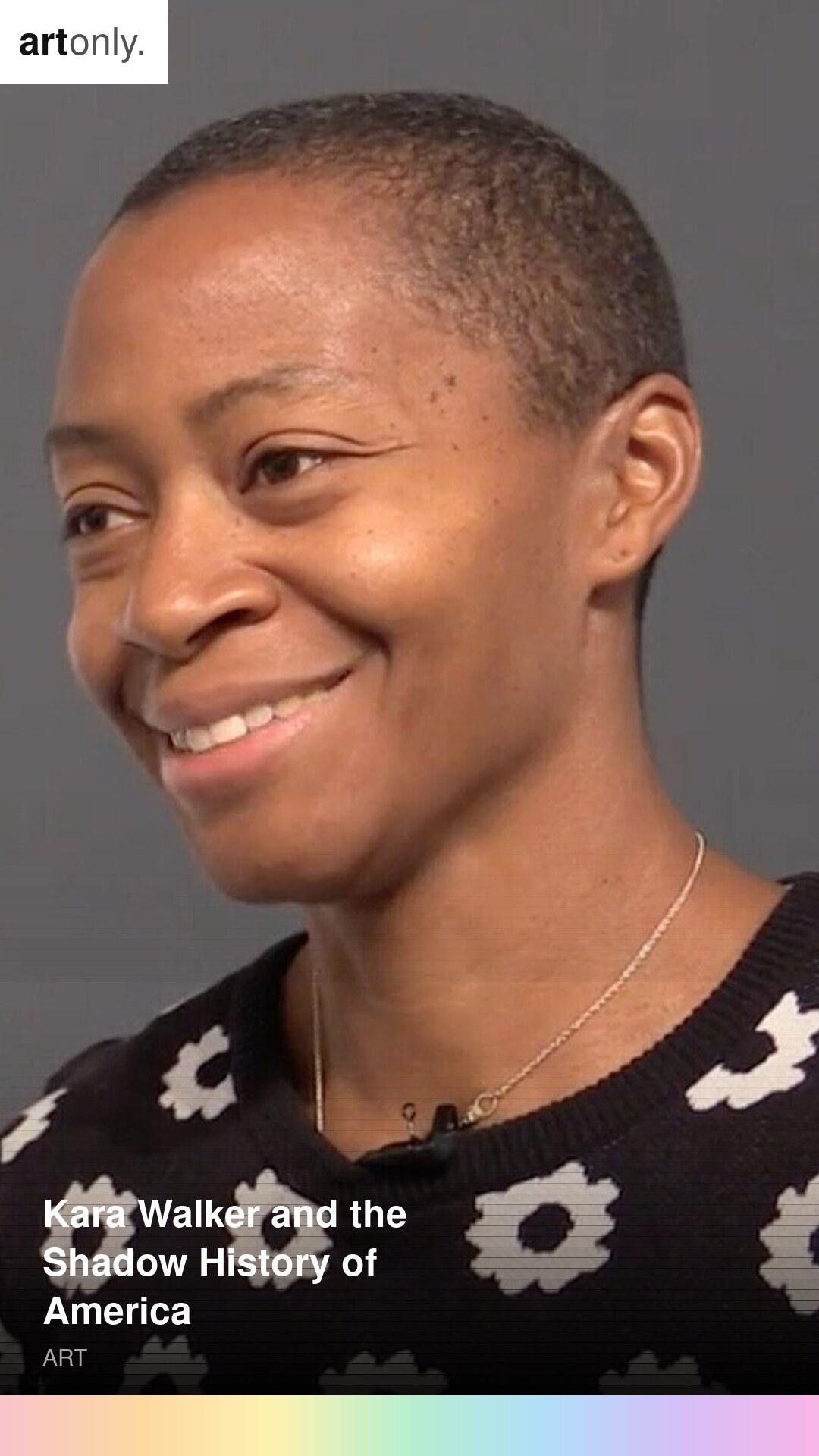
Born in Stockton, California in 1969 and raised in Atlanta after her father took a teaching position at Georgia State University, Walker encountered the American South at an age when its history was close enough to touch. She has spoken about the experience of moving from California, where race operated differently, to Atlanta, where the weight of history was architectural and daily and impossible to ignore. That shift shaped everything that followed.
She attended the Atlanta College of Art before moving to Rhode Island School of Design, where she completed her MFA in 1994. The year after graduation, she had her first major solo exhibition in New York. The response was immediate and divided. She was twenty-four years old.
The Silhouettes
Walker's signature form is the large-scale cut-paper silhouette installed directly onto gallery walls. The silhouettes are black, their subjects white or absent, and their imagery is drawn from the iconography of the antebellum American South filtered through Walker's unflinching imagination. They depict slavery, its violence and its intimacies and its perversions, in a form that is simultaneously elegant and grotesque.
The choice of silhouette was not arbitrary. The form has a history in American portraiture as a genteel, affordable alternative to painted portraits. It carries connotations of domesticity and decorum. Walker hijacks those connotations entirely. The same decorative form that hung in parlors depicts scenes that those parlors existed, in part, to forget. The tension between form and content is the mechanism through which the work operates.
Her 1994 installation Gone: An Historical Romance of a Civil War as It Occurred Between the Dusky Thighs of One Young Negress and Her Heart announced her project fully. The title itself is an act of compression, containing the romanticization of the Civil War, the sexualization of Black women's bodies, the language of bodice-ripper fiction, and the specificity of Black interiority, all in one sentence. The installation occupied an entire room and pulled viewers into something that felt simultaneously like a fairytale and a crime scene.
The MacArthur and the Controversy
In 1997, Walker received a MacArthur Fellowship, the so-called genius grant. She was twenty-seven. The grant validated what many younger critics had already recognized: that her work was among the most conceptually rigorous and historically serious art being made in America.
It also intensified a debate that had been building since her debut. Several prominent Black artists and scholars, including Betye Saar and Emma Amos, wrote open letters arguing that Walker's imagery was harmful, that it replicated and circulated degrading representations of Black people rather than critiquing them, and that the predominantly white art world's enthusiasm for her work was itself a symptom of the problem. Saar actively campaigned against Walker's recognition.
Walker's response, in interviews and in the work itself, has been to acknowledge the tension rather than resolve it. She has said that her art exists in a space of discomfort because the history it addresses is uncomfortable. She has refused the position of educator or moral guide. She is an artist, not a corrective.
That refusal has frustrated some. It has also maintained the integrity of her practice. The work does not offer absolution. It offers confrontation.
A Subtlety
In 2014, Walker created what became her most widely seen and most widely discussed work. A Subtlety, or the Marvelous Sugar Baby was installed at the Domino Sugar refinery in Brooklyn, a building on the verge of demolition after 140 years of operation. The piece was a massive sphinx made from approximately 160,000 pounds of refined white sugar. The sphinx had the features of a Black woman and the posture of a mammy figure from American popular iconography, but scaled to thirty-five feet tall and coated in brilliant white sugar.
The piece was accompanied by smaller figures made from sugar and molasses depicting small boys in the attitudes of servitude. These figures deteriorated over the course of the exhibition, melting in the heat and humidity of the refinery space.
A Subtlety addressed the history of sugar directly, including the slavery that produced it and the global commodity chain that made industries like Domino possible. It was free and open to the public. Hundreds of thousands of people visited. Many posed for photographs with the sphinx in ways that reproduced, unconsciously or not, the very dynamics the work was examining. Walker has said that this was expected and that the audience's behavior was part of the piece.
The Studio and the Scale
Walker works across media. The silhouettes are her most recognizable form, but she makes paintings, drawings, animations, and videos. Her film Testimony: Narrative of a Negress Burdened by Good Intentions is an early example of her work in moving image, combining shadow puppetry and voice to extend the visual language of the installations into time-based work.
Her drawings are often large-scale and worked in ink and gouache with a looseness that contrasts with the precision of the cut-paper work. The freedom in the drawings allows for a different kind of exploration, more provisional, more openly conflicted, closer to the notebook than the finished statement.
She has been on the faculty at Columbia University's School of the Arts since 2015, teaching in the visual arts program. Her influence on younger artists working with history, representation, and the politics of imagery has been substantial. She does not produce followers so much as she generates permission, the permission to go directly at the hardest material and to make that confrontation itself the aesthetic event.
The Ongoing Project
Thirty years into her career, Walker's project has not narrowed. It has expanded. Recent works have addressed the legacies of colonialism in global context, the persistence of racial iconography in contemporary visual culture, and her own position as a Black woman navigating an art world that has celebrated her without always understanding her.
Her work appears in the permanent collections of the Museum of Modern Art, the Whitney Museum, the Art Institute of Chicago, and major collections internationally. That institutional embrace has not domesticated the work. A Kara Walker silhouette on a museum wall still does exactly what it was designed to do.
She has built something rare: a body of work that remains genuinely difficult to look at despite its beauty, that maintains its critical edge despite its institutional status, and that insists, after all this time, that the history it addresses is not past. It is present. It is the wall the silhouettes are mounted on. It is the room the viewer is standing in.
Kara Walker keeps pointing at it.