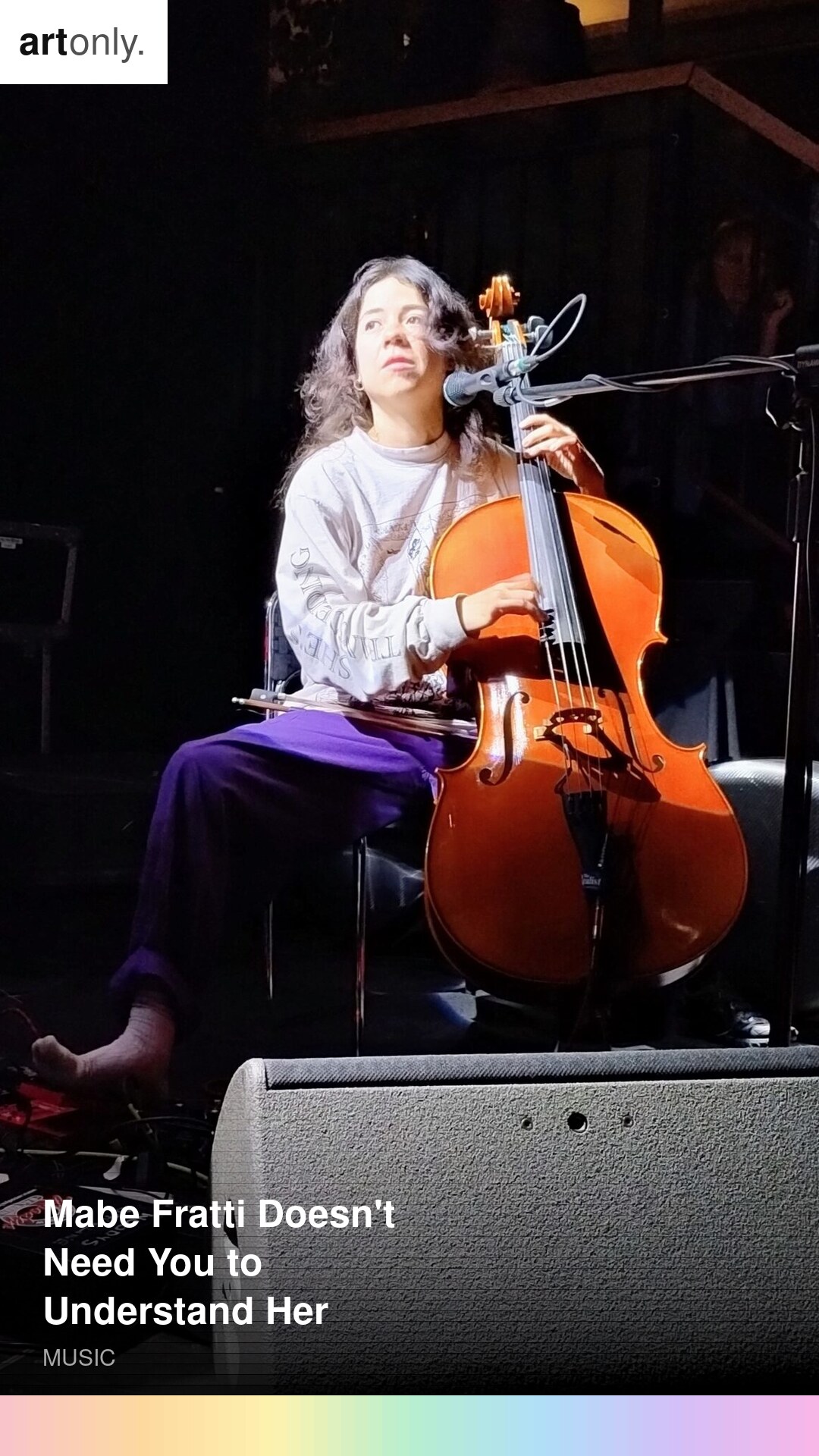
Mabe Fratti makes music that requires you to let go of the idea that you need to follow it. Not because it's deliberately obscure: there's nothing gatekeeping about what she does. The work operates on a frequency that bypasses the part of your brain that insists on narrative, and once you stop trying to locate it within familiar categories, something else opens up.
The Guatemalan-born, Mexico City-based cellist and composer relocated to Mexico City in 2016 and immediately found a home in its improvisational music scene, a scene that has been producing genuinely adventurous work largely unnoticed by European and North American press. Her cello technique doesn't announce itself. It sprawls and splinters across her recordings in ways that feel more like weather than performance. You don't always hear where the instrument ends and the electronics begin, and that blurring is the point. The cello is not played so much as inhabited.
The Records
Her 2022 album Será Que Ahora Podremos Entendernos is the kind of record that gets better the more you stop trying to locate it within a genre. The title translates as something like Will We Be Able to Understand Each Other Now, which is already a question that reframes the listening experience: the album is not offering understanding, it is asking whether understanding is even possible in this shared space. There are moments that feel adjacent to chamber music, others that could sit next to the noisier ends of experimental electronic, and passages that don't feel adjacent to anything. They're just themselves. Arthur Russell is an obvious touchstone, not for sound but for approach: the same willingness to let the formal logic of a piece override the expectations of genre, the same use of the cello as a wide-open sound laboratory.
With Sentir Que No Sabes in 2024, she moved toward something slightly more song-based without softening any of the edges. The title means Feel Like You Don't Know, and the album performs that uncertainty structurally: passages of relative clarity that dissolve into abstraction, melodies that arrive and depart before you've fully registered them. Her vocals are woven into the cello work in a way that makes them hard to separate. The voice becomes another texture, another frequency, another element in the composition rather than the figure against the ground. The production by I. La Católica gave the record a warm, slightly compressed quality that sits just inside pop convention before pulling back.
Titanic and the Collaborative Logic
She also records as part of the duo Titanic with Camille Mandoki. That project carries its own distinct logic: more collaborative in its decision-making, the two musicians developing a shared language that neither brings to their solo work in the same form. The 2023 Vidrio album blended jazz and chamber pop in ways that felt like a genuinely shared invention rather than two soloists taking turns. Fratti's solo work benefits from having this collaborative channel available. The two projects ask different things of her and both are stronger for the distinction.
The Festival Circuit and What It Reveals
Fratti has been building real momentum on the festival circuit, playing alongside artists from across the experimental spectrum and holding her own in every context. She doesn't adapt her work to fit the bill. The work is the bill. That kind of contextual confidence is rare, and it usually indicates an artist who has developed enough internal clarity about what they're doing that external pressure to conform to a context just doesn't land.
The Mexico City experimental scene that produced her shares this quality. It is not making music for export. It is making music for itself, in the specific acoustic and cultural context of that city, and the strength of the work comes partly from that rootedness. Fratti is one of the most genuinely adventurous composers working right now. Not within a genre, not with qualifications about accessibility. Just adventurous, just working, just building one record at a time into something that keeps getting harder to place and harder to look away from.
The Cello as a Radical Instrument
In classical music the cello occupies a specific position: lower than violin, higher than bass, the instrument of the middle voice, the one that carries the harmonic weight that neither of the extremes can carry alone. Its role is structural and supportive: the architecture of the string quartet rather than the face of it. Fratti takes that structural instrument and refuses the structure. The cello in her hands is not the middle voice. It's everything: melody, harmony, rhythm, texture, the lead and the accompaniment simultaneously.
The electronics she applies to the cello signal, the processing and layering and looping, extend what the instrument can do without erasing what it is. You still hear the bow on the string, still hear the instrument's resonant body. The electronics transform and multiply that sound rather than replacing it. This matters because the acoustic identity of the instrument carries emotional weight: the cello sounds the way it does because of its physical construction, and no amount of processing removes the fact of the body inside the sound.
Fratti understands the instrument at that level: not just as a pitch-producing machine but as a resonant object with a history and a physical identity. The music she makes with it is music that knows what it's working with. The cello is not a vehicle for the ideas. The ideas grow from the instrument.
The cello tradition she has absorbed includes the classical European canon, but also the experimental tradition of composers like Gyorgy Ligeti and the extended technique work of cellists like Michael Bach, who mapped new possibilities for the instrument in the second half of the twentieth century. Fratti works in that expanded space without making the expansion itself the subject. The technique serves the music. The music serves the feeling. That hierarchy is correct, and she maintains it. The Guatemala origin and the Mexico City relocation give her a particular cultural position within the experimental music world: not European, not North American, working in a tradition that is genuinely global while being rooted in a specific geography. That position is generative. The distance from the centres of the experimental music industry is part of what gives the music its particular quality of self-sufficiency.