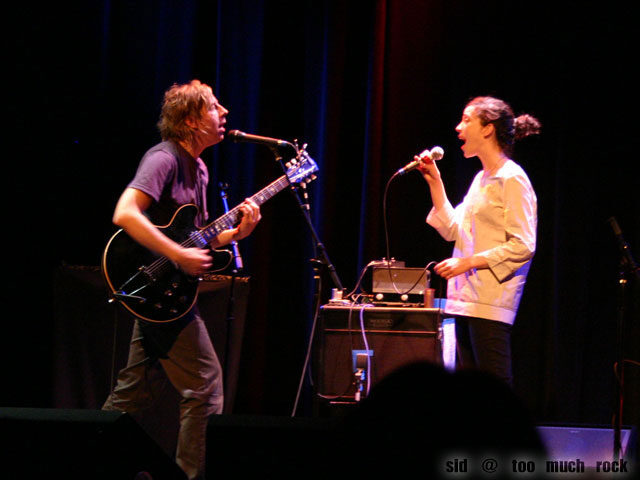
Tiny Telephone opened in San Francisco in the summer of 1997. Mk Ultra still had two years left as a functioning band. John Vanderslice, the group's singer and primary songwriter, had sourced an analog tape deck originally owned by the Beach Boys. He installed it in a building in the Mission District and started recording sessions for other artists before Mk Ultra had finished their own final record. The band was building the room for everyone else while they still had songs left to make.
Three Records on Artichoke

Mk Ultra released their debut album in 1993 on Artichoke Records, a San Francisco independent label. Vanderslice wrote melodic rock with wide harmonic range and a clarity of arrangement that stood apart from most Bay Area independent releases of the period. Their second album, "Original Motion Picture Soundtrack," came out in 1995 with a specific claim attached: the band said it had been composed as a score for an unrealized film directed by Tommy Borgnine, son of actor Ernest Borgnine. No film existed. The band confirmed as much. The premise was the content, not a publicity mistake.
The third album was "The Dream Is Over," recorded at Tiny Telephone in 1998 and produced alongside Greg Williamson, who had worked on Jeremy Enigk's "Return of the Frog Queen" and engineered records for Sunny Day Real Estate. Matt Torrey contributed drums, piano, and arrangements that incorporated cello and violin into the core band sound. Dan Carr played bass. John Tyner played guitar and Moog. The result sounded like nothing else Artichoke had released.
A Score Without a Film

The Tommy Borgnine fiction on "Original Motion Picture Soundtrack" is worth examining because it reveals how Mk Ultra thought about meaning in their work. The "unrealized film" framing was not sarcasm. It was a structural statement about what the music was doing: scenes that develop and cut, moods that function as establishing shots, arrangements that have cinematic logic without a cinematic source. Claiming a nonexistent film was a way of saying the music had a narrative that did not need to be stated out loud.
That instinct runs through "The Dream Is Over" too. The orchestral elements do not explain the songs. They complicate them. Torrey's drumming sits in tension with the string arrangements rather than underneath them, which means the melodies have to do more work to resolve. Vanderslice wrote lyrics that match the weight of the production without describing it.
Pitchfork reviewer Nick Mirov gave it a 9.2 in 1999 and called it "incredibly ambitious, full of passionate songwriting, and at once complex and effortless." Pitchfork was a fraction of its later size at the time. The score was filed and forgotten by everyone except the people who had already decided to stop playing.
What Tape Preserves

Vanderslice's decision to record on analog tape in 1998 ran against the direction most independent rock production was taking. The shift to hard drive recording was already underway, and most Bay Area studios that year were moving toward digital setups. Tiny Telephone went the other way. The analog infrastructure was a philosophical position as much as a technical one.
The low end on "The Dream Is Over" is warm rather than punched, which gives the bass and cello room to coexist without the mix choosing between them. The dynamics are preserved at the tracking stage rather than compressed into shape afterward, so the quiet passages feel genuinely quiet and the loud ones feel like something built rather than manufactured. The record sounds as intact in 2026 as it did in 1999. Early digital recordings from the same period have not aged as well. Vanderslice was making a bet on the lasting quality of tape saturation when he installed that deck, and the bet has held.
Two Members, Two Bands

Mk Ultra dissolved after touring in support of "The Dream Is Over," which included shows with Sunny Day Real Estate. After the band ended, Matt Torrey joined Jets to Brazil, the band Blake Schwarzenbach formed after Jawbreaker. Dan Carr joined Creeper Lagoon and played bass on their 2001 DreamWorks release "Take Back the Universe and Give Me Yesterday." Both moves placed former Mk Ultra members in front of larger audiences with more institutional backing behind them.
Neither album received the critical recognition of "The Dream Is Over." Torrey and Carr brought instrumental sensibilities developed in smaller rooms on smaller budgets, and those sensibilities showed up in how they played on records that had more infrastructure behind them. The skills Mk Ultra developed at Artichoke scale traveled into larger contexts. The band that built them did not.
The Studio as the Decision

Vanderslice spent the 2000s and 2010s recording other artists' albums at Tiny Telephone: Death Cab for Cutie, Mates of State, Okkervil River, among others. He also released more than ten solo records under his own name. None of them received a 9.2. That number belongs to the band he stopped running in 1999, in the studio he built while the band was still active.
"The Dream Is Over" was reissued in 2020 on Tiny Telephone and became available on streaming platforms. Monthly listener counts remain modest. Mk Ultra has no active social media presence. The album has not been rediscovered by a new audience looking for overlooked late 1990s Bay Area indie. It sits where it has always sat, which is not a bad place to sit.
Mk Ultra made a specific set of choices: build the studio before finishing the album, record orchestral arrangements at a time when that was not commercially useful, tour with Sunny Day Real Estate rather than pressing toward a national mainstream audience, then stop. The 9.2 arrived. Nobody changed course. The catalog is complete. Tiny Telephone is still open. The tape deck is still there.
That is a coherent life for a band to have had.