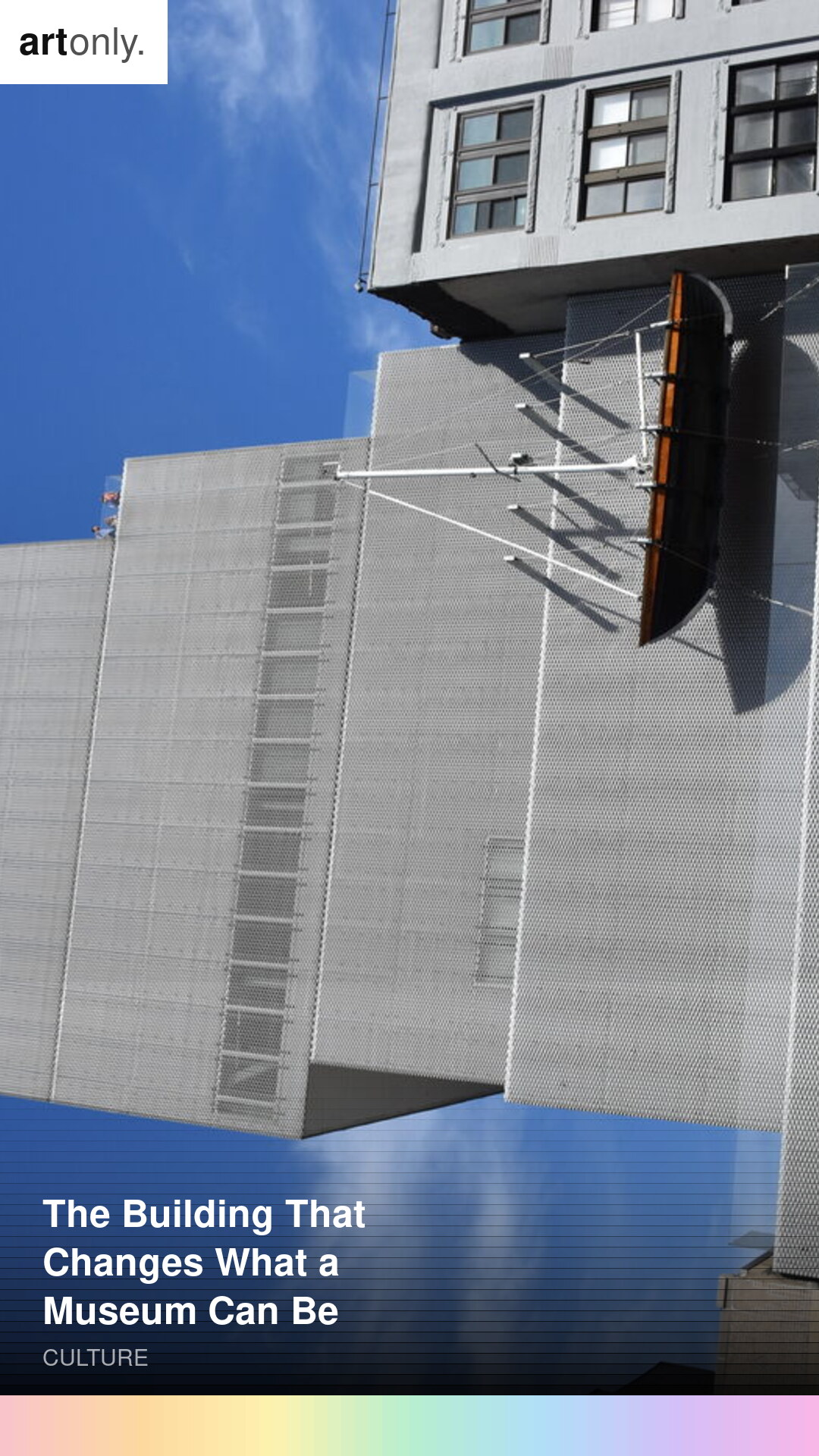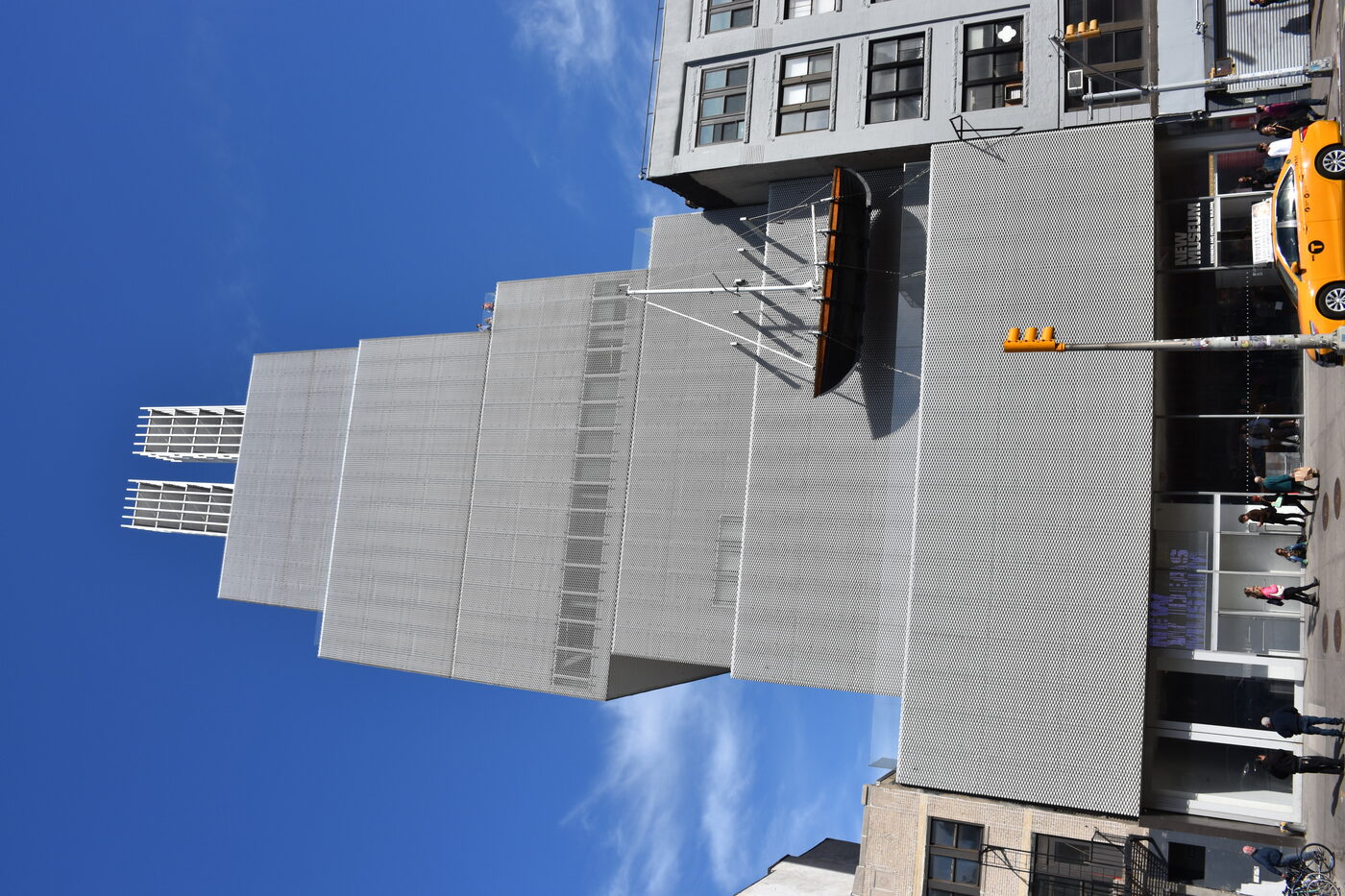
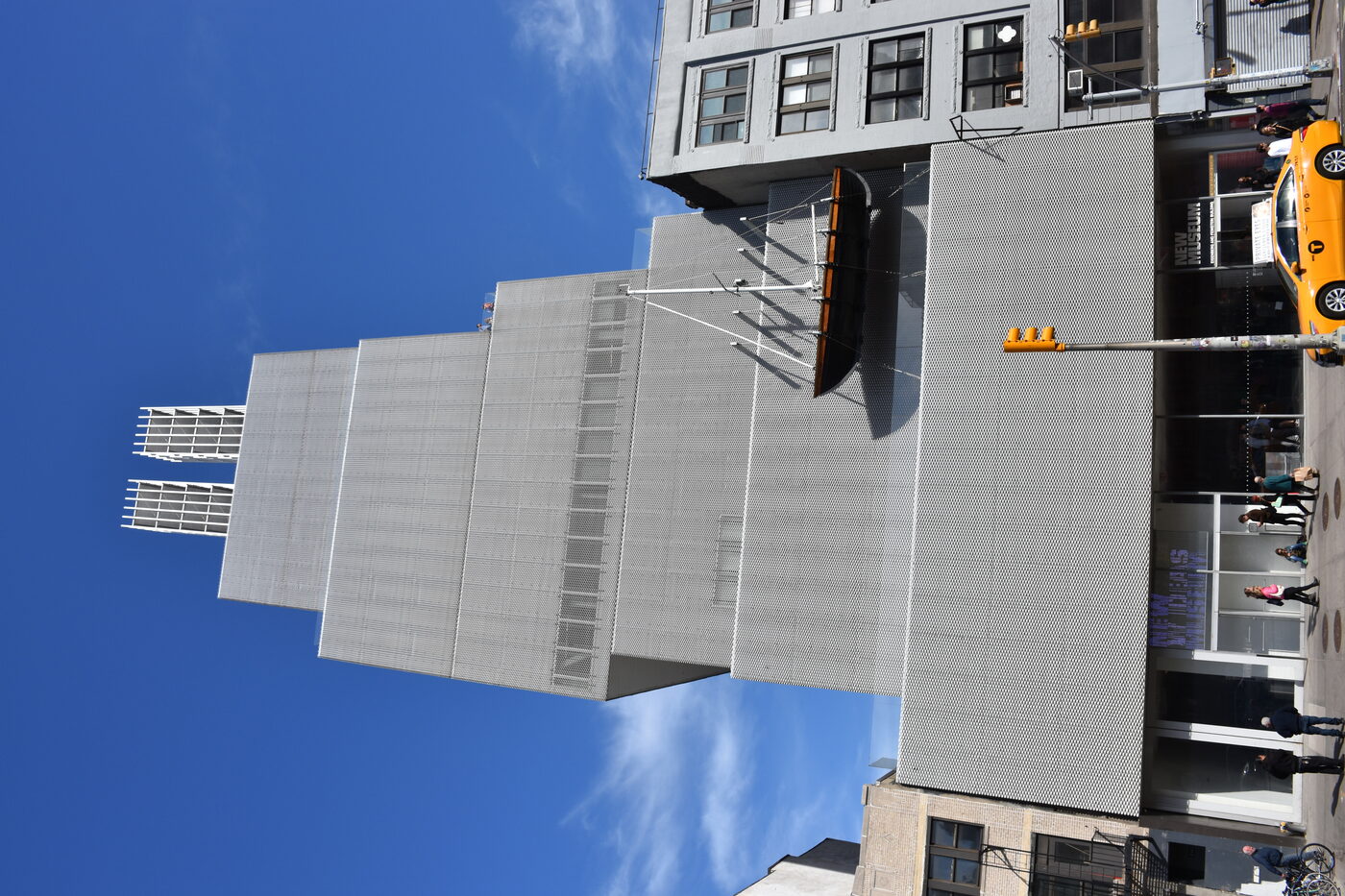
There is a new building on the Bowery. It opens at the corner of Prince Street and looks, depending on the hour, like a frozen waterfall or a lit lantern. By day its facade of laminated glass mesh shimmers with something close to restraint. After dark, the interior becomes visible through the skin and the whole structure glows, broadcasting what is happening inside to anyone passing on the street.
This is the New Museum's expansion, designed by OMA with Rem Koolhaas and partner Shohei Shigematsu. It opened on March 21, 2026, after a two-year closure, and it has doubled the institution's footprint to more than 11,000 square meters. The building is already being called one of the most significant additions to New York's cultural infrastructure in a generation. That may be an understatement.
Two Buildings, One Argument
The original New Museum, designed by SANAA and completed in 2007, is one of the most photographed structures in Lower Manhattan. Its stacked aluminum boxes, each slightly offset from the one below, made it instantly iconic. The question facing OMA was whether to match it, ignore it, or argue with it.
Koolhaas chose something harder to name. He called the new addition "a complement, a counterpart," not an extension. The two buildings now sit side by side at 235 and 231 Bowery, and though they share a wall and four connected gallery floors, they read as two distinct things that have found each other. The SANAA building is horizontal confidence. The OMA addition is vertical transparency. Together they form something that neither could be alone.
The exterior material does real work here. OMA chose a fine mesh laminated in glass that references SANAA's original metallic cladding without copying it. It transforms throughout the day. In sunlight it is cool and slightly industrial. At night it dissolves into a window onto the building's activity. Shigematsu has described the project as one concerned with legibility, with making a cultural institution genuinely readable from the outside. You can see people moving up the Atrium Stair before you even enter.
What Shigematsu Thinks a Museum Is
Shohei Shigematsu runs OMA's New York office. He is quieter than Koolhaas and more interested in what he calls "the human touch," in materials that show evidence of being handled or made. His quote about this project cuts directly to the central question: "Museums are the last truly public spaces in our cities."
That is not a sentimental observation. It is a design brief. If a museum is a public space first and an exhibition container second, then everything changes. The lobby becomes a threshold rather than a gatekeeping zone. The plaza at Bowery and Prince Street becomes programming, not just pavement. The restaurant, run by executive chef Julia Sherman, becomes part of the institution's argument about what belongs inside a cultural building.
Shigematsu has said that "sometimes the space comes first, not the theme." At the New Museum expansion, this is visible in every floor. The four connected gallery levels spanning both buildings were designed to allow curators to construct sequences that move across architecture, not just within rooms. The Atrium Stair, which runs up through the new addition, anchors a four-story fiber artwork by Czech sculptor Klara Hosnedlova. The work was commissioned for the space before the building opened. The staircase is not neutral infrastructure. It is a gallery that happens to move you between floors.
New Humans and the Opening Argument
The inaugural exhibition is called "New Humans: Memories of the Future." It was curated by Massimiliano Gioni and brings together more than 200 artists, writers, scientists, and filmmakers. Francis Bacon and Salvador Dali appear alongside Pierre Huyghe, Hito Steyerl, and Wangechi Mutu. The premise is the question of what technology does to human identity, which is not a new question but one that the current moment makes genuinely urgent.
A facade commission by Tschabalala Self wraps part of the exterior. Sarah Lucas contributed a public artwork for the entrance plaza. These commissions are not decorative. They position the building itself as an exhibition, extending the museum's argument into the street before anyone buys a ticket.
This is consistent with what the New Museum has always tried to do. Founded in 1977 by curator Marcia Tucker, the institution declared from the start that it would support artists who had not yet received significant exposure or recognition. Tucker wanted the museum to stay genuinely new, to avoid what she called the "stiff institutionalization" of the traditional art museum. By 2021 the museum formally became a non-collecting institution, which is unusual and deliberate. Without a permanent collection to maintain and protect, the institution can take risks with living work in a way that the major collecting museums cannot.
Why Architecture Matters Here
There is a reason this expansion took more than a decade to plan and nearly a billion dollars of ambition to realize. The New Museum was not adding storage. It was adding argument.
The OMA addition is the firm's first major cultural commission in New York, which is remarkable when you consider that Koolhaas published his foundational text on Manhattan, "Delirious New York," in 1978. Nearly fifty years after that book appeared, OMA has finally built something in the city it spent decades theorizing. The building on the Bowery is not a thesis. It is a lived-in answer to questions the practice has been asking for half a century about density, transparency, and what public architecture owes the people who walk past it.
The seventh-floor Sky Room, the 74-seat forum, and the permanent home for NEW INC, the museum's cultural incubator, give the building layers of use that make it function across a full day. It is not a place you enter for two hours and leave. It is a place designed to reward longer stays and repeated visits, to operate more like a neighborhood institution than a tourist destination.
The Light After Dark
There is a detail that keeps coming up in descriptions of the new building. After dark, when the laminated glass mesh becomes transparent, the building broadcasts itself to the Bowery. Passersby can see what is happening inside without being inside. This is architecture as invitation rather than announcement.
In a city that has become increasingly expensive and increasingly difficult for young artists and cultural workers to inhabit, that kind of visible openness matters. The New Museum has always positioned itself as an institution for the next thing rather than the established thing. The OMA expansion gives that mission a form worthy of it. Two buildings on the Bowery, found together, making an argument the neighborhood can see from the street.