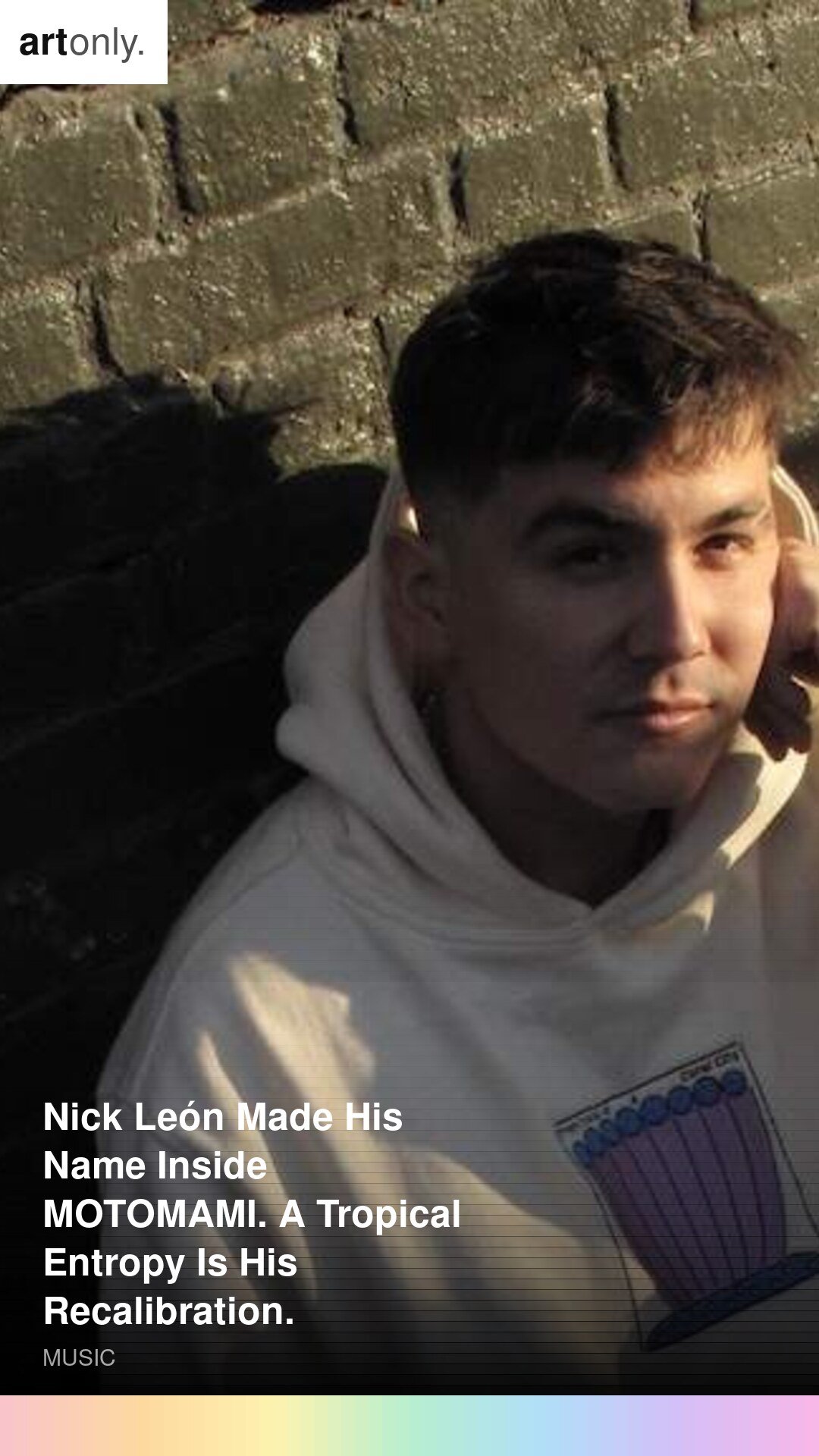
June 27, 2025. TraTraTrax. Catalog number TRALP2. The debut album from Nick León arrived with the precision of a shipping label, which made its title feel almost like a joke: A Tropical Entropy. Fourteen tracks. A Pitchfork score of 8.3. A description from the same publication of "a dembow pop record made for those muggy, electric nights." The album was, in the words of Resident Advisor, "far and away the strongest of León's releases." It was not a surprise to anyone who had been paying attention. It was a surprise to a lot of people who had not.
León grew up in South Florida. That is the most important sentence you can write about this record.
The City That Made Him
Nick León was born in Oakland, California, to Colombian parents and moved to Fort Lauderdale at age three. Fort Lauderdale sits in Broward County, directly north of Miami, and it is where he has spent most of his life. The album has a track called Broward Boy. This is not accidental.
He started producing at twelve, borrowing FruityLoops software from his older brother. He had played guitar and piano before that, and was told by a music teacher that he was not cut out for it. He appears to have taken this as useful information. He trained in audio engineering at the SAE Institute and completed an internship at a studio that had once been Lenny Kravitz's in the Setai hotel. By his teenage years he was making beats that circulated through South Florida's underground rap networks, producing for Denzel Curry and a cluster of artists coming out of the 305 scene.
What he was reaching toward was not rap production. It was something harder to name. Reggaeton from Puerto Rico and Colombia, the changa tuki rhythm that originated in Venezuelan barrios, UK bass sounds filtering through the internet, the particular heaviness of Florida sound systems at three in the morning. He was a producer working without formal music training in a city that most electronic music coverage still treated as a place where things happened on the way to somewhere else.
NAAFI, TraTraTrax, and the Underground
The label relationships that shaped León's solo career both came from Latin America. NAAFI, the Mexico City collective that became the most significant node for experimental club music across the Spanish-speaking world in the 2010s, released his Aguacero EP in 2020. The record incorporated field recordings from Florida's ecosystems alongside crumbling dub techno architecture, and it concerned itself explicitly with climate change. It also concerned itself with the dancefloor. These were not presented as contradictions.
TraTraTrax, the Colombian label founded by Juan Data, came next. Data had built a label that was genuinely difficult to categorize: it had released records across changa tuki, experimental bass, and the outer edges of hyperpop, and it operated as a serious critical institution rather than a taste making service. León released the Xtasis EP there, featuring DJ Babatr with remixes from Doctor Jeep and Pearson Sound. It was the record that established him as a figure whose music required real attention.
The Xtasis cycle also brought him, indirectly, into the orbit of Rosalía. In 2022 he was involved in production work that put his name in front of a mass audience for the first time. The visibility was real and instantaneous. What followed was eighteen months of relentless European touring.
The Burnout and the Return
León has described that period with clarity. "I was like, oh, I don't hate dance music. I've just been in Europe for too long." He traveled to Brazil and Ecuador and found a version of the music that felt continuous with what he had grown up with. Not nostalgia. A confirmation. The thing he had been building was connected to something living.
He returned to Miami with a purpose he had not had before the touring cycle. He also launched Impacto, the label he started alongside producer Jonny from Space in 2023, which released its inaugural record Saka La Bolsita in the same year. The label work was not a distraction from the music. It was an extension of the same logic. Create the conditions for work that the mainstream infrastructure does not support.
He had also been watching a city transform around him. Miami in the early 2020s received an influx of capital and tech workers and speculative development that altered its character in ways that were simultaneously visible and hard to articulate. Joan Didion's 1987 book Miami, which León returned to during the writing of the album, offered a useful framework. Didion wrote about the city as a place where American narrative coherence broke down, where surfaces dissolved, where the usual grammar of cause and effect did not hold.
Building the Record
A Tropical Entropy did not sound like a grief record or a protest record. It sounded like fourteen tracks from someone who understood the city they were describing from the inside. The opening track, Entropy, establishes the temperature immediately. Things are moving. The structure is present. Something is also wrong at the edges.
Ela Minus, the Colombian electronic artist whose own work sits at the intersection of synthesizer composition and underground club culture, appears on Ghost Orchid. The collaboration is unhurried. It does not announce itself as a moment. Erika de Casier, the Copenhagen songwriter who has spent the last several years becoming one of the most quietly brilliant artists in contemporary pop, contributes to Bikini, which had already circulated as a single in 2024. Casey MQ, Xander Amahd, Lavurn, Jonny from Space, Esty and Mediopicky on Millennium Freak. Each guest is chosen with precision. The album does not perform its connections.
Art direction came from Caterina Haddad. The visual language matches the sonic one. Dissolution. Heat. Something beautiful in the process of coming apart.
A Tropical Entropy
DJ Mag described the record as cerebral post club music, noting that León drowned Afro Caribbean and Brazilian rhythms in ethereal FX, simmering sub bass, and fractured synths. This is accurate as far as it goes. What the description captures is the texture. What it does not account for is the pacing.
The album does not rush. Hexxxus, with its dancehall architecture, arrives without apology. Broward Boy positions itself in a specific geography with a directness that most producers avoid. Crush and Ocean Apart and Product of Attraction find their rhythms in ways that feel organic rather than assembled. The second half of the record quiets slightly, the way Miami quiets just before dawn, when the city is still moving but the surfaces have changed.
Resident Advisor called it the strongest work of León's career. Pitchfork gave it an 8.3 and placed it among the notable records of 2025. Year-end lists confirmed the consensus. A Tropical Entropy also appeared on the EA Sports FC 26 soundtrack in September 2025, which placed it in front of an audience with no prior relationship to the underground networks that had been following León for years.
He is in his early thirties. He has built two labels. He has made his debut album. The tropical entropy of the title remains active. Things fall apart. Something strange emerges from the heat. This is what Miami has always produced. León is simply the producer who finally made the record that said so directly.