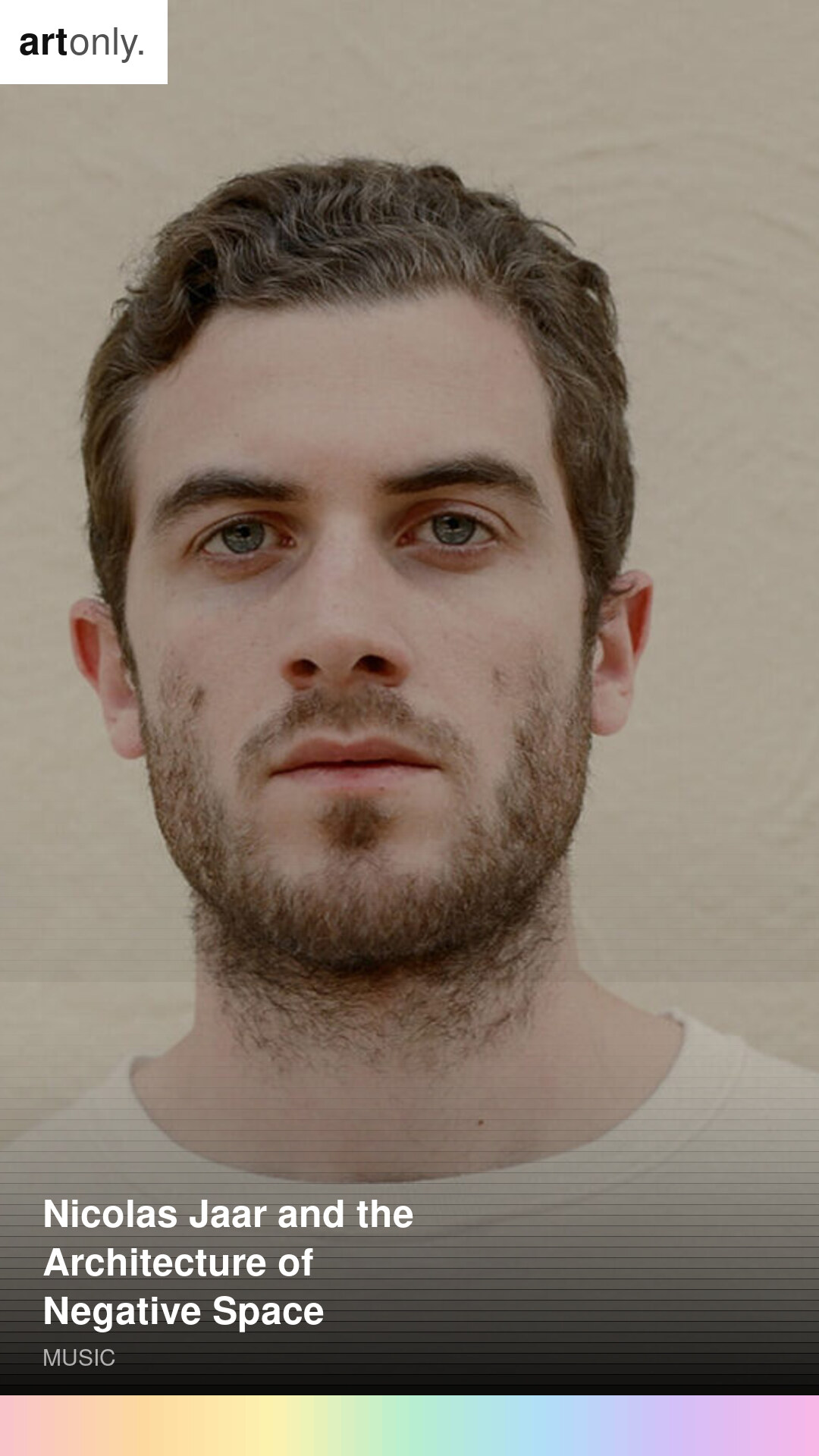
<p>There are artists who make music you hear, and there are artists who make music you inhabit. Nicolas Jaar belongs firmly to the second category. His work is not background sound. It is architecture. It is a space you enter and leave changed, never quite able to explain why.</p>
<p>Born in New York City in 1990 to a French dancer mother and a renowned Chilean artist father, Jaar grew up between continents. He spent his early years in Santiago, returned to Manhattan, and eventually landed at Brown University studying comparative literature. That last detail matters more than it might seem. He was reading theory and translation while other producers his age were watching YouTube tutorials. The gap shows in everything he makes.</p>
<h2>Space Is Only Noise</h2>
<p>When Jaar released his debut album in 2011 he was 21 years old and already sounding like someone who had spent a decade taking music apart. <em>Space Is Only Noise</em> landed at the top of year-end lists at Resident Advisor, Mixmag, and Crack Magazine simultaneously. The critical consensus was immediate, but what made the record genuinely unusual was its refusal to be comfortable. The beats arrived late or not at all. Vocals dissolved before resolving. Bass lines appeared without preamble and vanished the same way.</p>
<p>The record did not sound like a debut. It sounded like a culmination. That paradox, youthful vision married to something unnervingly mature, became a defining tension in everything Jaar would do afterward.</p>
<h2>Darkside and the Collaborative Turn</h2>
<p>Around the same period he began building a live concept called From Scratch, performing with records he had purchased that same day, improvising in real time in front of audiences who had no idea what was coming. The practice was part concert, part durational art piece, and entirely in keeping with a sensibility that prizes process over polish.</p>
<p>His collaboration with guitarist Dave Harrington under the name Darkside produced <em>Psychic</em> in 2013, a 9.0 from Pitchfork and one of the more genuinely strange rock-adjacent albums of that decade. Where Jaar alone tended toward minimalism and negative space, Darkside allowed the music to stretch and overheat. Harrington's guitar introduced a kind of entropy Jaar had never quite permitted himself, and the result sounded like a late-night drive through a city that no longer exists. Darkside returned in 2021 with <em>Spiral</em>, continuing the collaboration with that same combination of warmth and unease.</p>
<h2>Other People and the Infrastructure of Avant-Garde</h2>
<p>In 2014, after closing his earlier label Clown and Sunset, Jaar founded Other People. The imprint became something of a personal curatorial ecosystem, releasing work by William Basinski, Lydia Lunch, Pierre Bastien, and the Terepa collective, which included Laurel Halo, Julia Holter, and Lucrecia Dalt among others. The label's aesthetic was never governed by genre. It was governed by attitude, a shared commitment to music that resisted easy consumption.</p>
<p>In 2016 Other People launched THE NETWORK, a project comprising 111 fictional radio stations, each with its own logic, its own imagined geography and audience. Later published in book form, it was less a music release than a conceptual infrastructure. Jaar was not just making art. He was building the frameworks that other art could inhabit.</p>
<h2>Nymphs and the Serialized Vision</h2>
<p>The Nymphs project began in 2016 as a series of EPs released under Jaar's own name, initially available only through his website and through physical copies at performances. The series unfolded gradually across multiple installments, each one expanding the emotional register of the last. Where <em>Space Is Only Noise</em> had been cool and architectural, the Nymphs EPs were rawer, more explicitly political, more willing to let feeling overflow the formal constraints.</p>
<p>The serialized format was deliberate. Jaar has spoken about his resistance to the album as a fixed, finished object. He prefers forms that remain open, that invite the listener into an ongoing conversation rather than a completed statement. The Nymphs series embodied that preference structurally, arriving in pieces across time, accumulating weight gradually rather than arriving fully formed.</p>
<h2>Cenizas and the Interior Turn</h2>
<p>His 2020 album <em>Cenizas</em>, released on Other People, was perhaps his most introspective work to that point. The record built its architecture from silence and near-silence, from the suggestion of melody rather than melody itself. Voice appeared, but as texture rather than communication. It was music that asked a great deal of the listener and rewarded patience in proportion to how much you brought to it.</p>
<p>That same year he released <em>Telas</em>, a companion piece of sorts, quieter still. The two records together felt like rooms in the same building, connected by a shared emotional logic but distinct in character.</p>
<h2>Against All Logic and the Alias</h2>
<p>The Against All Logic releases, <em>2012 to 2017</em> and <em>2017 to 2019</em>, offered a different Jaar entirely. Produced under an alias that initially kept his name off the credits, the records were house music in the broadest sense but filtered through his characteristic obliqueness. The drums were harder, the samples more immediate, but the underlying sensibility was unchanged. These were not concessions to accessibility. They were demonstrations that accessibility and depth are not opposites, that a four-four kick can carry as much ambiguity as the absence of one.</p>
<h2>Piedras and the Long Composition</h2>
<p>The most recent chapter of his work centers on the Piedras project. What began as a 17-episode radio play became two albums released in 2024, <em>Piedras 1</em> and <em>Piedras 2</em>, works that weave together Chilean colonial history, the legacy of the Pinochet dictatorship, and Palestinian erasure into a dizzying amalgam of avant-pop and abstract sonics. The subject matter connects to his own family history in ways that are personal and structural simultaneously. His father Alfredo Jaar is one of the most important political artists working today, and the son has increasingly inhabited a similar territory, making work that cannot be separated from its historical moment.</p>
<p>The Piedras albums do not explain themselves. They present material and allow the listener to assemble meaning from fragments, from juxtaposition, from the spaces between sounds. It is demanding work, but demanding in the way a great novel is demanding, because the density is load-bearing, not decorative.</p>
<h2>What the Career Adds Up To</h2>
<p>Fifteen years into a recording career that began when most people his age were still figuring out what they liked to listen to, Jaar has built something rare. He has maintained artistic consistency without repetition. Each project has extended or complicated what came before without simply restating it. The installations, the label, the collaborations, the aliases, the radio plays turned into albums, all of it forms a single coherent body of work that rewards close attention.</p>
<p>He is not easy listening in any sense. But he is essential listening, a reminder that electronic music at its most ambitious is not about sound design or production craft. It is about what you choose to say and what you choose to leave unsaid, and the precision with which you make that choice every single time.</p>