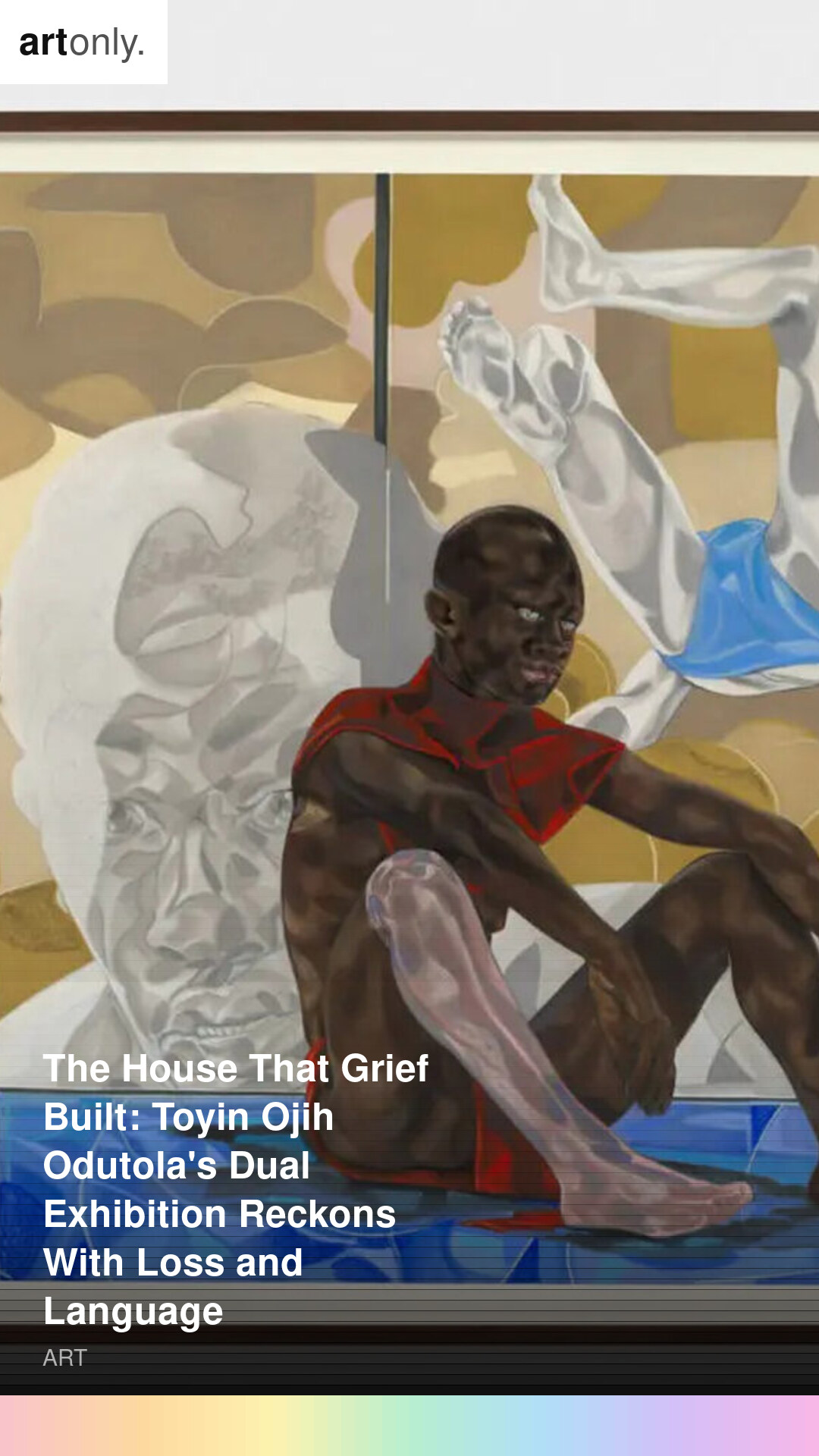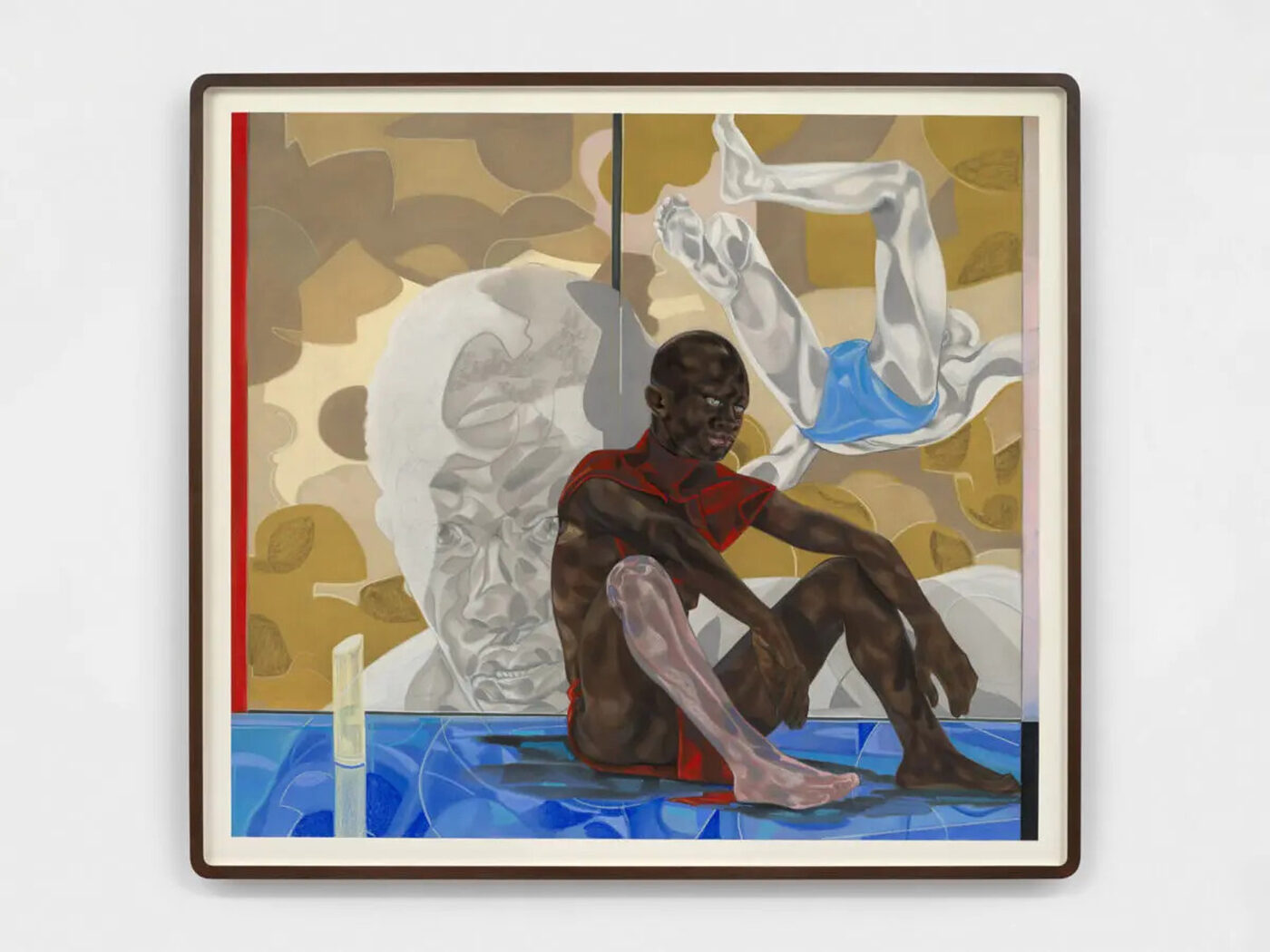
In May, the Nigerian-American artist opened Ilé Oriaku at Jack Shainman Gallery in Tribeca, New York. Thirty-one drawings on paper, linen, canvas board, and Dura-Lar film occupy the gallery's Lafayette Street space in what is Odutola's seventh solo show with the gallery. Weeks later, in Berlin, the Hamburger Bahnhof transformed its east cabinet into U22 Adijatu Straße, a fictional underground station with roughly twenty-five works in the same layered, luminous hand. Together these two exhibitions form a single extended reckoning. Their starting point was the death of her grandmother, Josephine Oriaku Ojih, in June 2023.
Odutola was at her parents' home near Huntsville, Alabama when the news arrived from Nigeria. She had just been preparing work for the 60th Venice Biennale and for a solo show at the Kunsthalle Basel. The grief arrived mid-process. Rather than stopping, she kept drawing, and the work began to absorb what she could not yet say. The exhibition takes its title from that loss directly: Ilé means house or home in Yoruba, and Oriaku was her grandmother's Igbo name. The entire show is structured as an Mbari house, the sacred communal spaces built in Owerri Igbo tradition as offerings to the earth deity Ala. Mbari houses were not meant to last. They were made to be made, to hold spiritual meaning in their construction rather than their permanence. Odutola has built one in charcoal and pastel, one that exists as long as the exhibition runs, and no longer.
The formal properties of her work have always been extraordinary. Born in Ile-Ife, Nigeria in 1985, Odutola moved with her family to Berkeley at age five, then to Huntsville, Alabama at ten. She studied studio art and communications at the University of Alabama in Huntsville and received her MFA from the California College of the Arts in San Francisco. Her early practice centered on dense, intricate portraits executed almost entirely in black ballpoint pen, building up strokes until skin became a landscape of marks. Critics and collectors responded immediately: Forbes named her to its 30 Under 30 list in 2012, the year she finished her MFA. Since then her palette has opened up, charcoal, chalk, colored pencil, pastel taking over from the pen, but the underlying logic has remained the same. She is building surfaces. She is making skin and fabric and shadow out of accumulated decisions.
For Ilé Oriaku the palette is jewel-like, referencing the pigment symbolism in traditional Mbari wall paintings, rich ochres and deep blues and a warm, diffuse light that feels almost sourceless. The figures in the works often turn away, their faces obscured or turned toward walls. Architectural spaces are fragmented, interrupted, partially visible. The physical act of looking is thwarted gently, deliberately. You come to see grief not as an absence but as an obstruction, something that stands between you and the direct view.
One of the standout pieces is Nwanyeruwa (Aba Women's Rebellion), a pastel and charcoal work on linen measuring seventy-five by fifty-one inches. Two figures occupy different planes of the picture, their presence formally separated in a way that mirrors the temporal distance between the 1929 tax revolt and the present. Another work, Third Person Singular, plays with grammar and personhood simultaneously. The pattern in the skin bleeds outward across the background of the image until figure and ground begin to lose their distinction. A piece titled Congregation pulls several figures together in quiet proximity, the scale modest at roughly twenty-seven by thirty-nine inches, the emotional register anything but.
At the entrance to Ilé Oriaku, visitors encounter a few lines of elegiac verse contributed by Odutola's mother. Somewhere in the gallery, an audio track plays: her grandmother's voice, recorded during a visit in 2018, spliced with birdsong that the artist captured outside on the morning she learned of the death. The sound is not announced or labeled. You may not notice it at first. When you do, it reorganizes the space around you.
Odutola has spoken about grief with the same precision she brings to her mark-making. Grief is constant and it never goes away, she has said. So it is about how you mitigate that. Mitigation, in her hands, looks like thirty-one drawings built over two years, each one a room in a house that has no fixed address. It looks like a fictional underground station in Berlin named for a person who does not exist, populated by figures that move through historical and imagined space without resolution. It looks like the space between a grandmother's recorded voice and the birdsong of the morning after.
The Berlin exhibition, U22 Adijatu Straße, takes a different structural approach. Rather than the contained spiritual architecture of a Mbari house, it borrows the logic of transit infrastructure, the underground line, the named station, the sense of movement without arrival. The fictional U22 line runs through a city that is real but transformed. Adijatu is a name that could be West African, could be elsewhere. The station is not on any map. As a conceit it is deceptively simple and disorienting in practice. You enter a museum cabinet and find yourself underground, moving through history and figment simultaneously.
Odutola has described her work as operating like a comic book, a sequence of panels building toward something. She has also said, with characteristic directness, that mastery is something she avoids like the plague. There is something in that statement that explains why the work never calcifies. Her technique is extraordinary, the kind of draftsmanship that draws audible responses from viewers in galleries. But she keeps building formal challenges into the work, new materials, new structures, new narrative scaffolding that prevents the technique from becoming the point.
The institutions holding her work reflect a sustained institutional confidence: MoMA, the Whitney, the Metropolitan Museum of Art, the National Portrait Gallery in London, the Smithsonian's National Museum of African Art. She received the Prix Jean-François Prat in 2020, Carnegie Corporation's Great Immigrants Award in 2022. The critical response to Ilé Oriaku has been consistent in its recognition that something has shifted in the work, that the personal is now fully inside the political and mythological structures she has always favored, no longer kept to one side.
What Odutola has made with these two exhibitions is a sustained argument that drawing can hold what language cannot. Her grandmother's Igbo name is now the title of a gallery show. Her grandmother's voice plays inside an art space in lower Manhattan. A fictional station bears a fictional name in a real museum in Berlin, which is also a kind of monument, which is also a kind of house.
Ilé Oriaku runs at Jack Shainman Gallery in New York through July 18, 2025. U22 Adijatu Straße continues at Hamburger Bahnhof through January 4, 2026.