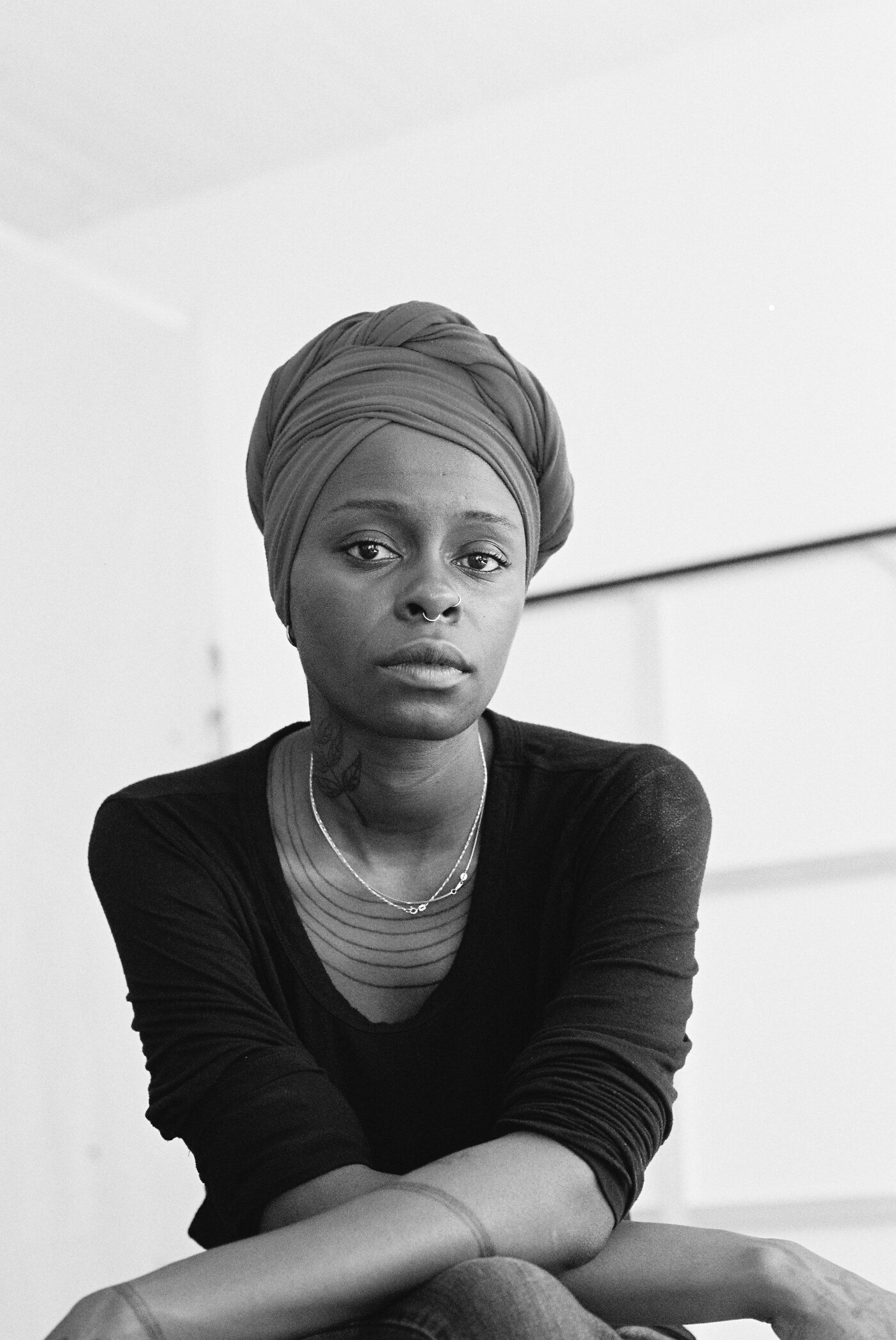
Ojih Odutola was born in 1985 in southwestern Nigeria. Her family moved to Berkeley, California in 1990, then to Huntsville, Alabama in 1994, where her father became an associate professor at Alabama A&M University. The trajectory from Nigeria to Huntsville is part of what makes her work specific: the figurative tradition she works in draws on Yoruba and Igbo portraiture, and the conditions in which she developed that practice were American, Southern, and far from the institutional art world.
What the Title Holds

The exhibition title contains words from two different languages. "Ile" is Yoruba and means house, building, or home. "Oriaku" is Igbo and is the name of her grandmother, who died before the show opened. Ojih Odutola built the exhibition as a tribute to her grandmother and to her uncle, also deceased. She described the structure as a Mbari house.
The Mbari house is a tradition from Igbo culture in southeastern Nigeria: an elaborate, community-built structure created to honor the earth goddess Ala, filled with figures and scenes, and then left to decay naturally once complete. Ojih Odutola used this framework to organize the exhibition: the gallery becomes the house, the drawings become its inhabitants, and the figures inside the work occupy a space that is also a memorial.
She structured the gallery explicitly as a dramatic stage where figures are caught between poses, right before or after an exchange. The spatial logic of Mbari architecture, in which figures exist in relation to each other within a constructed environment, informs how the works are installed and how they are meant to be read.
How the Materials Work

Ballpoint pen is not a material associated with fine art exhibition in the way that oil or acrylic is. It dries immediately, cannot be blended in the way paint can, and was designed for fast, disposable mark making. Ojih Odutola has worked with it for most of her career alongside pencil, pastel, and charcoal.
The technique she has developed involves building up layers of mark making across the surface of a drawing until the accumulation produces an image that reads as continuous tone. She blends and shades at a level of detail that requires the viewer to be physically close to see the individual marks. From across a gallery, the works look like paintings.
For "Ile Oriaku," she introduced chalk and colored pencil more prominently alongside her established materials. The color palette in several works uses saturated orange and pink that contrast sharply with the dark tones she uses for skin. Color in these works is not decorative. It grounds the figures in the composition while the mark making in surrounding areas becomes softer and more atmospheric.
The Berlin Show

Simultaneous with "Ile Oriaku" at Jack Shainman, Ojih Odutola opened her first solo exhibition in Germany at Hamburger Bahnhof, Berlin's contemporary art museum, on June 13, 2025. That show runs through January 4, 2026 and contains approximately 25 works. Its title refers to a fictional underground transit station: a line called U22 and a stop called Adijatu Strasse.
The U22 is imaginary. Adijatu Strasse is a name. Ojih Odutola used this framework to transform the museum's east cabinet into a fictional location at the intersection of movement and history. The show explores how transit systems organize and separate communities, and what it means to name a station after a person.
Adijatu is a name, like Oriaku in the New York exhibition. Both belong to real people connected to Ojih Odutola's personal history. Moving from one show to the other is not a change of subject. It is the same investigation into how names hold people and how physical spaces memorialize or erase them, carried into a different formal structure.
Seven Shows and What They Prove

Seven solo shows with one gallery is a long relationship by contemporary art standards. Jack Shainman has represented Ojih Odutola through a period in which her reputation moved from emerging to established, and through several transitions in her technique and subject matter.
The contemporary art market pushes artists toward movement between galleries as a signal of demand. Ojih Odutola has built her practice in the opposite direction, developing a figurative language over many years within a consistent institutional relationship. The result is a body of work that is internally coherent in a way that movement between galleries would have interrupted. Each show at Jack Shainman builds on what the previous ones established.
The Mbari house structure in "Ile Oriaku" is the most architecturally ambitious framing she has put around her drawings. The technique has not changed in its fundamentals: layers of mark making in ballpoint and pastel and charcoal, accumulated until the image holds. What has changed is the confidence with which she constructs the context in which the marks are read. The seventh show is not a retrospective. It is a statement about where the practice is now.
The work that fills the Mbari house at Jack Shainman is also a record of sustained observation. Ojih Odutola draws the figures she imagines as though she has known them for years, and the specificity of their gestures confirms that sustained familiarity. The house holds them. The art holds the house.