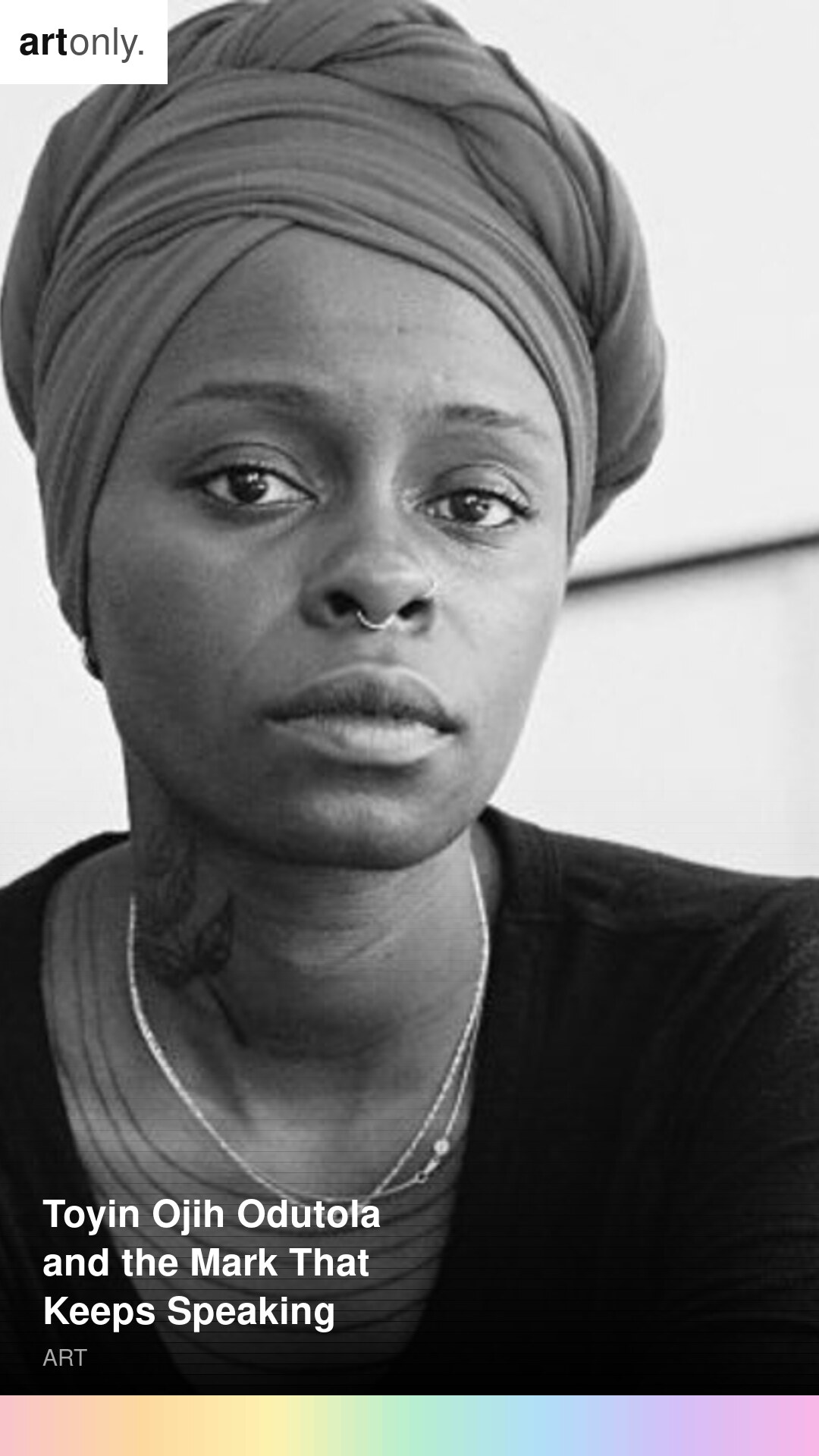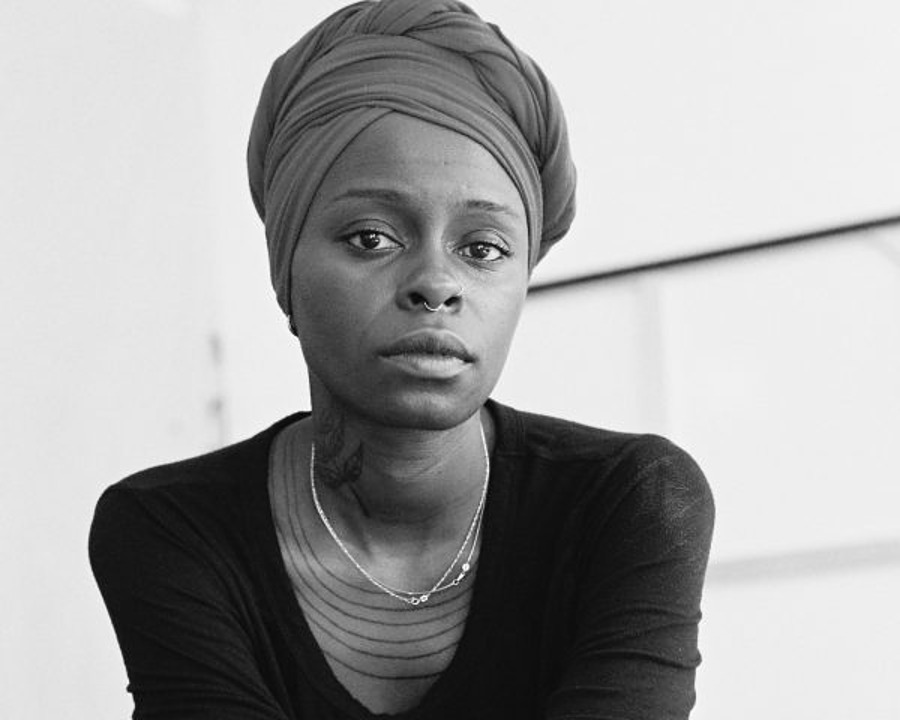
Toyin Ojih Odutola does not paint. That distinction matters, and she has been careful about it for years. Her materials are ballpoint pen, charcoal, pastel, and marker. The surfaces she works on are paper and board. The figures that emerge from those surfaces carry skin that seems to hold light from inside, built from thousands of individual marks laid so densely they become texture, atmosphere, a kind of topography that you want to reach out and press your fingers against.
For an artist whose medium is so deliberate and so intimate, her rise through the international art world has been unusually fast and unusually deserved. She was born in Ife, Nigeria in 1985, raised partly in the United States from age five, and educated at the University of California Santa Barbara before completing her MFA at CalArts. By her mid-twenties her work was already drawing serious critical attention. By 2017 her two-person show with Jack Shainman Gallery, "A Countervailing Theory," had created a national conversation about speculative fiction, Blackness, nobility, and what it means to construct a dynasty from imagination rather than inheritance.
Building a Mythology, One Mark at a Time
That 2017 show introduced a fictional Nigerian aristocratic family, the Umuoha, through a series of large scale drawings that felt like evidence from a civilization that had always existed, just slightly sideways from the one we inhabit. The figures wore elaborate clothing and occupied interiors of obvious wealth. Their skin, rendered in Odutola's signature dense crosshatching, seemed carved from something harder than flesh. They looked back at the viewer with a steadiness that was not aggression and not invitation. It was simply presence.
The speculative history continued with "To Wander Determined," her 2017 Whitney Museum exhibition, which deepened the Umuoha narrative into something closer to a saga. Two men. A relationship left deliberately undefined. Landscapes that blended Nigeria with ancient Rome. Time operating as something elastic rather than fixed. The show drew comparisons to everything from Greco-Roman fresco to Manga, and none of those comparisons were wrong, but none of them fully captured what Odutola was doing either.
What she was doing, and has continued to do with increasing precision, is insisting that the bodies she draws are not illustrating a story. They are the story. The mark on the skin is the narrative. The way light catches a shoulder, the tension in a hand resting on a knee, the slight forward tilt of a chin that could be pride or wariness or both at once. These are not decorative choices. They are the actual content.
The 2025 Exhibition and What Shifted
In 2025, Odutola returned to Jack Shainman Gallery in New York with new work that represented a clear evolution in her practice. The exhibition, titled "Ilé Kan" (which translates roughly as "one home" or "one house" in Yoruba), moved the fictional world she has been building toward something more elemental. Earlier bodies of work had a quality of theater to them, even cinematic grandeur. The figures in "Ilé Kan" felt quieter, more interior. The scale pulled back in some works. The environments became less elaborate but somehow more charged.
Critics noted that the new drawings gave more attention to negative space than her earlier work. The skin still held its impossible density of mark, but it now sat within compositions that breathed differently. A figure might occupy only the lower third of a large sheet, the rest given over to gradations of charcoal that could be sky, or smoke, or simply the quality of being alone in a large room.
The color palette shifted as well. Where the Umuoha series used rich ochres and deep umbers and the kind of blue-black that looks wet, "Ilé Kan" introduced cooler tones. Slate, ash, the particular grey of dawn that hasn't decided whether it will become morning or remain night. It was a body of work that seemed less interested in spectacle and more interested in duration. What does it feel like to inhabit a body over time. What accumulates on the surface of a person who has been somewhere long enough to leave marks, and be marked in return.
Skin as Archive
The central philosophical concern in Odutola's practice has always been about what skin actually is. Not race, not identity, not the sociological category that skin gets conscripted into in so much discourse about Black art. Skin as a material, as an archive, as something that records everything that has happened to a body and does not erase any of it.
In interviews she has described her process as almost geological. Each mark laid down is a layer. The final surface of a finished work contains thousands of decisions, each one still technically visible if you look hard enough. Nothing is buried. Nothing is corrected in the traditional sense. The earlier marks alter what comes after, but they remain. This gives her figures a quality that is almost impossible to achieve in paint, a sense of accumulation that reads not just as skill but as time actually having passed.
This is why the comparison to photography, which comes up occasionally, feels wrong. Photographs arrest a moment. Odutola's drawings feel like they have been accruing across multiple moments, as though the subject has been sitting there not for the duration of a photograph but for the duration of a life, and all of those moments have left their impression on the page.
The Question of Fiction
One of the more interesting aspects of Odutola's practice is her insistence on the fictional nature of her figures. She does not draw from life in the traditional sense. The people in her works do not exist, or rather they exist only within the internal logic of the worlds she is building. This has led to some confusion about whether her work is portraiture, which it resembles in scale and intensity, or something else entirely.
She has called it world-building, and that feels accurate. But it is world-building with the rigor of a documentarian. The fictional worlds she creates have internal consistency. The relationships between figures carry weight across different works and different years. The Umuoha family did not disappear after 2017. They have continued to surface, to age, to carry whatever happened to them in those earlier drawings into the new work. Characters gain and lose things. The mythology deepens.
This commitment to sustained fictional history puts her in unusual company. She is doing for visual art something like what Hilary Mantel did for historical fiction, or what Octavia Butler did for speculative fiction. Building a world with enough internal gravity that it pulls the reader or viewer into its own logic, makes its own rules feel natural, and then shows you something true about the actual world through the lens of the invented one.
What the Work Demands
Seeing Odutola's work in reproduction is not seeing it. This is a consistent complaint among people who first encounter her drawings in print or on screen and then stand in front of the actual work in a gallery. The scale is one issue. Many of the larger pieces are imposing in a way that the body registers physically, not just visually. But the more important difference is texture.
The surface of her drawings carries an almost sculptural quality. The density of mark creates a relief that catches light differently depending on the angle of viewing. Moving slowly across a large work, the skin of a figure shifts. It becomes more dimensional, then less. The marks reveal themselves as individual decisions and then coalesce again into continuous surface. This is an experience that a reproduction cannot provide and that no amount of high resolution imaging fully captures.
The galleries that show her work have understood this. The Jack Shainman shows are calibrated to maximize encounter time. The lighting is considered. The spacing between works allows the eye to rest, to reset, to arrive at each drawing without carrying the residue of the last one.
What the work demands, ultimately, is attention. Not analysis, not the application of critical framework, not even knowledge of the fictional worlds she has been building. Just the willingness to stand in front of a mark-covered surface and let it take as long as it needs to take. That is rarer than it sounds. And Toyin Ojih Odutola has built a career on knowing exactly what to do with it.