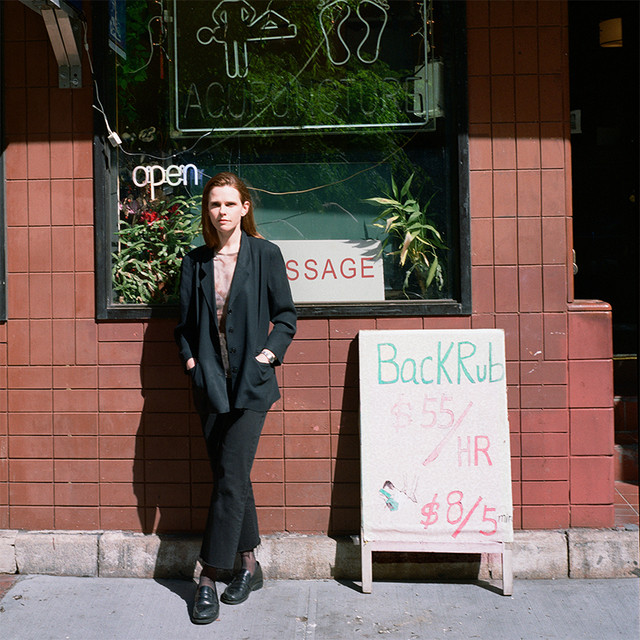
<p>Born in 1990 in Harlem, New York, Self grew up immersed in the visual density of a neighborhood that carries enormous cultural weight. She completed a B.A. at Bard College and an M.F.A. in painting and printmaking at Yale School of Art, two institutions with very different energies, and she seems to have absorbed something from both. From Bard, a certain intellectual restlessness. From Yale, formal rigor. The combination produced a practice that is genuinely hard to categorize, which is part of why it commands so much attention.</p>
<h2>The Materials of the Body</h2>
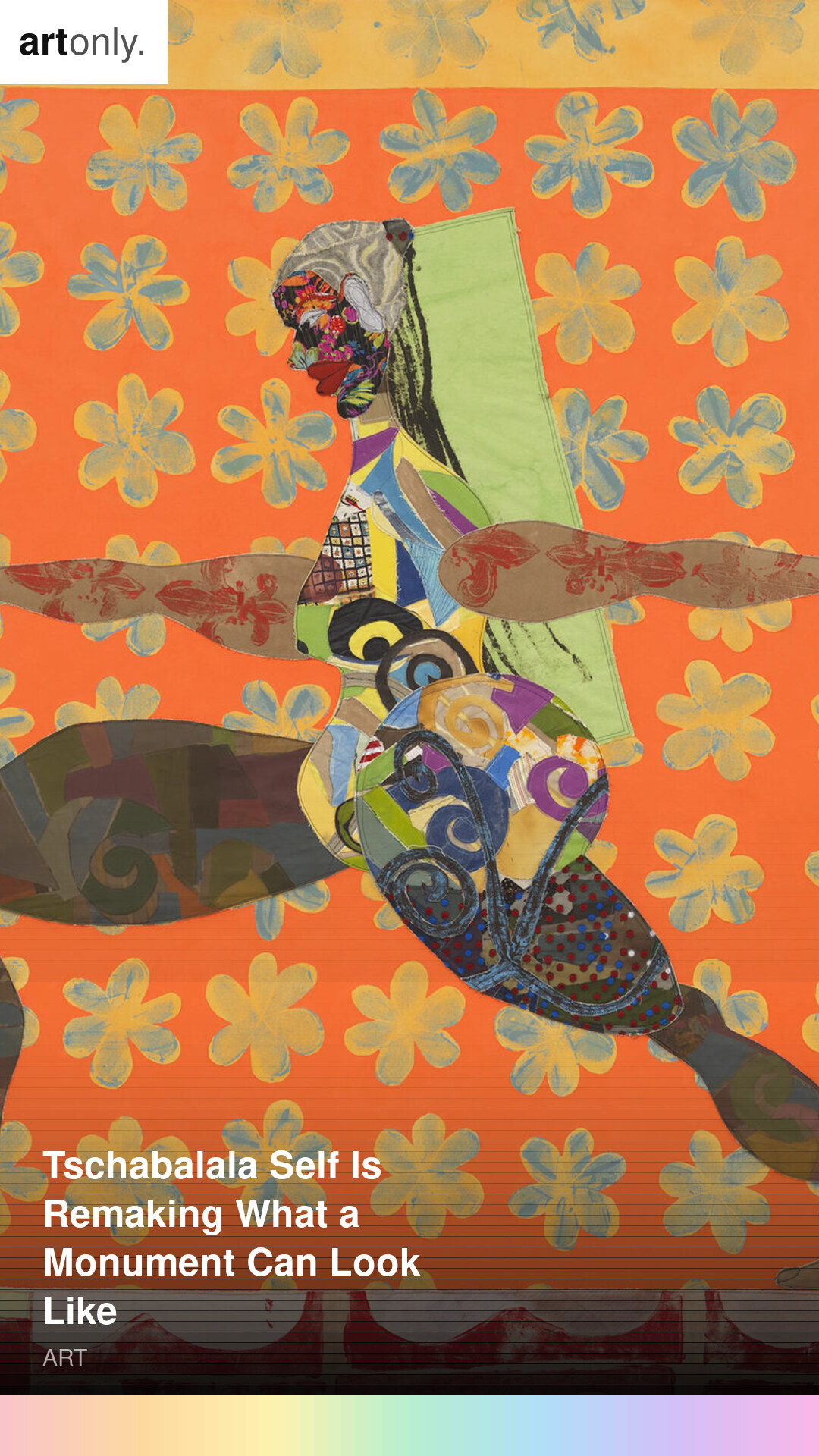
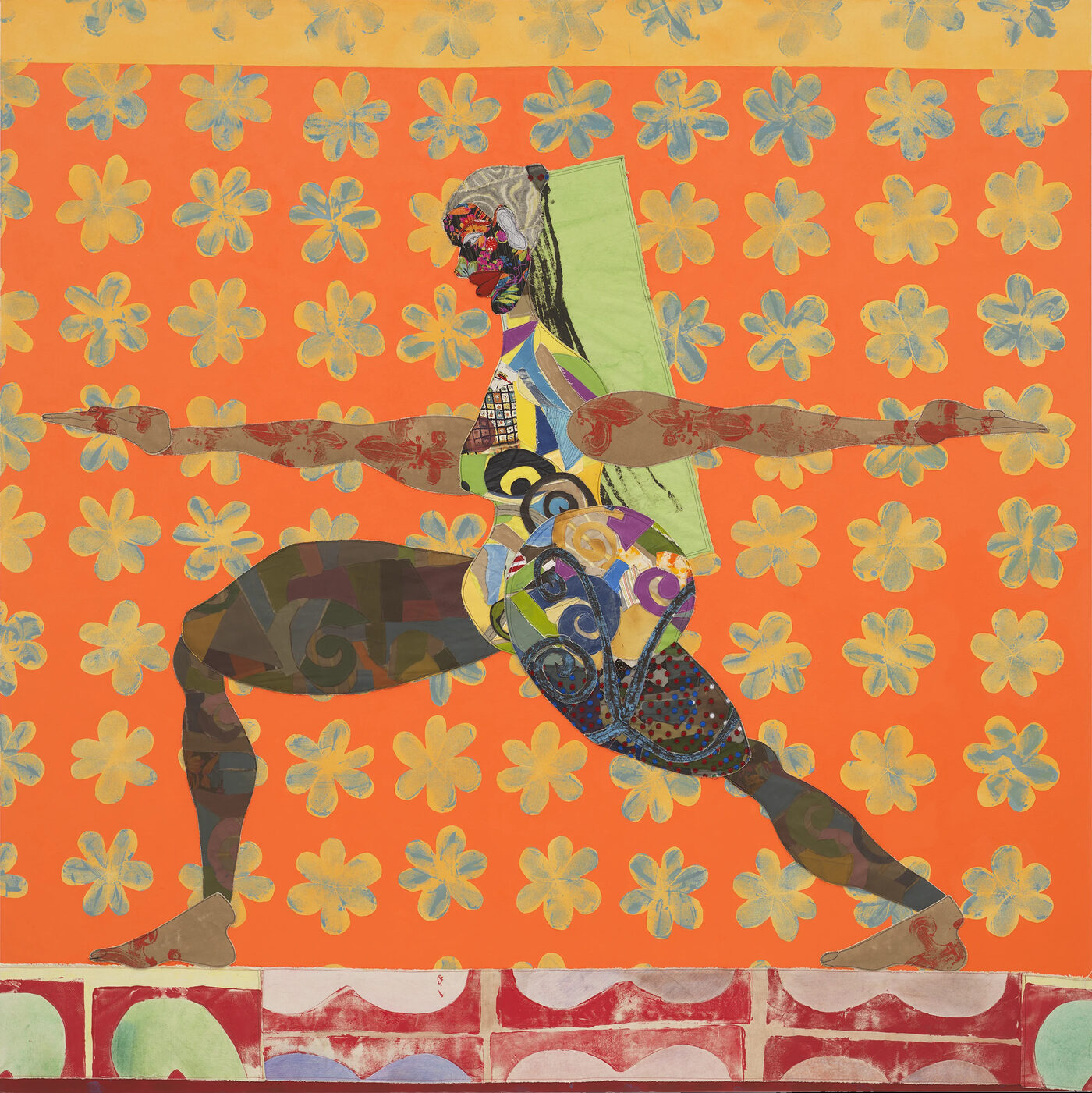
<p>Self's method is one of accumulation and assembly. She works with paint, but also with fabric, thread, printed canvas, dyed textile, and recycled fragments from her own earlier works. The figures she builds from these materials are composite creatures, bodies constructed rather than rendered. A torso might be raw linen stitched over painted canvas. Legs might be strips of velvet sewn against acrylic ground. The seams are visible, intentional, structural. She has said that she uses materials in unconventional ways to subvert the status quo, that you do not have to use paint to make a painting. What she produces are paintings that know they are paintings, that wear their own construction on their surface.</p>
<p>The subject of that construction is almost always the Black female body, and Self approaches it with a complexity that resists easy categorization. Her figures are not victims and they are not symbols. They are not illustrating a thesis. They exist with a kind of blunt physicality, exaggerated in ways that reference both folk art and modernist distortion, that cite Romare Bearden and Willem de Kooning in the same gesture. Peter Schjeldahl, writing in 2017, compared her work to Arshile Gorky, noting a similar urgency in the way forms press against the picture plane. The comparison landed because it was accurate. Self's figures do not recede. They press.</p>
<h2>Works That Matter</h2>
<p>Notable works from across her career trace the arc of an expanding ambition. <em>Bodega Run</em> planted her figures in the specific landscape of Harlem commerce, grounding abstraction in neighborhood life. <em>Cotton Mouth</em>, one of her most discussed paintings, used the textile materiality of her surface to make a pointed argument about silencing, about who gets to speak and who gets sewn shut. <em>The Function</em> captured figures in communal space, bodies in proximity, the social warmth of shared presence. More recent canvases from 2025, including <em>Bayou Bather</em> and <em>Heroine No. 2</em>, push her palette into warmer, more luminous territory while maintaining the same structural logic. The body remains central. The seams remain visible.</p>
<p>Her institutional trajectory has been correspondingly ambitious. A debut solo show in Berlin in 2015 led to a solo presentation at Parasol unit in London in 2017. Her first major European museum show, <em>Make Room</em>, opened at the Consortium Museum in Dijon in 2022 and traveled to Kunstmuseum St. Gallen the following year. The Schomburg Center for Research in Black Culture in New York has presented her work in an extended run through mid-2026, curated by Joy Bivins. The Australian Centre for Contemporary Art in Melbourne mounted <em>Skin Tight</em> in late 2025. Petzel Gallery in New York will mount her first solo show with them in fall 2026. She is represented by Pilar Corrias in London and Galerie Eva Presenhuber in Zurich.</p>
<h2>Going Public</h2>
<p>But the year's most visually commanding moments have been the public commissions. In March 2026, the New Museum unveiled Self's <em>Art Lovers</em> as part of its Facade Sculpture Program, installed on the exterior of the museum's expanded Bowery campus at the point where the original SANAA building meets the new OMA extension. The sculpture depicts two figures in an embrace, bodies meeting at the architectural seam. New Museum Director Lisa Phillips described it as paying homage to the joining of the two buildings. Artistic Director Massimiliano Gioni called it an insignia of love. What strikes about <em>Art Lovers</em> is how seamlessly it translates the logic of Self's studio practice into three dimensions. The bodies still push outward. The join is still the point.</p>
<p>The Trafalgar Square commission is something else entirely. <em>Lady in Blue</em>, selected by London's Fourth Plinth Commissioning Group in 2024, will occupy the plinth beginning in September 2026 for eighteen months. The sculpture is cast in bronze and patinated with lapis lazuli blue, a pigment with centuries of history in European painting, used here to dress a figure that European monumental tradition has largely ignored. Self describes <em>Lady in Blue</em> as a homage to a young, metropolitan woman of colour, a quotidian figure, like many one might encounter in contemporary London. She calls it a symbol of shared present and future ambitions.</p>
<h2>What a Plinth Means</h2>
<p>The Fourth Plinth has hosted work by Yinka Shonibare, Katharina Fritsch, Elmgreen and Dragset, and Heather Phillipson, among others. It has become one of the most scrutinized public art platforms in the world precisely because of what it implies: that this figure, on this base, in this square, matters. Self's choice of a blue bronze woman, grounded and upright, neither heroic in the traditional martial sense nor decorative, is a statement about presence. About who gets a plinth. About what monuments are for.</p>
<p>What ties all of this together is a consistency of intent that has only sharpened over the past decade. Self has always been interested in what she calls alternative narratives around the Black body. She has always been interested in who tells those narratives, using what materials, under whose authority. The move into large-scale public sculpture does not represent a departure from the studio practice. It is the studio practice, scaled to the street, to the facade, to the square. The seams are still there if you look for them. The bodies still press outward. They still refuse to recede.</p>
<p>In a moment when figuration has returned to institutional favor across the art world, Tschabalala Self stands apart from the trend because she was never simply riding it. The questions she has been asking since her debut in Berlin eleven years ago are the same questions she is asking now, just with more surface area, more bronze, more blue. The figures get larger. The argument stays the same. It is a good argument.</p>