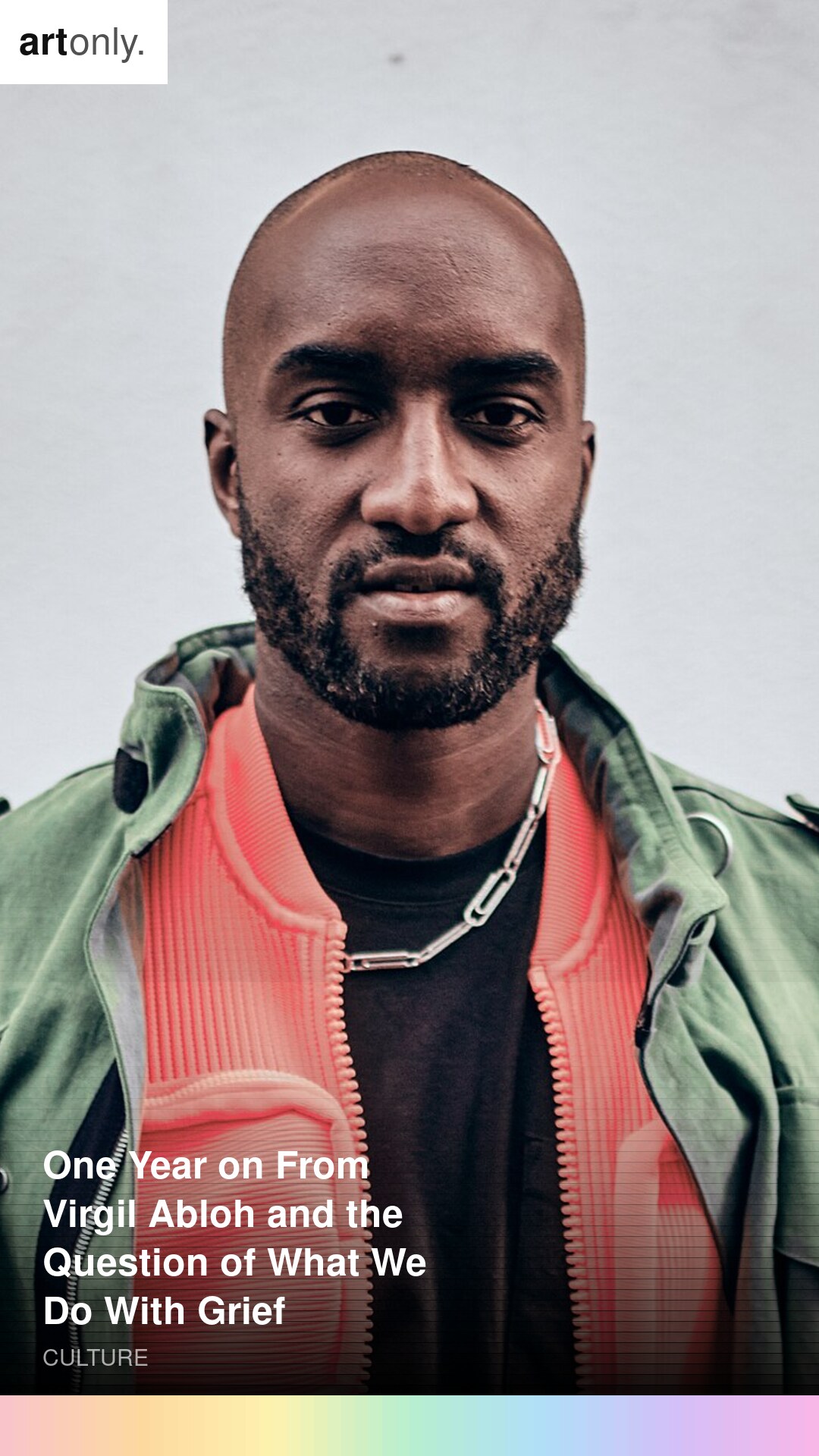
Virgil Abloh died in November 2021, and the response was immediate, enormous, and genuinely felt in ways that responses to celebrity deaths often aren't. The people who were most affected were not simply fans. They were designers, artists, students, people who had organized their ambitions around what his presence in the spaces he occupied made possible, what it meant that someone who looked like him, who came from where he came from, had made it to where he made it.
A year out, the question of legacy is complicated by the fact that his legacy was complicated. Abloh was a genuine creative force and also an enormously successful commercial entity and the two things sat in tension in ways that his life didn't fully resolve and his death didn't either. The retrospective discussions have tried to separate these: the designer, the cultural figure, the mentor, the person who opened doors. All of these are true and none of them is the whole thing.
What he did at Off-White and then at Louis Vuitton, the streetwear-meets-luxury synthesis, the use of quotation marks as design element, the deliberate foregrounding of reference, was formally interesting in the way that good design is formally interesting, and it was commercially successful in a way that changed the industry. These are different achievements and they coexist in his body of work.
The Design Language
The quotation marks are worth dwelling on because they became so widely copied that it became easy to forget how strange they were when they first appeared. Putting SHOELACES in quotes on a sneaker is an act of conceptual distancing: the object acknowledges its own object-ness, treats its own materiality as a readymade, winks at the consumer about the constructed nature of luxury. This is a move from Duchamp, filtered through hip-hop's tradition of referential self-awareness, applied to a two-thousand-dollar sneaker.
The Off-White collection from his tenure, viewed in retrospect, reads as an argument about cultural capital and who is allowed to claim it. The deliberate use of streetwear codes within high-fashion contexts was not pastiche. It was a statement that those codes carried their own validity, that hip-hop's visual language was not inferior to the European luxury tradition but a parallel tradition with equal claims on seriousness.
What He Made Legible
The most consistent thing I heard from designers and creative people in the year after his death was not about any specific project. It was about permission. He made something legible that had been present but unnamed, the possibility of being from hip-hop culture and streetwear and Black American cultural life and also being in the highest rooms of fashion and art and luxury. Not as a novelty, not as tokenism, but as the thing itself.
This legibility matters enormously to the people for whom it mattered. It's the difference between aspiring to something you have precedent for and aspiring to something you're inventing without a map. Abloh was a map for a generation.
The critique, that the synthesis he produced was ultimately a commodification, that the streetwear-to-luxury pipeline was still capitalism doing capitalism's work, is also true. Both things are true and the grief doesn't require resolving the tension.
I've been thinking about how we mourn public figures who represent something beyond themselves, who become the embodiment of a possibility. The grief isn't just for the person. It's for the loss of the possibility their presence represented, the reopening of questions that their presence had seemed to settle.
The Architecture of His Influence
Abloh trained as an architect, took courses at the Illinois Institute of Technology alongside Kanye West, and the architectural training is visible in how he thought about fashion. He talked about design in systemic terms, about how garments function within a broader visual environment, about what it means to alter one element of a system and watch the rest reorganize around it.
This systems thinking meant that his influence on younger designers was not primarily about the visual vocabulary he created but about the framework he modeled: that cultural references are legitimate design materials, that biography is a design resource, that the space between disciplines is where the interesting work happens.
What Comes Next
A year out, the institutions he built continue. Off-White under new creative direction. Louis Vuitton with a different vision. The work he made remains in the world, the installations, the collaborations, the archive of his designs.
The mentorship network he built, the people he encouraged and supported and hired and opened doors for, continues in their work. This might be the most durable form of legacy for someone who was, among other things, a teacher.
The design work is still in the world, the clothes, the collaborations, the installations, the objects. The world is still shaped by the decisions he made when he was the creative director of Louis Vuitton's menswear, decisions that reached an audience of a scale that Off-White alone never had. The influence is distributed across an industry and across a generation of designers who absorbed what he demonstrated was possible.
The question of what we do with grief doesn't have an answer that resolves the grief. It has only the ongoing answering, the continued making, the continued reference, the continued presence of his work in the world doing what he made it to do. That's something. It's not enough. It's what there is.