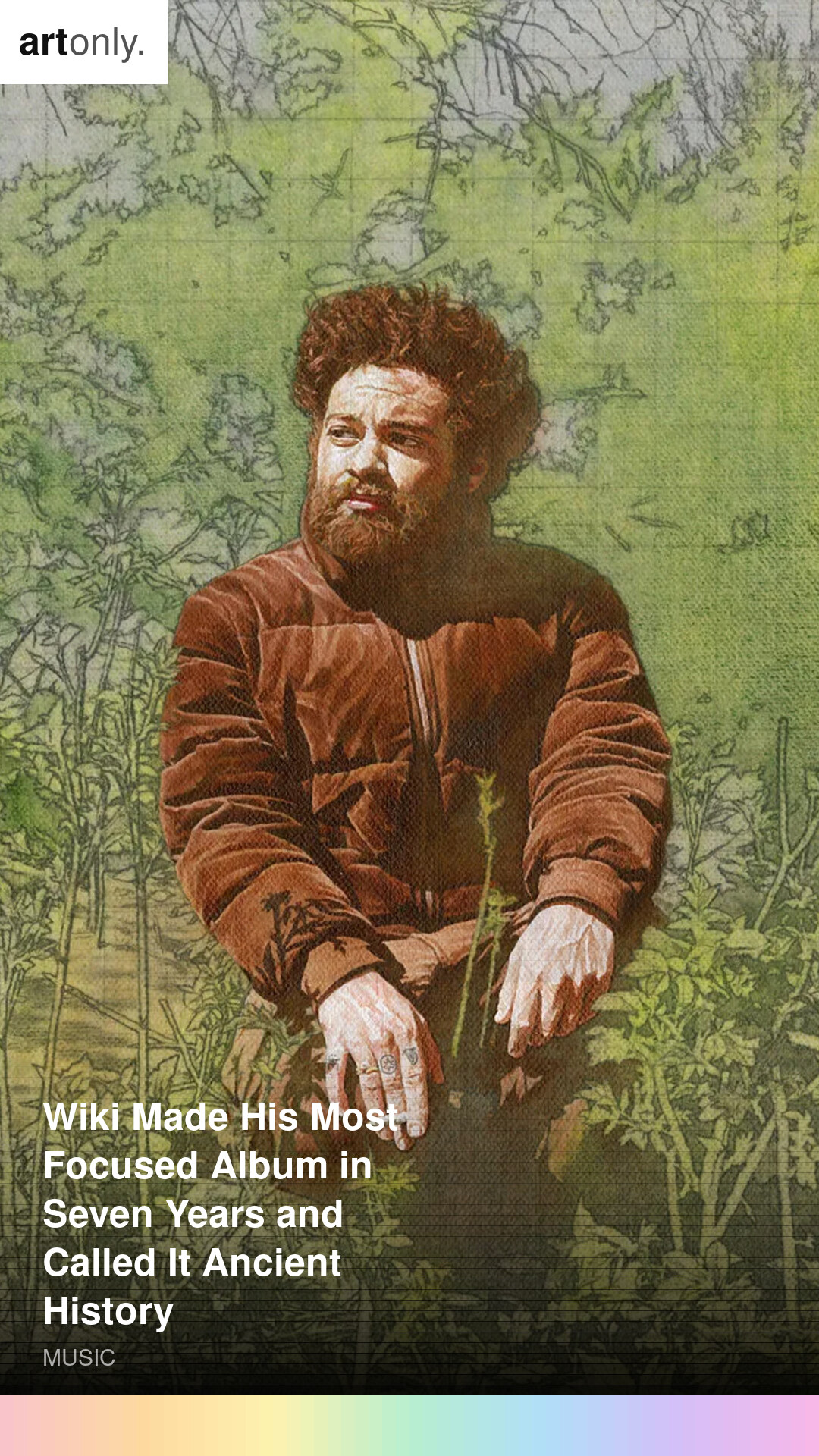
Ancient History is the kind of album that requires context to appreciate fully, though once that context is in place, the record opens in a way that purely formal criticism cannot account for. Wiki, whose real name is Jason Brickman, co-founded Ratking in New York City in the early 2010s alongside P on the Keys and Hak Miller, making music that was so specifically and insistently local, so rooted in a particular set of streets and a particular sensibility of downtown New York, that critics who encountered it often described it with a mixture of admiration and bewilderment. The bewilderment was the evidence of how original the work was. Ratking did not fit any category that existed at the time. They had to be argued into relevance. The argument was correct and they are now understood, at more than a decade's remove, as one of the defining New York rap acts of their moment.
After Ratking dissolved in 2016, Wiki pursued a solo career that produced several projects, with Oofie in 2019 standing as his most complete individual statement before this year. That album, produced entirely by Navy Blue, was a record about intimacy and loss, about the particular texture of life in New York as it was being reshaped by forces that were making the city increasingly inhospitable to the people and the culture that had made it worth inhabiting. Ancient History, released June 12 on his own Wikset Enterprise imprint, covers related ground but from a different vantage point. It has been seven years. The city has changed. The record knows this, and it does not perform nostalgia about it.
The Parks as Method
The conceptual anchor of Ancient History is place in a very specific sense. Wiki has described the album as rooted in the New York City parks he has spent the last several years returning to most: not as symbols, not as scenery, but as part of the ordinary structure of daily life. Places to meet people. Places to write and think. Places to step briefly outside the pace of the city without actually leaving it. This distinction is subtle and becomes musically significant. Park as symbol or concept is something that has appeared in music before. Park as actual recurring location, as the place where particular conversations happened and particular feelings arrived, is more interesting and considerably harder to put into a record.
Park, the lead single, operates exactly in this territory. It is not an ode. It is a documentation. Wiki's voice carries the quality it has always had: unhurried, particular, committed to the specific over the general, capable of making a listener feel that what they are hearing happened at a specific moment in a specific place and that this particularity is not limiting but is precisely the argument. The record as a whole has this quality. The parks of Ancient History are not metaphors for anything. They are locations. The record is their record, and the people Wiki encountered in them are its population.
The Production Coalition
What makes Ancient History something beyond a compelling personal statement is the production roster, which reads like a document of who matters in New York underground rap's present and recent past. The Alchemist, whose ear for samples and whose understanding of how jazz and soul fragments can be reconstituted into something that carries the weight of the original while being entirely new, brings to his contributions a gravity that grounds the more intimate content in tradition. Navy Blue, who produced all of Oofie and appears here on a single track, demonstrates by contrast how much Wiki's sound can shift depending on the collaborator while remaining recognizably his own.
MIKE, appearing under his dj blackpower alias, and Nick Hakim, operating as Dom Maker, bring a more experimental quality to their respective contributions. MIKE's production has always existed at the intersection of noise and intimacy, making music that feels provisional in a way that reveals rather than conceals. Hakim, whose solo work occupies a space between soul and experimental pop, brings something that resists the categories of hip-hop production and enriches the record because of that resistance. The result is an album where the sonic variety is held together not by a unified production aesthetic but by the consistency of Wiki's perspective. He is the constant. The producers are the different angles from which the constant is examined.
Features from Your Old Droog and duendita occupy their positions carefully. Your Old Droog's literary precision complements Wiki's observational approach without overwhelming it. duendita, whose own work has made her one of the more distinctive voices in New York's experimental music underground, brings a register that the record reaches for and achieves.
The Solo Question
Something happens to an artist when they make a record entirely on their own terms, without the structure of a collective or the support of a major label apparatus. The autonomy carries a weight that institutional context tends to distribute and therefore relieve. Ancient History is released on Wikset Enterprise, Wiki's own imprint, which means no filter between what he wanted to make and what was made. The record sounds like this. It does not sound like an album negotiated into existence. It sounds like an album that could only have been made by one person who knew what they needed to say and took the time to figure out how to say it.
The seven-year gap between Oofie and Ancient History is not a concern but a feature. Wiki was not absent from music during those years. He was present in the city, in the parks, in the ongoing conversation about what New York is and what it costs and who it is still for. The album is what that sustained presence produced when it was finally compressed into a studio and a tracklist. What it describes as ancient was not ancient at all. It was happening the entire time. It is still happening. New York does not become the past. It becomes the present again, and you have to stay with it or be left by it. Wiki, on the evidence of Ancient History, stayed. The record is what that choice made.