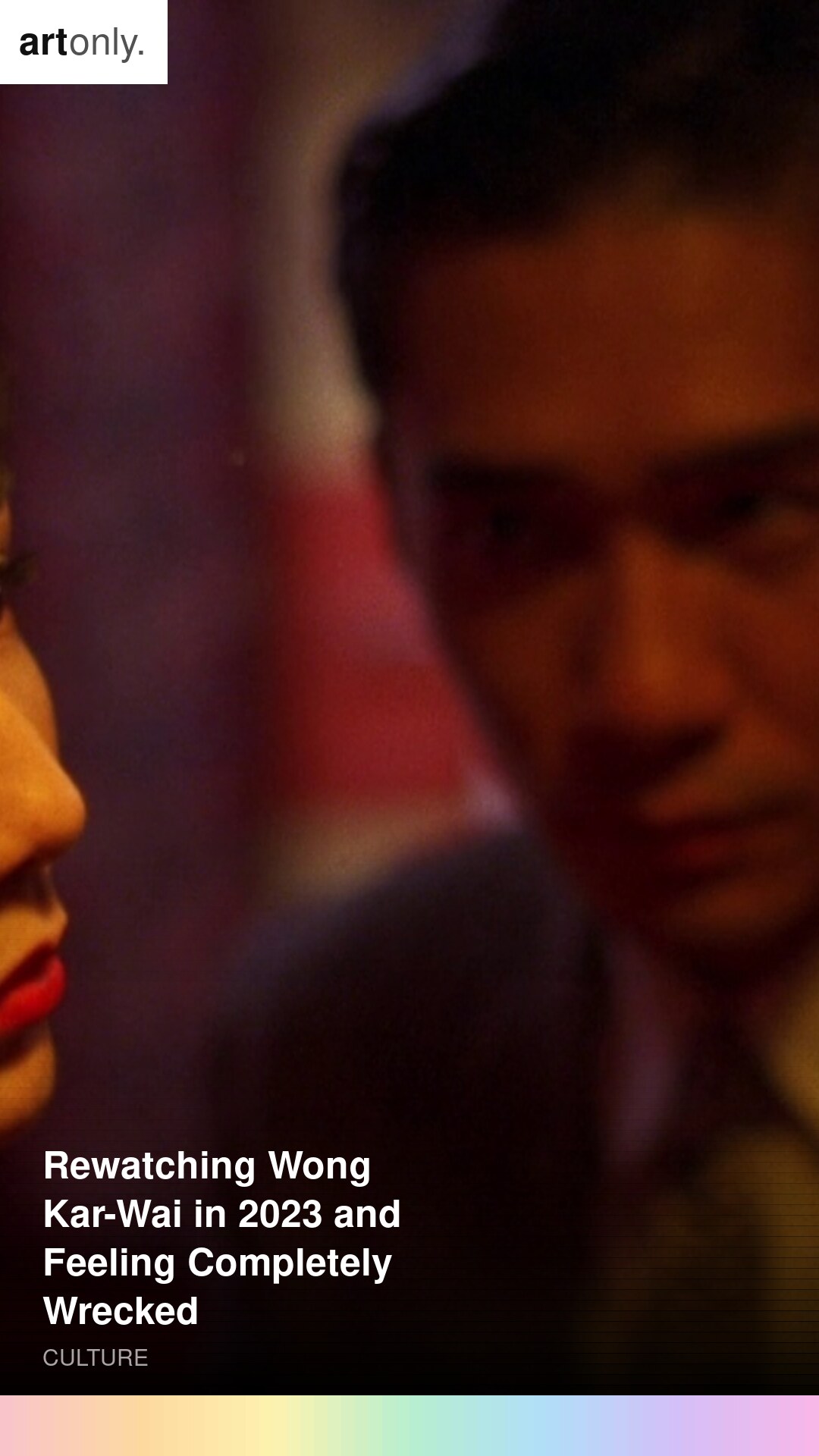
Criterion released a major Wong Kar-Wai box set in 2022 and I've been inside it since, which is the only honest way to describe the experience of spending extended time with his filmography. In. It's a different spatial relationship to cinema than I usually have. You're not watching from outside; you're inside the films, inside the quality of longing they produce, and the way out is not obvious.
Wong Kar-Wai is a Hong Kong filmmaker who makes films about desire and time, specifically about the way time distorts desire, the way things you wanted become more vivid after they become impossible, the way memory is less reliable than yearning but more real than either. His films are structured around missed connections, around the moment of opportunity that passes, around the gap between what was felt and what was said or done.
Chungking Express. Fallen Angels. In the Mood for Love. 2046. Happy Together. The Grandmaster. The films are stylistically various but thematically consistent, and watching them in sequence produces the cumulative effect of being inside a single long film about the impossibility of fully having the thing you want.
What Christopher Doyle Brought
The visual language of Wong's films is inseparable from his longtime cinematographer Christopher Doyle, who shot most of the work through the 1990s and into the 2000s. The handheld movement, the saturated color, the step-printing that gives certain scenes their stuttered quality, these elements were developed by Wong and Doyle in a genuinely collaborative process. The look of the films is not a style imposed from outside. It grew from a working relationship between a director who rarely used scripts and a cinematographer who understood how to be present for moments that could not be rehearsed.
The Criterion restorations make this collaboration newly visible. The transfers capture the grain and texture of the original photography in ways that earlier home video releases could not. Watching Chungking Express in this format, you see what Doyle was doing with available light and fast film stocks. The slight overexposure in certain shots is not a flaw. It is a choice about how the film should feel.
What Time Does in These Films
The technical and formal strategies Wong uses to represent time are extraordinary and have been copied enough that they've entered a kind of visual grammar, but the copies never quite achieve what the originals do. The step-printing, the technique of printing frames multiple times to produce a stuttered, slowed-down quality of motion, is the most obvious element, but it's in service of something very specific: the experience of a moment being simultaneously experienced and remembered, the way time seems to stop and stretch at moments of intense feeling.
In the Mood for Love is the most perfect film in the set, and one of the more perfect films I know. The story of two people who discover their spouses are having an affair, who fall in love with each other, who do not act on it, the not-acting is the whole film, the restraint is the drama, the unsaid is louder than anything that could be said.
Tony Leung Chiu-Wai and Maggie Cheung in that film are doing something in their bodies and their eyes that I cannot fully explain in terms of craft. They are present in those scenes with a quality that the camera seems to be in awe of, that the slow-motion and the narrow corridors and the red walls frame rather than create.
The 2046 Question
2046, the film that Wong spent years making as a companion to In the Mood for Love, is the most complex object in the set. It is a film about the impossibility of return, about the way the past becomes fixed even as the present keeps moving, about desire that has calcified into something more like a wound than a longing. Tony Leung's character in that film is not seeking connection. He is using the appearance of seeking to avoid it. The film knows this and shows it without judgment.
Whether 2046 is as successful as In the Mood for Love is a question the film itself seems to anticipate and refuse to answer. It is looser, more sprawling, less formally perfect. That imperfection is honest about what it is: a film about aftermath, about what you do with feeling after the feeling has finished with you.
Why Now, Why 2023
I keep asking myself what it means that I find this filmography so overwhelming now. The films are set in places and times that I didn't live, 1960s Hong Kong, the decades of change and anxiety that preceded the handover and followed it. But the feelings are not period specific. The longing is not dated. The experience of desire for something that has already passed, or that exists in an adjacent world you'll never fully reach, is not a cultural artifact. It persists.
I watched Fallen Angels at two in the morning last winter and sat with it after in the dark for longer than I should have. I was completely wrecked in the best possible way, the way that art sometimes makes you feel, where the fullness of the emotion is itself the value, where being overwhelmed is the point.
Wong Kar-Wai is a specific kind of wrecking. I recommend it.
The Criterion releases have the quality of gifts, the restoration work, the new essays, the interviews and supplements that provide context without over-determining the viewing experience. But the gift is really just the films themselves, given the presentation they deserve.
I'll be in them for a while longer. There's no clean exit from a filmography this emotionally dense. You just keep returning, keep finding something, keep feeling the specific quality of wrecked that only very good cinema produces.