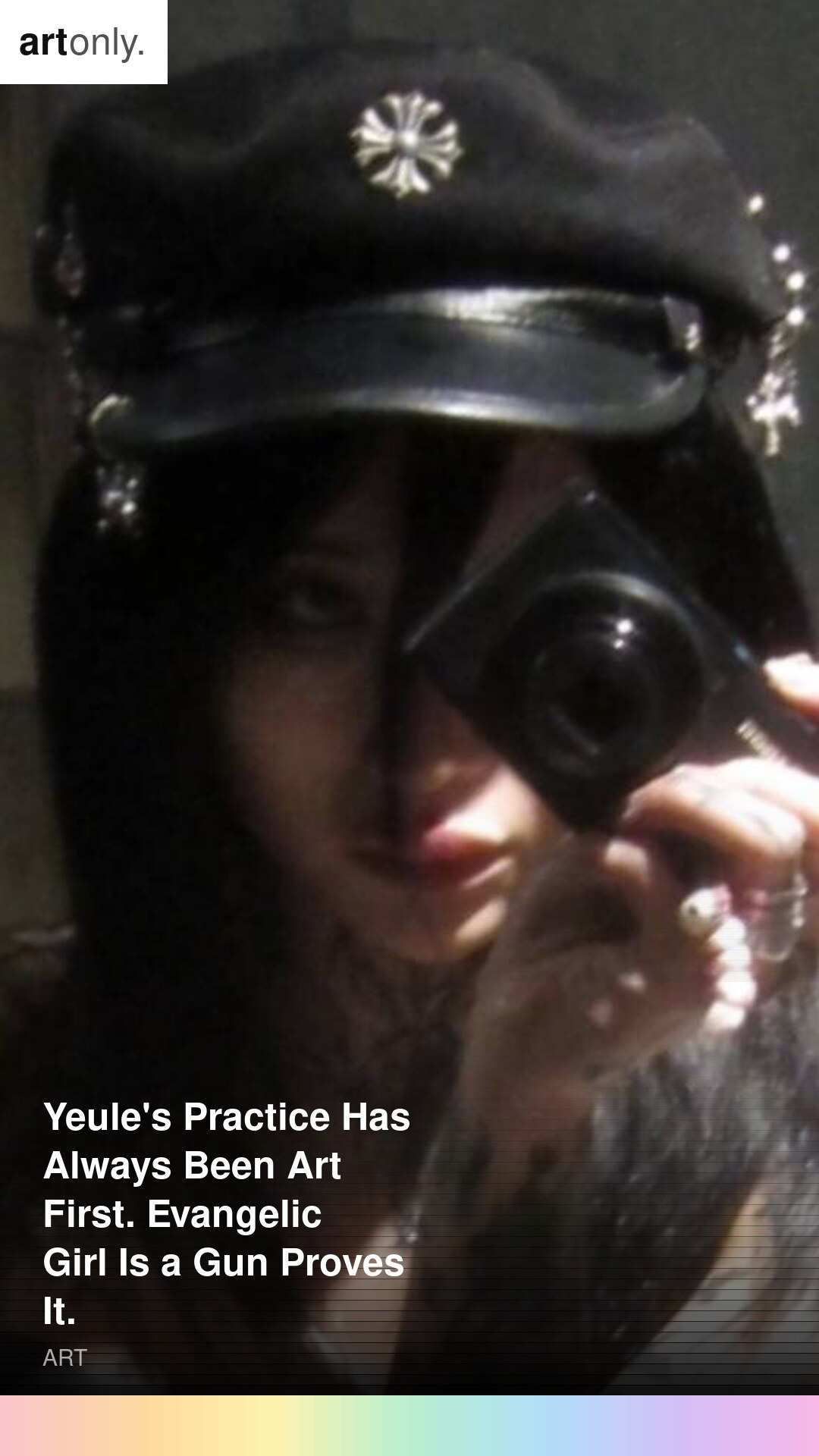
Nat Ćmiel enrolled in Fine Art at Central Saint Martins in London in 2018. The program is not a music conservatory. It is a visual art school where students work across painting, performance, sculpture, and installation. Ćmiel, who records and performs as Yeule, chose that context deliberately. Most musicians who attend art school do so briefly or tangentially. Ćmiel completed the program. The distinction matters.
Born in Singapore and based in London, Ćmiel has spent several years building a body of work that defies the standard categories available to a recording musician. The music is released on labels. It gets reviewed in music publications. It is available on streaming services. None of those facts adequately describe what the practice actually is.
Evangelic Girl Is a Gun, released May 30, 2025 on Ninja Tune, is Yeule's fourth album. The producers involved, Clams Casino, A.G. Cook, Fitnesss, Chris Greatti, Kin Leonn, and Mura Masa, span an unusually wide range of contemporary production approaches. The resulting album moves across trip-hop, soft rock, country, and glitch textures in ways that feel less like genre-blending and more like a painter using all available pigments without apology.
Central Saint Martins and the Conceptual Frame
Fine Art education at Central Saint Martins operates on a principle that is difficult to describe to people outside it. Students are not primarily trained in techniques. They are asked, repeatedly and with increasing pressure, to articulate why they are doing what they are doing. The answer cannot be aesthetic alone. It must be conceptual.
That training is legible in everything Ćmiel makes. The albums are not organized around pop songwriting conventions or verse-chorus structures. They are organized around recurring conceptual motifs: the cyberpunk aesthetic, identity dissolution, the body under technological pressure, the way intimacy survives or fails to survive mediation. These are questions an art student is trained to ask. They are also questions that most music does not attempt.

Painting and Making Music as One Process
Ćmiel paints. This fact is not incidental to the music. They have described the process of writing lyrics as structurally similar to the process of making a painting: a practice of accumulation and revision in which the original intent becomes buried under subsequent decisions, until the finished surface conceals its own origins.
That description matches the listening experience of Yeule's albums. The vocals are processed to the point where the grain of the voice is altered. The arrangements accumulate texture until individual elements are difficult to locate. The finished record does not feel transparent about how it was made. It feels like something that arrived complete, without revealing its construction.
The artwork for Yeule's releases reflects the same sensibility. The covers are designed objects with their own visual logic, not illustrations of the music or promotional materials for the artist's personal image. Evangelic Girl Is a Gun has a cover that critics described as carrying a dark, cyberpunk aura, a visual register that the album's opening sounds then immediately undercut with something brighter and more sun-drenched.

What the Production Credits Say
The list of producers on Evangelic Girl Is a Gun does not represent a coherent aesthetic movement. A.G. Cook is the figure most associated with the PC Music sound, a hyperprocessed synthetic pop that emerged from London in the early 2010s. Clams Casino built a career producing atmospheric sample-heavy cloud rap during the same period. Mura Masa operates primarily in indie-adjacent electronic pop. Fitnesss, Chris Greatti, and Kin Leonn each bring different tendencies from different corners of contemporary production.
The album treats this heterogeneity as a feature. The sounds that emerge are too contradictory to belong to any single aesthetic program. Transitions between tracks do not smooth over the differences between producers. The album sits with the friction rather than resolving it. That is an artist's approach to collaboration, not a label's approach to market positioning.

The Ten Tracks as a Visual Sequence
Tequila Coma, The Girl Who Sold Her Face, Eko, 1967, VV, Dudu, What3vr, Saiko, the title track, and Skullcrusher. The ten titles read as a collection of images rather than a narrative arc. There is no movement from problem to resolution, no emotional journey with a beginning and end. The album accumulates frames.
That structure suits the subject matter. The record is about fragmentation, about identity under conditions that refuse coherence, about what remains of a self when the self is distributed across screens and performances and processed sounds. The title track addresses that tension most directly. The evangelic girl and the gun occupy incommensurable registers of meaning, and the album declines to resolve them.

How Critics Have Described the Work
Album of the Year gave Evangelic Girl Is a Gun a score of 90. Under the Radar described it as a series of vivid portraits well worthy of their own gallery. Paste Magazine called Ćmiel a post-human pop star. The critical reception has largely tracked what the work is actually doing: evaluating the albums in terms closer to art criticism than music journalism, attending to concepts and intentions rather than singles and chart trajectories.
That kind of attention is not guaranteed for artists working in experimental or hybrid spaces. It reflects the clarity with which Ćmiel has positioned the practice from the beginning. When the Central Saint Martins training is visible in an artist's output, as it is here, reviewers who understand that context respond differently. They are prepared to engage with ideas rather than surfaces. Yeule's audience has grown because the work earns that engagement each time.