The first AI-generated works entered major museum collections quietly. No press conferences, no manifestos, no lines drawn in the sand. They appeared alongside human-made work in group exhibitions, identified in wall text but not set apart. The message was clear: this is art. Deal with it.
The art world is dealing with it, but not well.
The Institutional Dilemma
Museums exist to preserve and present cultural artifacts that their curators deem significant. For centuries, the implicit assumption was that these artifacts were made by humans. AI-generated work challenges that assumption at its foundation, and institutions are responding with a mixture of cautious experimentation and deep institutional anxiety.
The cautious experimenters argue that AI is a tool, no different in principle from a camera or a printing press. The art is in the selection, the prompting, the curatorial decision to present it. The anxious respond that there is something categorically different about a tool that can produce output indistinguishable from human creation without human intent.
Both positions have merit. Neither has won.
MoMA and the Anadol Precedent
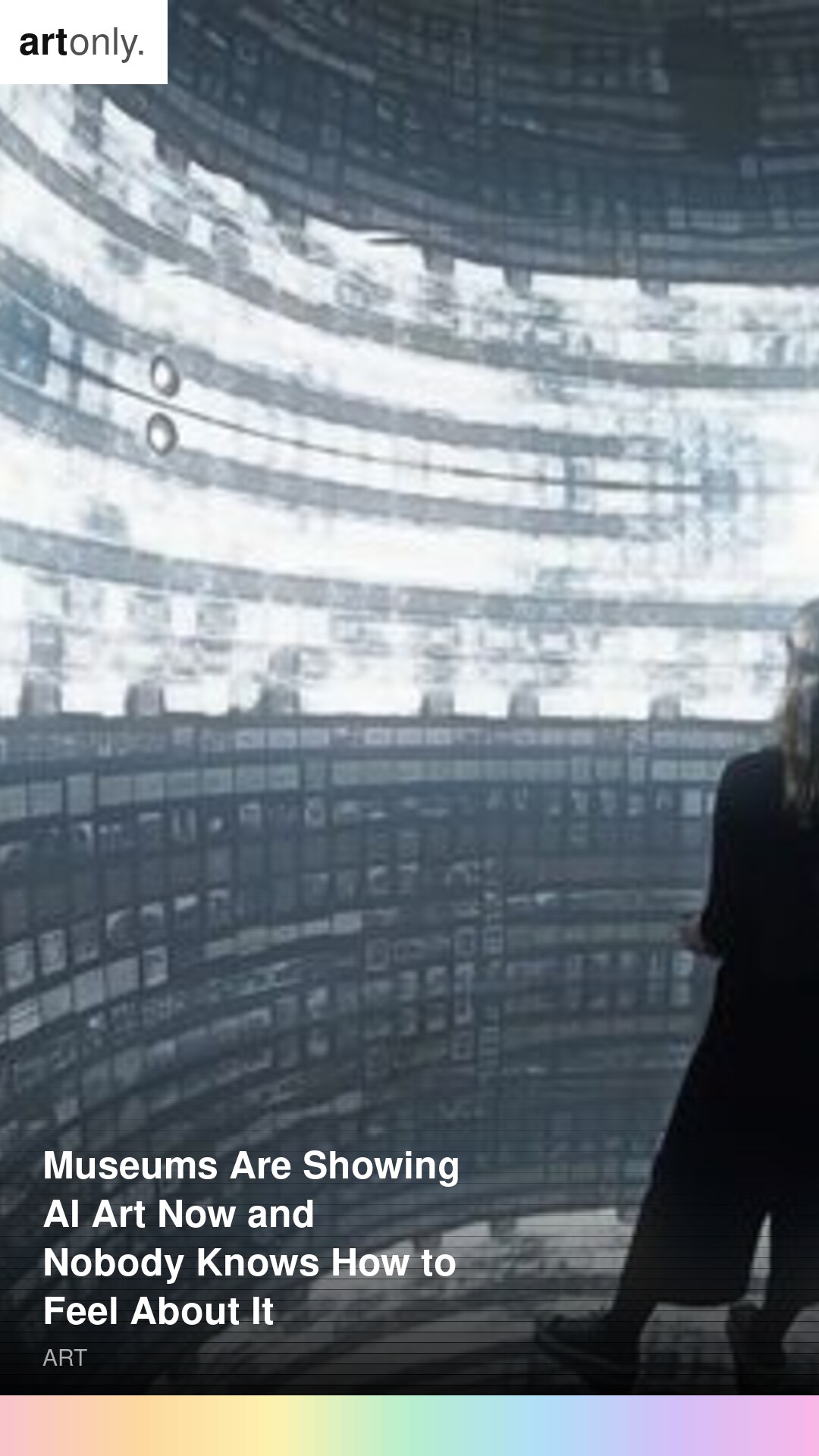
MoMA's 2022 acquisition of Refik Anadol's Unsupervised set the terms for how major institutions would approach AI work. Anadol, a Turkish-American artist who trained machine learning models on MoMA's own collection data, created a large-scale installation that generated fluid, constantly shifting visual forms in real time on a screen in the museum's lobby. The acquisition was not presented as controversial. It was framed as a natural extension of the museum's history of collecting media art.
The Anadol precedent established several things simultaneously: that AI art could enter prestigious collections without scandal, that the framing of the artist as the directing intelligence behind the system mattered more to institutions than the question of mechanical generation, and that immersive scale helped. Unsupervised was hard to dismiss because it was physically overwhelming. You could not look at it and simply conclude it was nothing.
Anadol has since announced Dataland, scheduled to open in June 2026 in Los Angeles at the Frank Gehry-designed Grand LA complex, billed as the world's first museum dedicated entirely to AI arts. Its inaugural exhibition, Machine Dreams: Rainforest, draws on datasets assembled from 16 rainforests globally, in collaboration with the Smithsonian, the Cornell Lab of Ornithology, and London's Natural History Museum. Whatever you think of the work, the institutional ambition is not trivial.
The Artist Response
Working artists have been more direct in their response than institutions. The opposition to AI art in professional creative communities is deep, principled, and increasingly organized. Artists argue that AI models are trained on copyrighted work without consent or compensation, that the technology threatens livelihoods, and that the output lacks the intentionality that defines art.
These are not trivial concerns. The labor question alone, thousands of artists whose work was used to train models that now compete with them, is a genuine ethical crisis that the technology industry has not adequately addressed. When museums collect and exhibit AI work without addressing how that work was made possible, they become complicit in a system that has already caused measurable economic harm to working artists.
Institutions have largely avoided this conversation. Their silence on the training data question while displaying the output is a position, even when it presents itself as neutrality.
What the Audience Thinks
Museum visitors, meanwhile, seem largely unbothered. Studies suggest that most viewers cannot reliably distinguish AI-generated visual art from human-made work when the labels are removed. When told a work is AI-generated, they rate it lower. When not told, they rate it the same as human work.
This disconnect between institutional anxiety, artist opposition, and audience indifference is the defining tension of the AI art debate. The institutions are asking philosophical questions. The artists are asking economic questions. The audience is asking no questions at all.
That audience indifference is not a verdict. It reflects the same dynamic that played out with digital photography, with sampling, with every other technology that entered creative practice faster than the ethical frameworks could follow. The audience consumed the output of those technologies before the underlying disputes were settled. They still consumed it after. The disputes mattered anyway.
The Curatorial Problem
Museums that collect AI work face a curation challenge that does not have a clean solution. How do you write wall text for a work whose authorship is genuinely contested? How do you place it in art historical context when the tradition it belongs to is being written in real time? How do you answer a visitor who asks whether the artist actually made this?
The answers most institutions have settled on are variations of the same evasion: the artist directed the process, the artist made the creative decisions, the AI was a tool. These answers are partially true. They are also designed to preserve the romantic notion of artistic authorship in circumstances where that notion is under genuine pressure. Being honest about that pressure would be more useful than managing it.
The Verdict
There is no verdict. The AI art question will not be resolved by a single exhibition, a single court ruling, or a single critical essay. It will be resolved over decades, through the accumulated weight of practice, policy, and cultural consensus.
In the meantime, the works hang on museum walls, and people look at them, and some of them feel something. Whether that feeling counts as an encounter with art depends on who you ask and when you ask them.
Museums that acquire AI-generated work are making an institutional bet. They are saying that this category of object will matter, that future audiences will want to encounter it in the context of collections that have preserved it. Whether that bet pays off depends on what happens to the cultural and technological context around these objects over the next fifty years. Institutions that acquired video art in the 1970s looked prescient in retrospect. The bets being placed now on AI work will look either prescient or embarrassing by the time the current generation of curators has retired. The stakes are institutional credibility, which is the only thing museums are ultimately preserving.