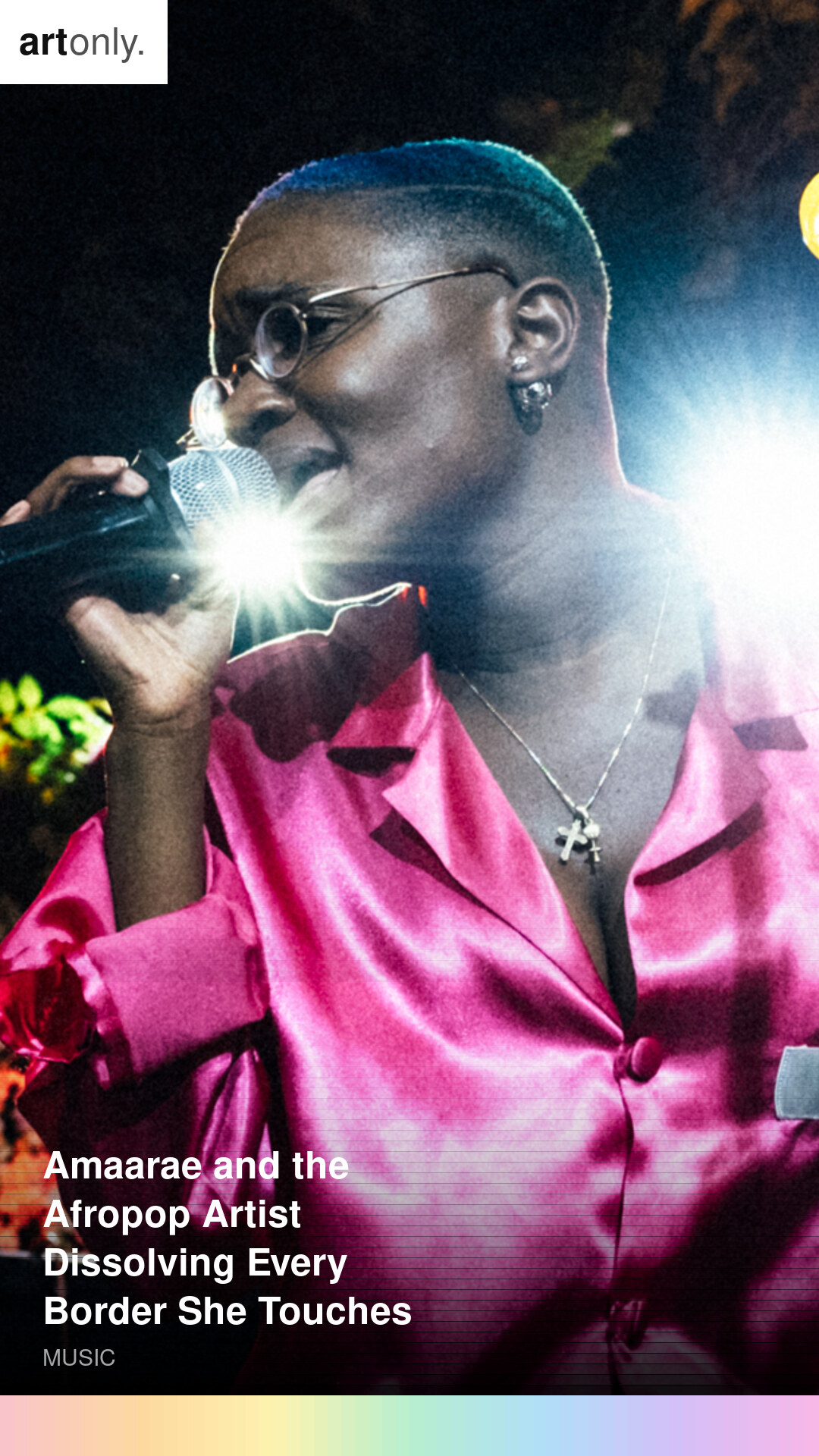
Amaarae's biography is itself a kind of argument about the porousness of borders. Born in the Bronx, raised between Ghana and Atlanta, operating across all of those contexts and several others simultaneously, she makes music that doesn't resolve itself into the categories any single geography would assign it. Her full name is Ama Serwah Genfi, and there is something telling about that gap between the name she carries and the single name she performs under. The abbreviation is not a simplification. It's a focusing lens. The artist who makes Fountain Baby contains everything the full name carries and routes it through something harder to summarize.
This isn't a PR talking point about multicultural identity. It's the actual condition of her creative life, and it shows in the music in ways that are particular and interesting rather than generally cosmopolitan. Highlife. Baile funk. UK garage. R&B. Afropop. These are not ingredients she combines. They are the air she breathes, all at once, and the music reflects that atmospheric condition rather than any recipe.
There's something unsettling about how good this is. Fountain Baby, released in 2023 via Interscope and Republic, is one of those records where the categories you would normally apply keep sliding off. It's Afropop and it's R&B and it's alternative and it's pop and it's none of these things quite accurately. It moves between registers with a fluency that suggests someone who doesn't experience the registers as different things, who inhabits them all simultaneously, who draws on each as the moment requires without the movement feeling like switching codes.
Her voice is central to all of this. It has developed a specific quality, high and delicate in a way that sounds, in the wrong context, like it could be overwhelmed, but it has tremendous carrying power, tremendous emotional precision. She places it in production contexts that could easily crush it and finds, every time, that it doesn't get crushed. It locates itself within the density of the production and speaks clearly through it.
The Song That Changed the Conversation
Before Fountain Baby made the argument at album length, "Sad Girlz Luv Money" made it in three minutes. The track, featuring Kali Uchis and Moliy, went viral in a way that tracks rarely do through simple word of mouth, and it did so because the song is genuinely excellent rather than because of any promotional machinery. The three voices on that record are distinct and fully themselves. Amaarae's contribution is not a feature on someone else's track. It's a declaration of a specific kind of artistic personality, one that can share space without shrinking.
The interesting thing about breakout moments is what they reveal about the work that came before. "Sad Girlz Luv Money" did not create Amaarae's sensibility. It exposed it to an audience that was ready to hear it. The years of work before that moment, the development of a voice and a point of view and a production aesthetic, were what made the song possible. The viral event was a consequence, not a cause.
On Borders and What Happens When They Dissolve
The music that results from genuine living across cultures, not the tourist version, not the studied incorporation of foreign elements for sonic interest, but the music of someone who has actually lived in multiple cultural contexts and carries them all as home, has a specific quality that I find myself returning to and trying to name. It's something about the depth of the influence, the way it goes below the surface into how you hear and what you respond to and what you take for granted. Amaarae's music has this depth.
The Ghana context is not decorative. The Atlanta context is not decorative. The Bronx context is not decorative. They are all present at the level of how the music thinks, not just how it sounds. The rhythmic sensibility, the harmonic decisions, the way the production breathes, these reflect multiple homes. Not a synthesis, not a blending, but a simultaneous presence. The highlife cadences are not citations. The baile funk pulse is not an influence she can name and put down. They are built into the grain of the work.
UK garage contributes something different, a kind of compressed energy, a relationship between rhythm and negative space that the music deploys with real understanding. Listening to Fountain Baby closely, you hear how these traditions interact not as styles imposed on a track but as structural principles that organize the material at every level.
The Premed Years and What They Prove
Amaarae studied premed before committing to music full time. That fact gets mentioned and then quickly dropped in most coverage, but it points to something worth holding. The decision to leave that path for music was not a pivot made from comfort or the absence of alternatives. It was a choice made in the presence of another serious option. Artists who arrive at their practice through that kind of choosing tend to work differently. They bring a focus that isn't available to people who never had to decide. The precision in Amaarae's work, the way every element of a song earns its place, reflects someone who understands what she traded and takes the trade seriously.
On Coachella and What a Stage Reveals
In April 2025, Amaarae became the first Ghanaian artist to perform a solo set at Coachella. The significance of that fact extends beyond the milestone framing it usually receives. Coachella as a cultural indicator has real limitations, and its validation means less than it once did. What the performance actually demonstrated was something more interesting: a stage practice that can hold its own at maximum scale.
Performers who have a genuine relationship with their own material, who didn't just make the songs but live inside them, carry something into the room that audio reproduction can only partially capture. Amaarae has that relationship. You can hear it in how she delivers even the most produced moments. There's a physical quality, a sense of weight and breath. The voice is connected to a body, and the body is connected to something that exceeds craft alone.
The live dimension amplifies everything the records do. The vocal command that sounds almost effortless on Fountain Baby becomes, in a live context, visibly intentional, and that visibility is its own form of expressiveness. The audience is watching someone work, and the work is beautiful.
On Arrival and What Comes After
There's a word I want to avoid, which is "breakthrough," because it implies that something was closed and has now opened, that Amaarae has gone from obscurity to visibility, and that framing diminishes the years of work that preceded the visibility. She has been making music of quality for a long time. What Fountain Baby achieved was not the creation of something new but the extension of something already real to an audience large enough to create a tipping point of cultural conversation.
What I'm interested in now is what comes after that tipping point. Artists who succeed commercially are placed under a specific set of pressures, to repeat, to consolidate, to give the new audience more of what brought them there. The artists who resist those pressures while continuing to grow are the ones worth following through multiple phases. My sense, from everything Amaarae has made and said and done, is that she is one of those artists.
Black Star, her third album, arrives August 8, 2025, through Golden Child Entertainment and Interscope Records. The title carries weight. It positions the work within a longer tradition of Ghanaian and continental African cultural assertion without laboring the point. If Fountain Baby was the record that extended her reach, Black Star is where she decides what to do with the reach. In 2025, the work of the next phase is beginning. I'm watching carefully.
The music demands you let your categories dissolve alongside hers. That's the condition of engaging with it honestly, accepting that your existing frameworks aren't adequate, that you'll need to build new ones, that the building is itself part of the listening. Most art asks less than that. Amaarae asks everything and the asking is worth meeting.