Born in Toulouse. Raised between Dublin, Dakar, Oakland, and New York. Studied at Tisch. Settled in London. anaiis has spent her entire life in transit, and her music sounds like it -- not restless, but rooted in the act of moving itself. Devotion & the Black Divine, her third studio album released last September on 5dB Records, is the first time she sounds like she has arrived somewhere. Not at a destination, but at a clarity about who she is and what her music is for.
The Architecture of Healing
The album opens with "Something Is Broken" -- a title that is also a diagnosis. anaiis lays past pain flat on the table with the quiet authority of someone who has done the therapy, done the journaling, and arrived at the conclusion that some things cannot be fixed, only acknowledged. "There'd be no remedy, no prayer, no better, no saving for me," she sings, and it reads as surrender only until you realize it is actually the precondition for everything that follows.
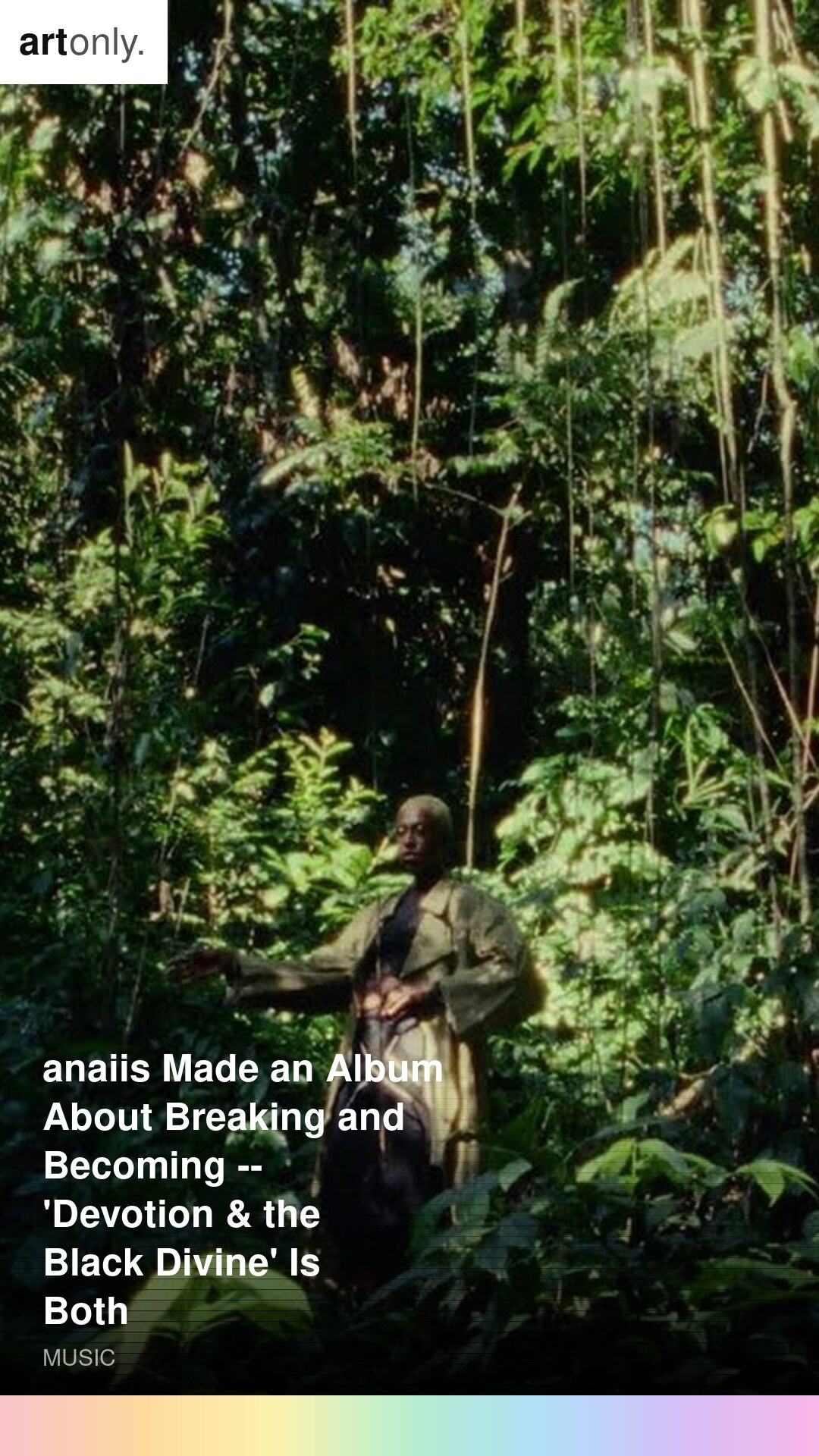
"Deus Deus" arrives next like a prayer whispered in a cathedral that does not exist yet. The word repeats -- deus, deus, deus -- in layered echoes over a soulful reggae drop that should not work but does, because anaiis treats genre the way she treats geography: as something you pass through, not something you belong to. The video, shot in lush tropical forest with director Tayo Rapoport, captures this perfectly -- anaiis standing amid impossible green, a figure neither lost nor found but simply present.
Motherhood as Creative Catalyst
"I've given myself permission to be more experimental on this album," she told Crack Magazine, and you can hear that permission on every track. Recorded live-to-tape between London and Los Angeles, the album carries a warmth that studio polish would have killed. New motherhood runs through the record's DNA -- not as a theme but as a lens. "Here Comes the Sun" captures the isolating shadows that accompany profound change, the midnight loneliness of early parenthood set against slowly building orchestral swells. "My World (Beyond)" transforms that isolation into devotion: "My world revolves beyond me, I found the courage to love."
Her collaboration with Grupo Cosmo in Brazil -- a mini-album improvised in a week with her newborn son in tow -- clearly unlocked something. The looseness of that project bleeds into Devotion & the Black Divine, giving it a spontaneity that her more carefully constructed earlier work sometimes lacked.
The Josh Grant Sound
The production partnership at the heart of this record is not incidental. anaiis wrote and composed every track with producer Josh Grant, and the coherence of the album owes as much to that collaboration as to her own singular voice. Grant's approach leans into the live-to-tape methodology: the record breathes, shifts, and occasionally creaks in ways that feel intentional rather than accidental. Bass lines sit low and warm. Drums have weight without aggression. The strings on "In Real Time" arrive with an ethereal quality that stops short of orchestral grandeur, staying intimate, almost conversational. Grant understands that anaiis's voice is the instrument everything else must serve, and he builds around it accordingly.
That restraint is harder to achieve than it sounds. Lesser productions would have smoothed out the record's rougher edges, the places where the tape hiss lingers a beat too long or a vocal line resolves unexpectedly. Grant leaves those moments intact. The result is an album that sounds lived-in from the first listen, the sonic equivalent of furniture that has actually been sat on.
What Genre Cannot Contain
"Moonlight" is the album's centerpiece -- a slow-burning empowerment anthem that moves from dream-pop shimmer into trip-hop territory before settling on something that sounds like 1970s soul recorded in 2025. "Black, and you know how to walk in your power / Proud, 'cause you know you've put in all the hours," she declares in a cadence that is less anthem and more affirmation. The Observer compared her to Moses Sumney, and the comparison holds: both artists make music too rich for any single genre label, both draw from Ella Fitzgerald, and both understand that lo-fi textures can make soul music feel more intimate rather than less polished.
"Call Me (A/B)" unfolds in two contrasting movements -- quiet solace erupting into sensual intensity, with emphatic drumming driving an infectious R&B groove and anaiis pleading to be taken "higher than psilocybin." It is the album's most ambitious structural choice and its most rewarding. The two-part architecture mirrors the album's broader logic: breakdown followed by becoming, stillness followed by surge.
Interludes as Architecture
The four interludes distributed across the tracklist are not filler. They are load-bearing. "freedom dreaming" [amb's interlude], "an act of togetherness" [amb's interlude], "love and devotion" [Jatovia Gary's interlude], and "every part of my aliveness" [Sanah Ahsan's interlude] function as breath between statements, spaces where the album's emotional logic is allowed to settle before the next track asks something of you. Jatovia Gary is a celebrated visual artist and filmmaker whose spoken contributions here carry weight precisely because they arrive late in the record, when anaiis has already done the groundwork. Sanah Ahsan, a psychologist and poet, gives the album's penultimate interlude a quality that feels less like a bonus and more like a closing argument.
The decision to name these moments explicitly in the tracklist -- crediting their contributors, marking them as interludes rather than hiding them as unlisted tracks -- signals something about how anaiis conceives of community. The album is her singular vision, but it does not pretend to have been made alone. Motherhood taught her that, or confirmed what she already knew.
Closing as Commitment
"Bright Lights" ends the record the way a good last chapter ends a novel: not with resolution, but with forward motion. Where "Something Is Broken" gave us diagnosis, "Bright Lights" offers orientation. The production opens up, the arrangements lift, and anaiis sounds like someone who has put down weight she had been carrying long enough that she forgot it was there. "Dreamer Too" earlier in the sequence established that she is not willing to abandon the idealism that got her here; "Bright Lights" confirms she intends to take it somewhere new.
The full 14-track arc -- from fracture to light, with interludes marking the transitions -- is the kind of deliberate album sequencing that is increasingly rare when streaming logic rewards front-loaded singles over sustained listening. Devotion & the Black Divine resists that logic entirely. It rewards the full run.
The Verdict
anaiis has been named to IMPALA's 100 Artists to Watch for 2026, and she performs at SXSW London in June. IMPALA, the independent music trade body that represents the European independent sector, has been right more often than not about whose career is about to change shape. The recognition matters in this context because anaiis has built her following through critical attention and devoted listeners, not playlist placement or algorithm-driven virality. That foundation holds.
But Devotion & the Black Divine does not sound like an artist reaching for a bigger audience. It sounds like someone reaching inward and finding more there than expected. That is rarer, and it lasts longer.