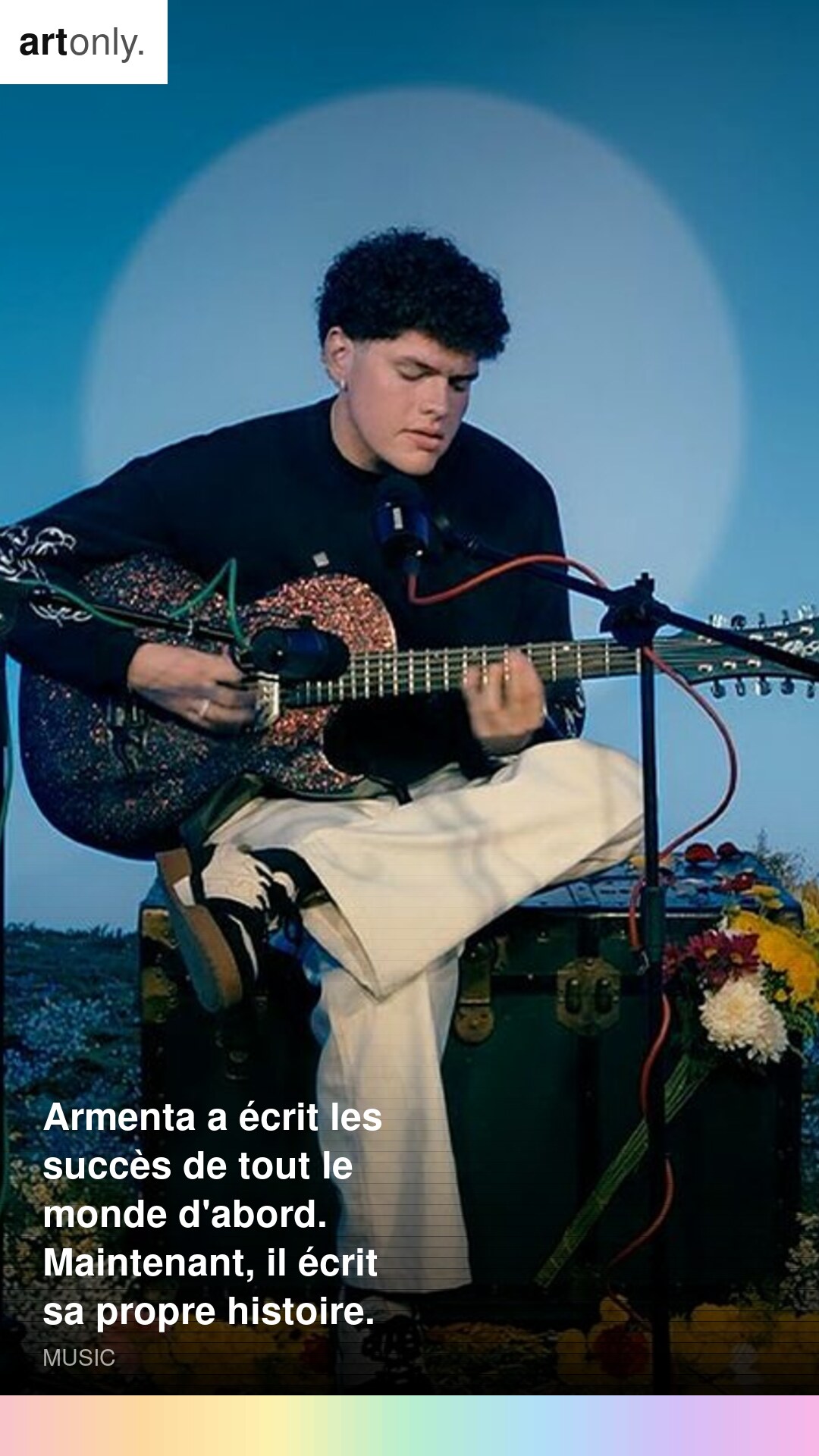
There is a particular kind of invisibility that comes from being the person behind the person everyone knows. Miguel Armenta, known simply as Armenta, spent the better part of five years writing songs that other people performed, songs that accumulated hundreds of millions of streams under other people's names. SABOR FRESA for Fuerza Regida. DOS DÍAS for Tito Double P and Peso Pluma. HARLEY QUINN with Marshmello. The catalog of songs he has written for others reads like a greatest-hits compilation for the corrido tumbado moment. And yet almost nobody outside the industry knew his name.
Pórtate Bien changed that.
The Album That Made the Case
Released in 2025, Pórtate Bien is not the album of a man discovering his voice for the first time, it is the album of a man who has been developing that voice in private for years and is finally ready to let the room hear it. Born in Los Mochis, Sinaloa, and shaped by the border culture of Tijuana, Armenta brings a hybrid identity to the record that runs deeper than genre-blending. The songs sit at the intersection of corridos tumbados, indie rock, boleros, and reggaeton in a way that does not feel like a mood board but like lived experience, the natural result of growing up where Mexican folklore and English-language music exist in the same cultural moment.
His voice is softer than you might expect for a genre whose aesthetic often runs toward assertiveness. That softness is deliberate and it is the record's most interesting quality. Tracks like PENSANDO Y PENSANDO and BUSCÁNDOTE have a melodic vulnerability that the corridos world rarely permits, and Armenta deploys it without apology. He has said that his tagline, Pórtate Bien, behave yourself, is as much a mission statement about honesty as it is a piece of moral instruction. The music backs that up.
The album spans 15 tracks and moves without apology between registers. Aching indie rock sits alongside steely corridos. Flirtatious reggaeton Mexa gives way to heartfelt boleros. The range would feel scattered in less confident hands. What makes it cohere is storytelling: every track is rooted in a specific emotional situation rather than a genre exercise, and Armenta's years of writing for others taught him exactly how to build a song around a moment rather than a sound.
The Formation of a Songwriter
Armenta grew up singing in his Catholic school choir in Los Mochis, Sinaloa, an origin that explains both his natural facility with melody and his instinct for songs that carry emotional weight rather than simply project attitude. Sinaloa is the geographic and spiritual center of the corrido tradition, a genre with roots in early twentieth-century narrative balladry that documented border life, conflict, and daily existence in northern Mexico. Growing up surrounded by that tradition, visiting the family land regularly, gave him a deep connection to the form's storytelling logic.
Moving to Tijuana introduced a second layer of influence. Tijuana sits at one of the most culturally charged borders in the world, and its musical output reflects that position, norteña rhythms absorbing R&B cadences, Spanish and English occupying the same verse, the corrido tradition processed through a generation with access to SoundCloud, reggaeton, and American rock. Armenta did not treat these inputs as contradictions to be resolved. He built his writing practice around their coexistence.
The result, across hundreds of songs written for other artists before his own debut, was a catalog that spans more tonal and stylistic range than most writers working in any tradition, let alone the relatively narrow genre space of corridos tumbados. By the time Fuerza Regida performed SABOR FRESA and Peso Pluma and Tito Double P released DOS DÍAS, Armenta had already figured out what he wanted to say. He was waiting for the right moment to say it under his own name.
What Tijuana Actually Sounds Like
The Tijuana border is one of the most culturally generative environments on earth, and it has been underrepresented in the global conversation about Latin music despite producing a disproportionate share of its innovation. Armenta's music is a direct product of that geography, the way norteña rhythms bleed into R&B, the way Spanish and English share the same sentence in casual speech, the way the corrido tradition gets filtered through a generation that grew up with equal access to American pop and Mexican folk.
This is not the Mexico City version of Mexican music, polished for national broadcast and international export. It is the border version, rougher in texture, more syncretic in form, more directly connected to the daily life of people navigating two cultures simultaneously. Armenta is clear about this origin and refuses to sand it down for broader consumption.
With 7.2 million monthly Spotify listeners and a new album UN LEÑO already out in 2026, Armenta is no longer invisible. He performed at Mexico City's ARRE Festival before Pórtate Bien even dropped, delivering songs he had written for others to an audience that was starting to understand he was the connective tissue holding several of the genre's biggest moments together. The transition from songwriter to frontman is one of the most difficult moves in music, the skill sets are different, the exposure is different, the vulnerability is different. Armenta has made it look almost effortless, which is the surest sign that the work was put in long before anyone was watching.
The Songwriter as Frontman
The specific difficulty of the transition Armenta has made is worth naming. As a songwriter writing for others, the work is evaluated by a different standard. A song is a song: does it serve the artist who performs it, does it connect with the audience, does the narrative land. The songwriter's own personality is not on the line in the same way.
As a performing artist, the music becomes inseparable from the person making it. The vulnerability is different in degree and kind. The creative instincts that made Armenta an exceptional songwriter, the precision about emotional truth, the willingness to write from soft rather than hard positions, the range of genre reference, are exactly the instincts that make Pórtate Bien feel personal rather than commercial. But those same instincts require the performer to be present in the work in ways that are more exposed than the craft-based anonymity of songwriting.
The ARRE Festival performance, delivered to an audience that knew the songs from other artists' mouths, was a kind of reclamation. These were Armenta's songs, performed for the first time by the person who wrote them for himself. The audience's reception confirmed what the album would later demonstrate on streaming platforms: the original version is the right version.
The Ongoing Argument
What Armenta represents, at his best, is a version of música mexicana that refuses to choose between its roots and its ambitions. He is not trying to crossover in the traditional sense, not softening the edges or removing the distinctly Mexican elements to reach a broader audience. He is betting that the audience will follow the music if the music is honest enough. So far, the numbers suggest he is right. The more interesting possibility is that he is building something with a longer shelf life than the trends that surround him, music that sounds specific enough to last.
Corridos tumbados as a genre has accumulated enormous commercial momentum in the past five years, and with commercial momentum comes the pressure to standardize, to produce what the algorithm rewards, to reduce the form to its most replicable elements. Armenta's instinct runs the other direction. The softness, the melodic vulnerability, the genre range of Pórtate Bien are all choices that resist standardization. They are the choices of a writer who knows what makes a song last rather than what makes it trend.