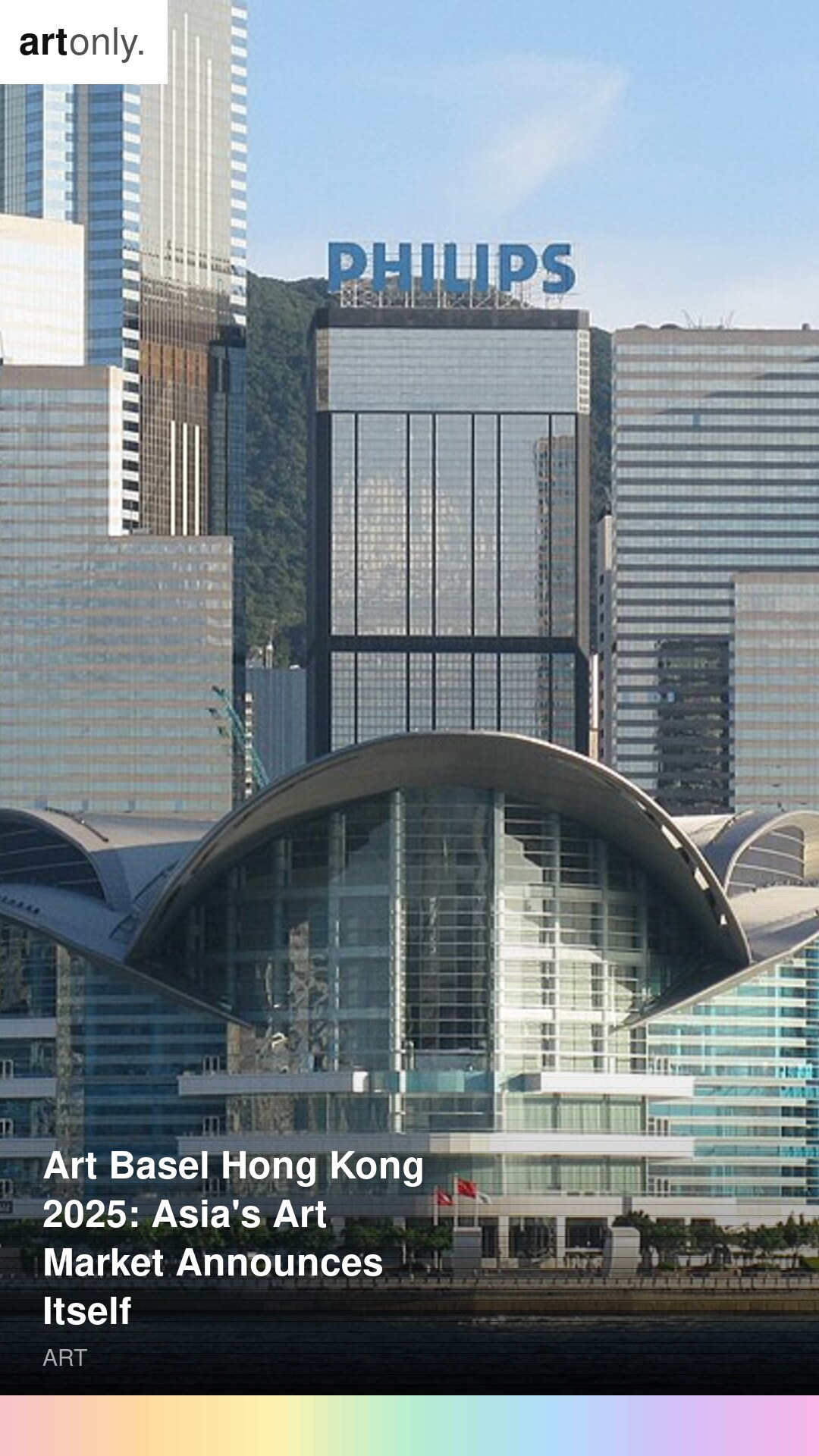
Art Basel Hong Kong returned in late March with 240 galleries from 42 countries, drawing 91,000 visitors from over seventy countries. More than half of the participating galleries came from the Asia-Pacific region, a proportion that underlines the fair's role as the primary marketplace for Asian contemporary art.
The twenty percent attendance increase from 2024 was not a soft number. It reflected genuine collector activity, institutional engagement, and a renewed confidence in Hong Kong's position as the axis of Asia-Pacific art commerce. Whatever geopolitical and economic headwinds the region has been navigating, the art market's presence in Hong Kong is not retreating.
The Sales
The numbers told a story of cautious but genuine strength. Yayoi Kusama's INFINITY-NETS [ORUPX] from 2013 sold for 3.5 million dollars at David Zwirner, the highest reported sale of the fair. The work belongs to the INFINITY-NETS series that Kusama began in the 1950s, the sale price reflects both the artist's sustained global demand and the specific appetite in Asia for her work. A Louise Bourgeois bronze, Cove (1988, cast 2010), went for 2 million at Hauser and Wirth, acquired by an Asian private collection. Michaël Borremans's Bob (2025) achieved 1.6 million and was acquired by the Corridor Foundation in Shenzhen, a significant institutional placement. Zeng Fanzhi's Untitled (2024) sold for 1.5 million, also at Hauser and Wirth. Roy Lichtenstein moved for 1.5 million at Thaddaeus Ropac. Takashi Murakami's new gold leaf work sold for 1.35 million at Perrotin. Christina Quarles's Push'm Lil' Daisies, Make'm Come Up (2020) sold for 1.35 million.
The mid-range market proved particularly active. Works priced between fifty and one hundred thousand dollars saw the strongest and most consistent demand. HdM Gallery achieved a complete sell-out of its booth, which featured twenty works on paper by Chinese-French Modernist Sanyu priced between approximately 27,000 and 48,000 dollars. A complete booth sell-out at those price points, across twenty works, is a meaningful result, it indicates genuine collector engagement rather than a market that moves only at the top.
Who Was in the Room
Ultra-wealthy collectors were present throughout the fair but making deliberate choices rather than impulse acquisitions. The mood, as described by multiple dealers, was selective. Buyers who arrived with specific intentions executed on them. Speculative buying, the practice of acquiring work primarily to resell it, was less visible than in earlier peak years. This is the kind of market that galleries prefer: slower in total volume, more stable in price support, composed of buyers who intend to live with what they acquire.
Institutional patrons were also active. The Corridor Foundation's acquisition of the Borremans at Hauser and Wirth was one of several placements that went directly to institutional collections rather than private holdings. Institutional buying at a fair of this kind is a quality signal, it means curators with professional standards of judgment are finding work worth acquiring.
The Discoveries Prize
The inaugural MGM Discoveries Art Prize went to Korean artist Shin Min and gallery P21 for the installation Ew! There is hair in the food!! The fifty thousand dollar prize came with an exhibition opportunity in Macau, establishing a new pathway for emerging Asian artists that the fair is clearly developing as a systematic program rather than a one-time gesture.
Shin Min's work sits at the intersection of personal and domestic experience and formal installation practice. The title's deliberate bathos, mundane disgust elevated to gallery space, is characteristic of a certain strand of contemporary Korean art that processes everyday life through irony and material precision. The Prize's selection of this work, for the inaugural edition, signals a willingness to recognize work that is culturally specific and formally playful rather than gravitating toward the institutional center.
The M Plus Commission
Ho Tzu Nyen's Night Charades, presented on the M Plus facade, reimagined iconic Hong Kong film scenes through animation. Co-commissioned with Art Basel and presented by UBS, it was a reminder that the fair's influence extends beyond the convention center walls. The M Plus museum, which opened in 2021 as the first museum of visual culture in Asia of its kind, has become one of the defining institutional presences in Hong Kong's cultural landscape. Its collaboration with Art Basel on commissions of this kind extends the fair's footprint into the public realm.
Night Charades used the building's exterior as a screen, repurposing the visual archive of Hong Kong cinema through the specific lens of Ho Tzu Nyen's practice, which consistently examines how images circulate and transform across cultures and histories. The scale of the facade, one of the largest museum facades in the region, made the work visible from the waterfront and from across Victoria Harbour, giving it an audience far larger than any single gallery booth.
The Structural Argument
Art Basel Hong Kong is not a satellite of the Basel mothership with Asian inventory. It is a genuinely distinct fair with its own character, collector base, institutional relationships, and critical priorities. More than half the galleries come from Asia-Pacific. The prize programs are oriented toward Asian artists. The institutional commissions engage with Hong Kong's specific cultural history.
The twenty percent attendance increase is the market's way of confirming what the fair's structure has been asserting: Asia is not a secondary market. It is a primary one, with its own logic, its own hierarchy of value, and its own version of what matters in contemporary art. If the rest of the global art world is paying attention, the 2025 edition provided adequate evidence.
The Takeaway
Hong Kong drew twenty percent more visitors than in 2024. The market tone was selective but present. The institutional acquisitions were significant. The inaugural prize program introduced a new support structure for emerging Asian artists. If this is what cautious optimism looks like in Asia's art market, the rest of the world should be paying attention.
Hong Kong confirmed in 2025 what the previous two editions had begun to argue: the most consequential art market conversations are no longer taking place exclusively in the West.