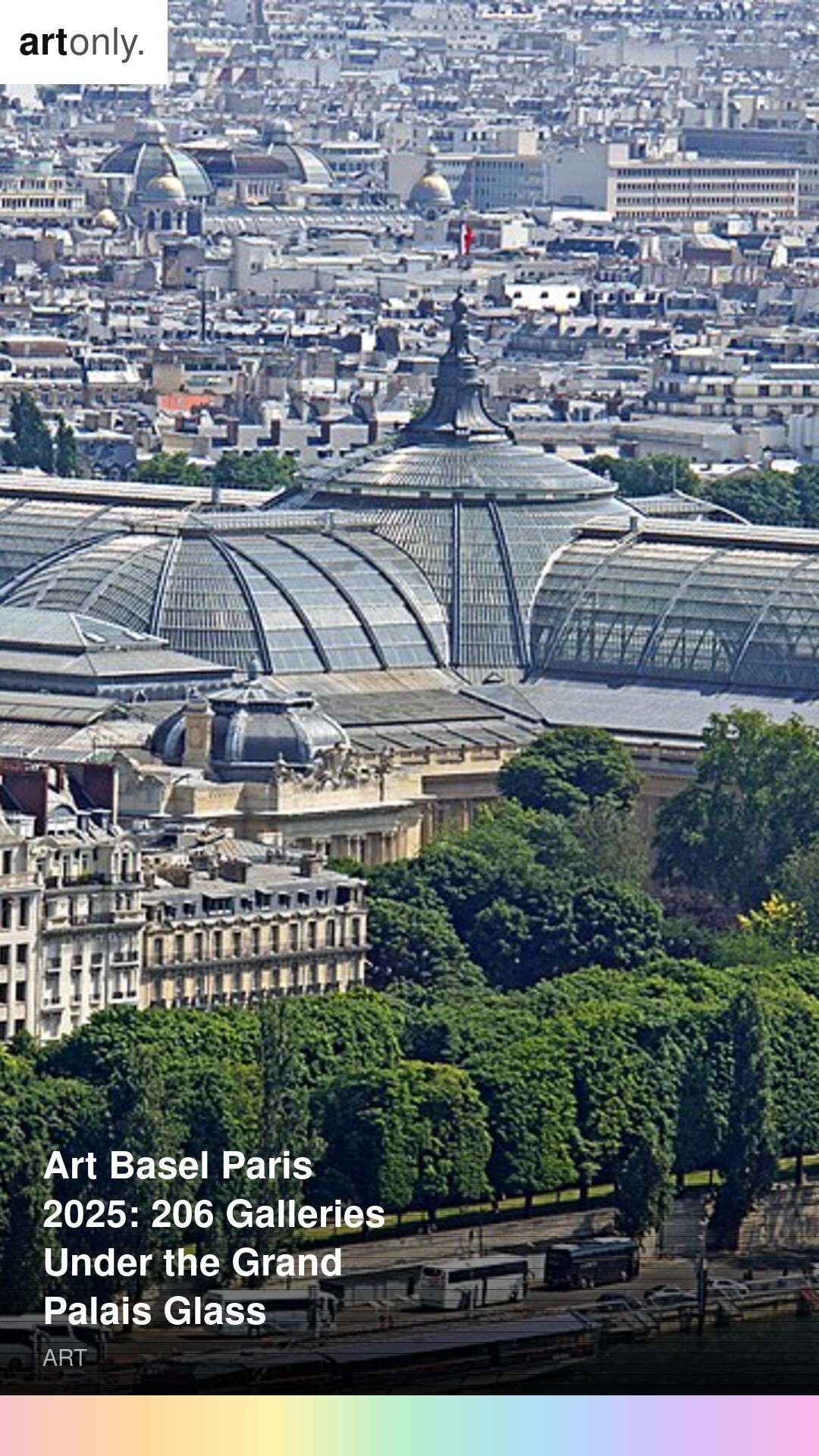
Art Basel's Paris edition brought 206 galleries from 41 countries into the Grand Palais in late October, including 63 based in France and 25 newcomers. Under the iconic glass roof, the fair positioned itself as both a marketplace and a cultural event inseparable from the city around it.
The fourth edition of Art Basel Paris closed with more than 73,000 visitors across its public days, a number that confirmed the fair's status as the primary international art market event in the French capital, despite Paris hosting several competing fairs across the calendar year.
The Sales
The Avant-Première preview format, which gave select galleries access to VIPs earlier than the standard preview, produced the fair's largest sales. Hauser and Wirth led with Gerhard Richter's Abstraktes Bild (1987) selling for twenty-three million dollars, the highest reported sale of the entire fair and one of the largest single art market transactions of 2025. At White Cube, Julie Mehretu's Charioteer (2007) sold for 11.5 million. Pace placed Amedeo Modigliani's Jeune fille aux macarons (1918) for just under ten million, and Agnes Martin's Children Playing (1999) for 4.5 million. David Zwirner reported multiple seven-figure results including a Ruth Asawa hanging sculpture for 7.5 million and a Martin Kippenberger painting for five million.
The mid-range performed strongly across the fair's duration. Brussels dealer Xavier Hufkens's booth nearly sold out by the closing day. At the Cour de l'Hôtel de la Marine, Almine Rech sold Joël Andrianomearisoa's large-scale textile installation Les Herbes folles du vieux logis (2020 to 2025) for 250,000 dollars, a placement that confirms growing international collector interest in work from the African continent.
The Emergence sector showcased radical new projects by rising artists, while Premise offered singular curatorial proposals intended to broaden the understanding of art history. Thirteen panel discussions ran across three days at the Petit Palais, conducted in both English and French, a bilingual program that reflects Paris's genuine position at the intersection of the Anglophone and Francophone art worlds.
Paris as Context
What makes Art Basel Paris distinct from its sibling fairs is the city itself. The October edition coincided with major museum programming across the capital. The Fondation Louis Vuitton staged a Gerhard Richter retrospective. The Fondation Cartier opened brand-new spaces on Place du Palais-Royal. The Bourse de Commerce mounted a Minimalism exhibition from the Pinault Collection. The Musée d'Art Moderne presented solo shows for George Condo and Otobong Nkanga.
No other Art Basel edition benefits from this density of institutional programming. Collectors and curators who come for the fair stay for the museums. The cultural infrastructure of Paris turns a four-day art fair into a week-long immersion. This is not accidental, the October timing was chosen precisely because it aligns with a moment when French institutional programs are in full swing after the September reopenings. The fair does not compete with the museums. It operates in dialogue with them.
The Grand Palais itself contributes a spatial quality no other Art Basel venue provides. The glass and iron structure, built for the 1900 Universal Exposition and renovated extensively before reopening, admits natural light that changes through the day and with weather. Gallery booths under that roof have a quality of illumination that convention center spaces cannot replicate. Art looks different in natural light. Several dealers noted this year that works they had seen in other contexts appeared differently in the Grand Palais, warmer, more material, more alive.
The French Contingent
With sixty-three French galleries participating, Paris remains the edition most rooted in its local scene. This proportion, nearly a third of total participating galleries, is higher than any other Art Basel edition achieves with its host country. The result is a fair that feels embedded in the Parisian gallery ecosystem rather than descending on it from outside.
Newcomers to the 2025 edition included Crevecœur from Paris, Jan Kaps from Cologne, David Nolan from New York, and Stevenson from Cape Town. The presence of Stevenson, one of the most respected galleries working with African and South African artists, alongside Paris-based newcomers represents the fair's stated commitment to broadening the geographic range of its exhibitor list without losing the local character that makes the Paris edition specifically Parisian.
The Premise sector, in its second year, presented twelve single-artist exhibitions framed around curatorial arguments about underrepresented histories and recalibrated art historical narratives. This is the section where the fair's intellectual ambitions are most visible, not the primary sales floor, but the space where the fair performs its relationship to art history as an ongoing argument rather than a settled canon.
The Atmosphere Argument
The most consistent thing dealers reported from Paris 2025 was atmosphere. Multiple exhibitors described a mood of genuine engagement, collectors who came to look, to think, and to make decisions driven by conviction rather than trend. Xavier Hufkens's near-sellout was attributed partly to this: buyers who arrived knowing what they wanted and the fair giving them the context to act on that knowledge.
Paris generates this atmosphere better than any other city on the Art Basel circuit because Paris is a city that takes aesthetic experience seriously as a civic value. The museums are full on weekday afternoons. The bookstores sell art criticism. The restaurants treat their work as craft. Collectors who come to Paris for the fair arrive already in a state of heightened attention that other cities don't reliably produce.
This is a real competitive advantage, and it shows in the sales.
The Paris edition's decision to use the Grand Palais rather than a convention center is not merely logistical. It positions the fair as a cultural event rather than a trade show, which attracts a different visitor and signals a different set of values to exhibitors. The galleries that do well in Paris are not always the same galleries that dominate Basel Switzerland or Miami. The context rewards different things. That differentiation within a single fair circuit is one of the most sophisticated things Art Basel has accomplished.