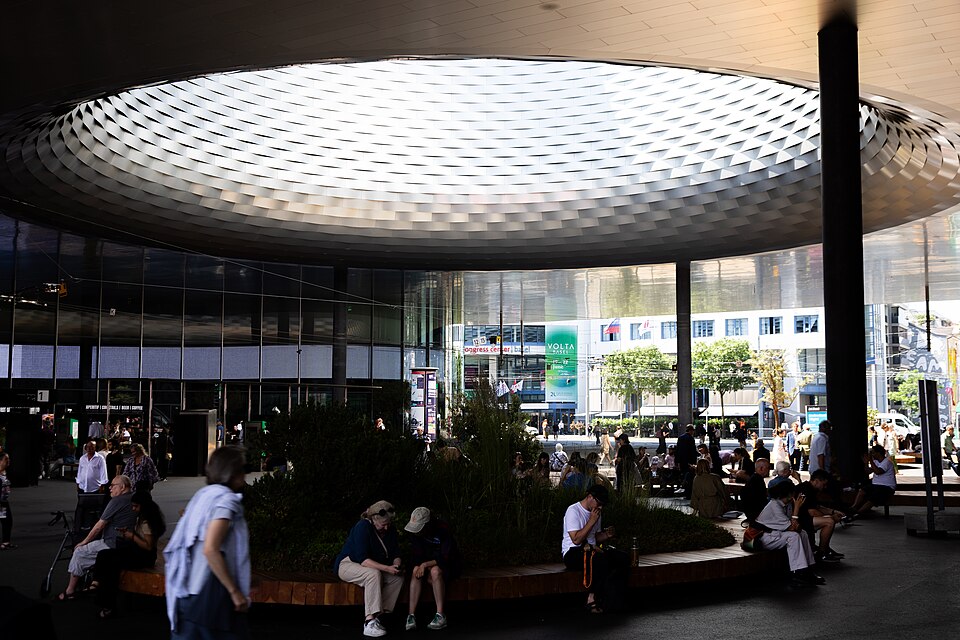
The mothership edition of Art Basel returned to Switzerland in June with 289 galleries from 42 countries and 88,000 visitors across six days. If Hong Kong signaled cautious optimism, Basel confirmed it.
The sales were serious. David Hockney in the range of thirteen to seventeen million. A Ruth Asawa sculpture at 9.5 million through David Zwirner. Gerhard Richter at 6.8 million. Two new Dana Schutz paintings moved for 1.2 million and 850,000 respectively. The blue-chip market was buying.
Katharina Grosse Takes the Messeplatz
The standout moment was not inside the halls. Katharina Grosse created CHOIR (2025), a site-specific chromatic intervention across the entire Messeplatz, the public square outside the Messe Basel convention center. At more than 5,000 square meters, it is the largest work Grosse has created in an urban center.
Grosse applied magenta to the square's surfaces. Magenta because it is the most visually legible color to the human eye in outdoor settings, the hue that asserts itself most forcefully against daylight, architecture, and ambient visual noise. Curated by Natalia Grabowska of the Serpentine, the piece functioned as both announcement and argument: the fair's most powerful art does not need walls, and the public square is as valid a site for serious contemporary practice as any museum interior.
CHOIR was impossible to miss for anyone walking toward the Messe from the city center. It was also impossible to ignore, the scale and the color made it an involuntary experience rather than an elective one, which is the condition that distinguishes genuinely public art from art that happens to be located in public space. Visitors who had no intention of attending the fair encountered it. Locals who had no interest in the art market walked through it on their way to work. This contamination of the ordinary by the extraordinary is what the best public commissions do, and Grosse achieved it completely.
Unlimited
The Unlimited sector, curated by Giovanni Carmine, Director of the Kunst Halle Sankt Gallen in his fifth consecutive year in the role, featured 68 monumental installations. It remains the world's largest platform for large-scale contemporary art, and in 2025 it reinforced its position as the section where artists take their biggest swings.
The selection included monumental installations, towering sculptures, immersive video projections, and sprawling wall works. The sector's unique characteristic, the rule that participating works must be made specifically for the space, at a scale that cannot be accommodated in standard gallery or museum contexts, means that Unlimited consistently shows work that exists nowhere else and can be seen only in Basel during the fair week. This is a powerful curatorial constraint that forces genuine ambition.
For collectors, Unlimited presents a specific acquisition challenge: the works are enormous, require institutional-scale wall space or floor space, and are priced accordingly. The buyers are typically institutions rather than individuals. The placement of an Unlimited work in a museum or major private collection is a significant commitment that takes months to arrange. The fact that galleries continue to present work here, year after year, confirms that the sector produces results, not immediately, not uniformly, but with the kind of long-term institutional engagement that matters for artists' careers.
The Premiere Sector
A new addition for 2025: Premiere featured ten galleries each showing work by up to three artists, all made in the past five years. The constraint, recent work only, presented by galleries making their first appearance in this dedicated sector, functioned as a deliberate counterweight to the Unlimited sector's emphasis on major established figures.
Premiere was a signal that Basel is not only a museum-quality marketplace for validated names but a launchpad for emerging voices. The ten galleries selected brought artists whose work has not yet achieved the kind of secondary-market confirmation that characterizes the main gallery section. The fair's endorsement, at this level of visibility, matters for how those artists are subsequently positioned in the market.
New Collectors
The demographic shift was visible throughout all six days. A new generation of buyers in their thirties, startup founders, investment bankers, inheritors who have been building collections for five to ten years rather than five to ten months, entered the fair with insured collections valued between 300,000 and one million euros. These are not first-time buyers. They are buyers who have moved past the beginner phase and are making decisions that require the kind of judgment that comes from sustained engagement with the field.
This cohort buys differently from the previous generation of comparable wealth. They research more deeply before arriving. They are less susceptible to the pressure dynamics of the VIP preview hours. They are more willing to leave the main fair for satellite events and emerging gallery programming. And they are building collections with a coherence that the speculative buyers of the boom years rarely achieved.
The future of collecting is younger than the art world expected, and it is spending with more intention than the market sometimes credits.
The Overall Reading
Basel 2025 was a confident edition. The CHOIR commission was the kind of curatorial risk, enormous in scale, entirely public, impossible to control or predict in its effects, that only a fair secure in its own position takes. The Premiere sector's launch demonstrated willingness to complicate the fair's identity rather than simply deepen the existing formula. The sales confirmed that the market's recovery from 2024's contraction was real, concentrated in the works of artists with the strongest institutional endorsement but spreading into the mid-range and the emerging sector with genuine force.
The mothership earned its title again.
Basel is where the industry takes stock of itself. The Premiere sector, the CHOIR commission, the Unlimited works that push against what a fair can hold: all of it adds up to an event that is not only selling art but arguing about what art is for. That argument is worth attending.
The mothership earns its authority not by being the oldest or the largest but by being the most consistent in its conviction that the art matters more than the market. Basel 2025 made that case again.