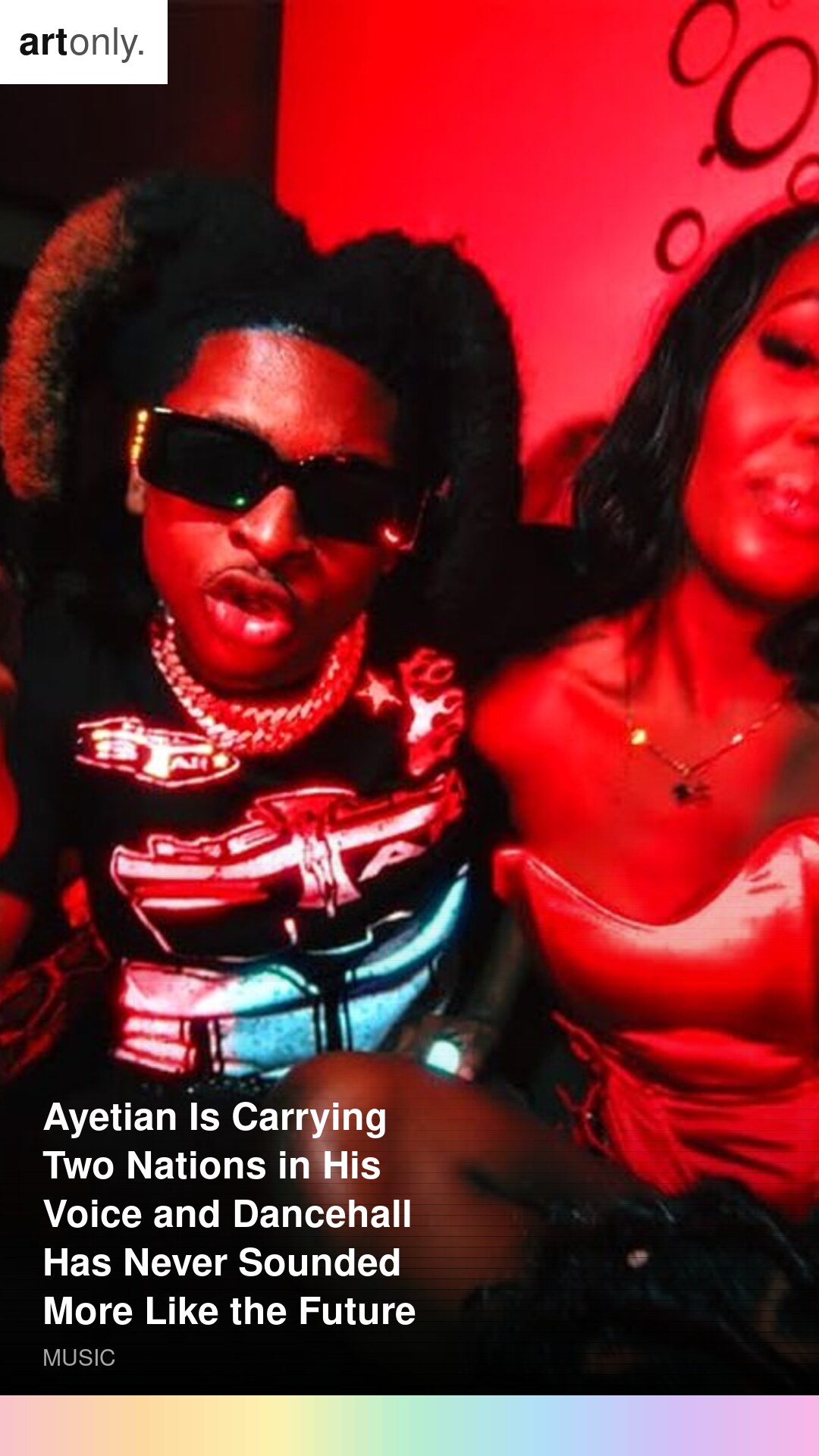
Dancehall has always been a music of identity negotiation, who you are, where you come from, what you carry that the world has not yet asked you to put down. Ayetian, born Malik Terc in Montego Bay to a mother who fled Haiti before he was born, has more to negotiate than most. At twenty-one, he has spent the last two years making that negotiation audible in the most direct way possible: by building songs that carry both nations simultaneously, not as a novelty or a marketing angle, but as the actual substance of the music.
Balance and What It Actually Means
The song that put him on the radar was Balance, released late 2024 with producer DJ Mac and videographer Brownland. The track moves at the pace dancehall operates at its most confident, unhurried, built on a rhythm that trusts itself, but there is something layered beneath the surface energy that separates it from the usual wave. Ayetian's delivery shifts register in ways that feel less like technique and more like genuine multiplicity. He is not performing the collision of his Jamaican upbringing and his Haitian heritage. He is just talking from inside it.
Tip followed in early 2025 and pushed the numbers further: over 3.4 million streams on Spotify, a profile in Billboard's 15 Hip-Hop, Caribbean and R&B Artists to Watch in 2026, and a U.S. tour that took him from Jamaica through North America and Europe. What What I Like, his collaboration with Moliy and Tyga, briefly made him a different kind of visible, the kind that comes with 7 million streams and a feature from an American rap veteran. He has handled that visibility carefully, which is to say he has not changed the music in pursuit of it.
What the Haiti Connection Actually Sounds Like
This is the question that makes Ayetian interesting rather than merely successful: what does it actually sound like to carry Haitian roots through a Jamaican dancehall framework? The answer, listening to his catalog, is that it sounds like a particular kind of weight in the phrasing, a seriousness that coexists with the music's surface energy without undermining it. His mother arrived in Jamaica with nothing. That fact is not explicitly present in the lyrics, but it is present in the way he sings, in the way he holds a chorus.
Haitian music carries its own enormous tradition. Kompa, the Haitian popular music form developed in the 1950s by saxophonist Nemours Jean-Baptiste, built an entire framework for rhythm and social identity. Ayetian is not directly citing kompa, but the sensibility that produced it, the understanding that music can hold a community's experience without narrating it explicitly, runs through his work. The songs do not explain themselves. They trust the listener to feel what they cannot fully name.
He has spoken publicly about wanting to represent both nations, about carrying the flag for a community that is often rendered invisible in the music that comes out of the Caribbean diaspora. That is a large ambition for a twenty-one-year-old. What is more surprising is that the music actually bears it out.
The Geography of Dancehall's Current Moment
Dancehall occupies a strange position in global music right now. Its rhythmic logic and vocal style have colonized enormous swathes of Afrobeats, UK rap, reggaeton, and mainstream American pop without the genre or its Jamaican artists always receiving direct credit for those borrowings. The genre is everywhere and simultaneously underrepresented in the critical and commercial infrastructure that assigns value.
Ayetian navigates this without bitterness or calculation. He does not make music that sounds like it is auditioningly for a crossover moment. Balance does not sound like a Jamaican artist trying to fit into an American chart. It sounds like a specific person from a specific place making music that could only come from that combination of circumstances. That groundedness is exactly what the genre needs at a moment when its influence is being diffused across a dozen other forms without attribution.
Montego Bay is not Kingston. The western side of Jamaica has its own relationship to the music, its own local scenes, its own particular flavor of dancehall that is slightly separate from the Portmore and Kingston lineages that dominate the genre's documented history. Ayetian carries that specificity too, though it is harder to name than the Haitian inheritance.
The Trajectory
Ayetian is currently in the running for the 2026 Mobia Award for Best Caribbean Music Act, weighing a record deal, and reportedly connected to an upcoming Netflix project in Jamaica. A mixtape is in progress. He has performed in Guyana at Masharama 2026. His monthly Spotify listeners sit at 1.5 million, significant for an independent Caribbean artist operating without a major label infrastructure.
The interesting thing about his trajectory is what it suggests about dancehall's current moment. The genre has been in a strange liminal space for the last several years, present in the DNA of everything from Afrobeats to UK rap to reggaeton without always getting the credit. Ayetian represents a version of it that is not trying to crossover by diluting itself. The music sounds like Jamaica. It also sounds like Haiti. And right now, in the hands of someone who actually lives that dual inheritance, it sounds like exactly where dancehall needs to go.
The Independence Question
The record deal Ayetian is reportedly weighing is worth watching carefully. Independent Caribbean artists who reach 1.5 million monthly Spotify listeners without major label infrastructure have built something real. The question a major label deal always asks is whether the infrastructure it provides outweighs the creative constraints it imposes. For an artist whose entire value proposition is specificity, the constraint question is not abstract. Genres get softened when they get mainstreamed. Dual cultural identities get simplified when marketing teams need a two-sentence pitch.
Ayetian has demonstrated so far that he knows what the music is and is not willing to trade it for visibility. Whether that conviction survives a significant label negotiation is the next chapter of the story.