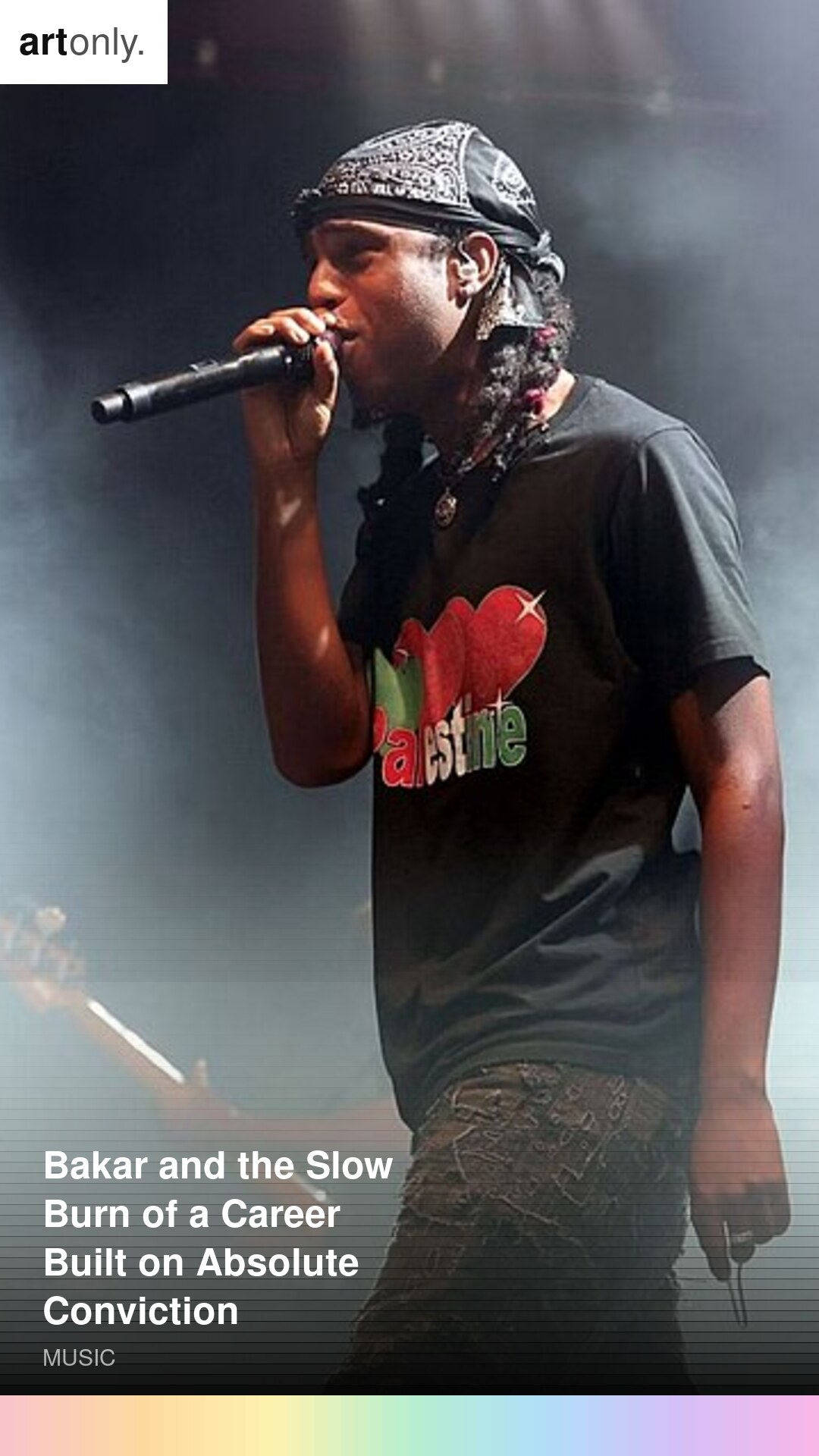
Some careers accelerate. Some build. Bakar is building, with the deliberateness of someone who has decided exactly who they are and is willing to wait for the world to come to that understanding rather than adjusting to meet the world's easier expectations. I find this kind of conviction both admirable and slightly unusual in the current climate, where the pressure to iterate fast and be legible immediately is so intense that slow-burning artists tend to either abandon the burn or go unnoticed.
I first encountered Bakar in the context of a wave of British artists doing something with guitar-based music that did not feel like the guitar comeback that critics were simultaneously announcing and lamenting. He was not nostalgic for anything in particular. The music did not sound like it was trying to revive a sound; it sounded like it was inventing one for the specific purpose of saying specific things. Which is, when you think about it, the only good reason to make any kind of music.
Nobody's Home was the record that made the argument. It is an album of considerable emotional range, tender and angry in quick succession, intimate and anthemic, willing to leave things unresolved in a way that invites repeated listening because you keep going back to see if you missed something that would make the picture complete. You never do. The incompleteness is structural.
The Guitar as Emotional Architecture
The way Bakar uses guitar is not decorative. It is doing work, defining space, creating emotional atmosphere, providing the structural framework that the voice and lyrics occupy. This sounds obvious but it is not. Many guitar records treat the instrument as a carrier for other content rather than as primary content itself. The best guitar albums make the instrument feel necessary, as though the music could not exist in any other form. Nobody's Home is one of those albums.
Produced by Zach Nahome, the record combines acoustic guitar licks and swinging rhythms with lyrics about identity, politics, and mental health. The Camden upbringing is audible. London specificity runs through the writing without being touristic about it. These are London stories and Bakar stories, which turn out to be the same thing.
There is an influence from Black American music that runs through his work in ways that are deep rather than superficial, not the appropriation of style but the absorption of philosophy, of an approach to how a song can feel, how rhythm and melody and emotion can be integrated rather than kept separate. He has talked about his relationship with that music in interviews and it comes through in the work as understanding rather than imitation. The album's critics noted fusion elements ranging from indie rock to alt-pop to ravey production to SoundCloud-era rap, and that promiscuity of influence is not carelessness. It is the natural output of someone who grew up listening to everything and decided to keep all of it.
On Building Rather Than Accelerating
The careers I find most interesting are the ones built over time, not because slow development is inherently more virtuous than sudden breakthrough, but because the building process tends to create stronger foundations. Artists who break through very quickly sometimes seem not to know who they are, or to be performing a version of themselves that was constructed in response to external expectation rather than internal necessity. Bakar seems to know exactly who he is. The music is consistent not in the sense of sameness but in the sense of inhabited perspective. You can tell this came from the same place as the last thing, even if the last thing sounded different.
Nobody's Home debuted at number 31 on the UK Albums Chart on Black Butter Records. That is a real number for a debut, and it landed on the strength of the music rather than a manufactured moment or a viral clip. The listeners it found were the right ones, which is to say people who came to the music because they heard something in it that they needed to hear again.
The Live Dimension
I think about the gigs Bakar has played, which by reputation are extraordinary. The physical energy, the commitment, the way he seems to create a particular relationship with a room that transcends the formal roles of performer and audience. I have seen video. I want to see it live. The slow building of a career through that kind of performance creates the kind of audience that stays, that follows you through changes, that trusts you because you have already demonstrated that trust is warranted.
Live performance is the other argument a slow-building career makes for itself. An artist who has played hundreds of shows before their first album charted carries that accumulated experience into every room they enter. The muscles are already developed. The setlist instincts are already calibrated. When the audience finally arrives in large numbers, the artist is ready for them. Bakar has been getting ready.
The Conviction That Carries
I keep coming back to Bakar. The conviction in the music rewards conviction in the listening.
The conviction I keep coming back to is not aggression or arrogance. It is the quieter kind, the kind that does not need to announce itself because it is simply operating from a fixed point. Bakar knows what he cares about. He makes music from that knowledge. The clarity that results is audible in every track. It is what makes you trust the music enough to follow it into its less immediately legible moments, because you know the conviction is load-bearing.
Some things about Bakar's career trajectory remind me of artists who took a decade to arrive at their audience's full attention, not because the music was not there, but because the music required the audience to come to it rather than the other way around. That kind of patience is becoming rarer. The pressure to be immediately legible, to have a hook in the first eight seconds, to be algorithm-friendly, these pressures would have crushed a music like his. He has made it through to the other side of the attention cycle still making exactly the music he wants to make. That fact alone makes the music worth seeking.