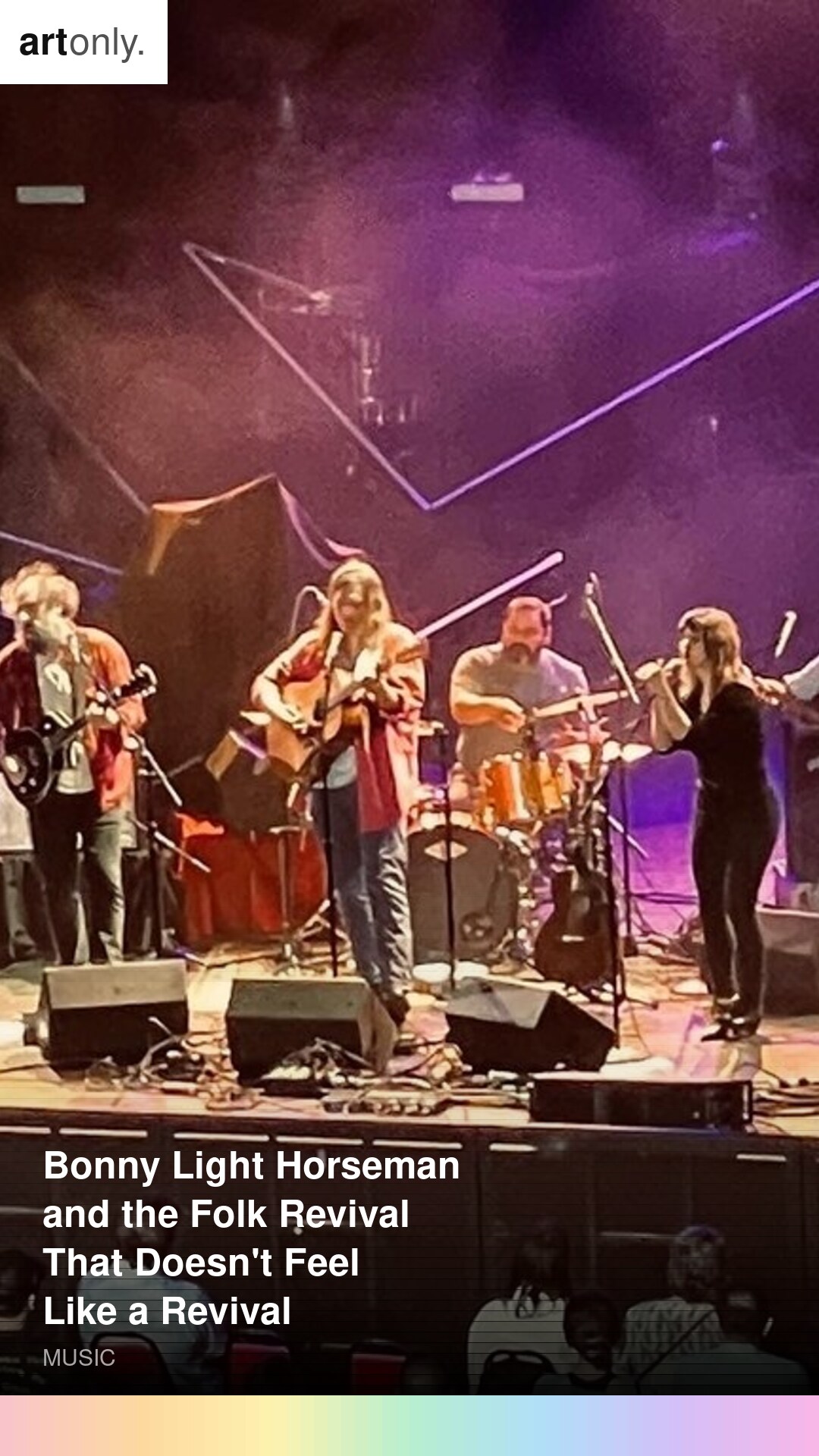
Every generation inherits folk music and does something different with it. The question is always the same: how do you honour a tradition that was built before you, in a world that no longer exists, and make it mean something to the world that does? The wrong answers are: ignore the tradition entirely and call it folk because it has acoustic instruments; or reproduce the tradition so faithfully that it becomes a document rather than a living thing. Bonny Light Horseman, Eric D. Johnson, Anaïs Mitchell, Josh Kaufman, are doing something that feels like a third way, and I've been sitting with their music trying to understand exactly what.
The supergroup framing doesn't do them justice, though the individual pedigrees are remarkable. Anaïs Mitchell made Hadestown, which is its own extraordinary thing. Eric D. Johnson has years of Fruit Bats recordings behind him, and also plays with The Shins, which tells you something about his range of feeling and his refusal to be pinned to a single mode. Josh Kaufman produces and plays with a sensitivity that never announces itself. He has brought that quality to records by The National, Hiss Golden Messenger, and Josh Ritter, artists whose music depends on restraint. When the three of them make music together, there's a quality of effortlessness that only comes from people who are genuinely listening to each other, the kind of attentiveness that traditional folk music demands and rewards.
The Old Songs Newly Felt
The debut self-titled album, released in January 2020, was traditional songs, mostly, worked through with a care that made them feel discovered rather than covered. The challenge with traditional material is one of emotional authenticity: how do you sing a song written in another century about experiences and concerns that aren't yours and make the emotion feel genuine rather than performed? The Bonny Light Horseman solution, insofar as I can identify it, is to find the universal inside the specific. A song about loss is a song about loss. The seventeenth-century context shapes the form. The experience is accessible.
What separates this approach from nostalgia is the absence of longing for the historical context itself. They are not singing about the past as a place to escape to. They are singing about grief, longing, departure, return, the fixed emotional coordinates that don't change across centuries because they come with being human. The old language carries them with a particular efficiency, a compression of feeling that modern lyric writing often tries and fails to replicate.
Rolling Golden Holy and the Move Inward
The second record, Rolling Golden Holy, released in October 2022, moved further into original territory, and the originals carry the sensibility of the traditional material without the crutch of it. They sound like songs that could have been written a long time ago and survived to reach us. Which is the highest aspiration of a certain kind of songwriting: to make something that feels like it was always there, waiting to be found.
The production on Rolling Golden Holy is sparser than it needs to be, which is a choice that costs you commercial reach and gains you permanence. Songs recorded with that kind of space around them are harder to date. They don't carry the sonic signatures of a particular production moment. You can hear the room, and you can hear the people in it, and those are the two things that matter most in music built on voice and string. Kaufman's production instinct here aligns with the project's deepest intention, which is to make music that feels less like a release event and more like an artifact.
On the Word "Revival"
I used the word in the headline and I want to pull it back a little. Revival implies that something was dead. Folk music was never dead. It was always being made, by people who loved it, in forms that the mainstream press wasn't covering. What happens periodically is not that folk is revived but that folk becomes visible to a wider audience, because certain artists produce work that is legible enough to cross the threshold. Bonny Light Horseman have crossed that threshold without compromising anything, which is the hard version of crossing it.
The harmony work is what I find most moving. Three voices that understand how to be three voices, not performing unity, not smoothing away the edges where they don't quite match, but existing in genuine counterpoint, each informing and altering the others. Traditional harmony singing has its own logic, its own way of creating meaning through the relationship between voices rather than in any single voice. They understand that logic. You can hear it in the way the music breathes.
What Three Voices Actually Mean
Most contemporary music, even music that foregrounds vocal harmony, treats the backing voices as texture rather than argument. The lead carries meaning. The harmonies carry mood. In Bonny Light Horseman's arrangements, all three voices carry meaning. There are moments where it is genuinely unclear which voice is leading and which are following, and that ambiguity is not a production accident. It is the point.
This connects to something larger about how traditional folk music organizes social meaning. Songs were sung together, by communities, in circumstances where no single voice had priority. The song belonged to whoever was singing it, which meant the song belonged to everyone. Recording technology individualized vocal performance in ways that cut against that logic. Bonny Light Horseman's three-voice approach is a structural argument about who music belongs to and how it works.
I play Bonny Light Horseman when I want to feel connected to something older than my own concerns. That's a need I didn't know I had until I found music that satisfied it.
The Material Is Not the Point
The thing that keeps me coming back is the trust. There's an enormous amount of trust in the music: trust that the songs are strong enough to carry simple arrangements, trust that the listener will meet the work where it is rather than demanding it move toward them, trust that the long tradition these songs come from is itself a form of meaning rather than merely a source of material. Traditional music carries memory in the way that no other music does. The accumulated experience of every person who has sung a song before you is present in the song, shaping how it sounds and what it means.
This is what separates serious engagement with folk tradition from mere borrowing of aesthetic markers. You can take the banjo, the modal tuning, the unaccompanied verse structure, and deploy them as signals without understanding what they mean or why they exist. Plenty of artists do exactly that. The signal is the point: communicate authenticity, rootedness, organic connection to the earth or whatever. Bonny Light Horseman understands this as the shortcut it is, and refuses it. They sing with that weight present and they make it feel like resource rather than burden. That takes real understanding of what they've inherited, and it takes the willingness to be accountable to it.
The distinction matters because music that borrows the form without understanding the function produces work that is flattering to the listener, work that says you are the kind of person who appreciates real music. Music that actually carries the function does something harder. It asks the listener to sit inside an emotion they may not have chosen and stay there for the duration. Bonny Light Horseman asks that of you, and the asking is generous rather than demanding, which is the rarest possible combination.