Painting as Aggression
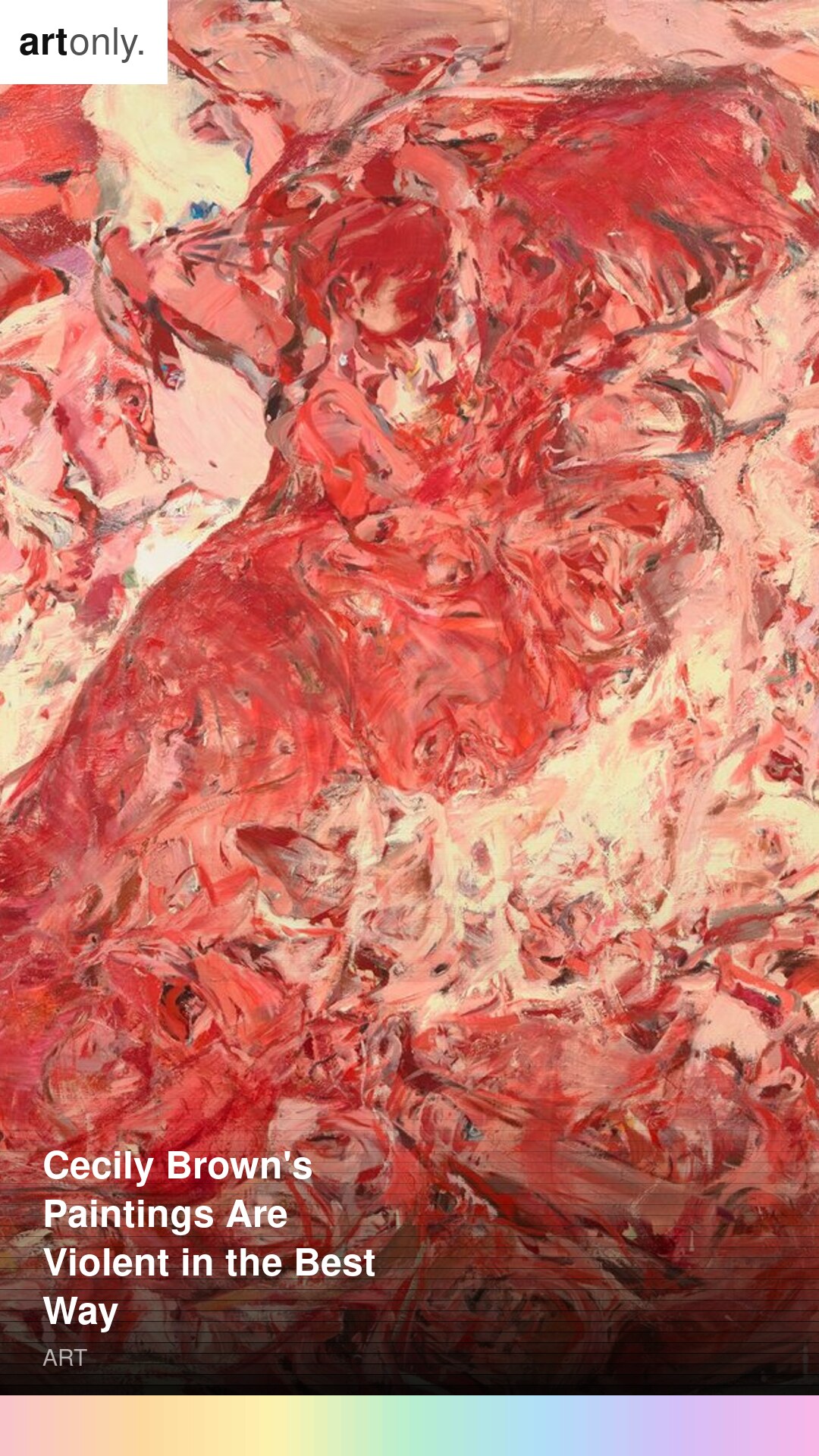
There's a violence in Cecily Brown's paintings that announces itself before you understand the images. The paint is applied with a force that's visible in the surface, the thick impasto, the directional brushmarks, the evidence of physical effort in how the canvas was worked. You stand in front of these paintings and feel the presence of a body that made them, a body that brought considerable energy and intention to the act of painting.
Brown was born in 1969 in Surrey, England, and her childhood was, by her own account, immersed in art and intellectualism, her mother was a novelist, her father an art critic and curator. She trained at the Slade School of Fine Art in the early 1990s, graduating during the same period that produced the Young British Artists, a generation she was tangentially connected to but never really part of. The YBAs worked conceptually, with irony and celebrity as tools. Brown always cared about paint as paint. That commitment to the material has never wavered.
She moved to New York in 1994, having first lived there as a Slade exchange student in 1992, and in New York she found contemporaries like John Currin and Lisa Yuskavage who were also invested in reinvigorating figurative painting from within. The influence went both ways. Brown's arrival in the New York gallery scene gave figurative painting renewed critical legitimacy at a moment when it badly needed it.
Her retrospective, which toured in 2022 and brought together work across several decades, was the kind of survey that forces a reevaluation of an artist you think you already understand. The early work and the recent work in the same rooms produced the effect of depth, of a sustained engagement with problems that had developed over time but maintained their essential character.
The paintings are of figures, often figures in states of erotic entanglement, of violent action, of some combination of both, rendered in a way that makes the boundary between the acts unclear. The figuration is not illustrative. The figures emerge from and dissolve back into the paint, are sometimes barely visible, sometimes fragmented beyond coherence. The picture plane is alive in ways that make looking an active rather than passive experience.
Where the Violence Lives
The violence I'm describing is not the violence depicted, though there is plenty of that, but the formal violence of the painting itself. Abstract Expressionism is the obvious reference, and Brown has consistently engaged with that tradition, but she brings to it a figuration that's absent from most of her predecessors, a figuration that makes the formal energy also erotic and sometimes disturbing.
The debt to Willem de Kooning is real and she owns it. De Kooning's Women series, those large, unsettling female figures that hover between portrait and abstraction, established that the figure could be treated as raw material rather than subject. Brown extends that logic but with a specific interest in the figure in motion, the figure in relation, the figure engaged in something that cannot be fully named.
Francis Bacon is another presence. Bacon's distorted figures in compressed spaces, his interest in flesh as something that could be forced into positions that revealed psychological states, shares territory with Brown's project. But where Bacon's paint surfaces are smooth and airless, Brown's are churned and accumulative. The paint in her work looks like it remembers being applied.
The bodies in her paintings are engaged in something and the something is always ambiguous. Is this pleasure or pain? Is this ecstasy or struggle? The formal qualities, the unresolved figure-ground, the compressed space, the way marks that might describe flesh also describe landscape, keep the images in a state of suspension that refuses easy interpretation.
I find this suspension one of the more genuinely interesting formal achievements in contemporary figurative painting. Most figurative painting either resolves too quickly, gives you the subject clearly and then you have it, or avoids resolution by retreating into abstraction. Brown does something different: she gives you just enough figure to make you want more resolution and then denies you the resolution, keeps you looking.
The large-scale works are where this effect is most powerful. At scale, the paintings become environments rather than objects, you can't take them in all at once, you move through them, and the movement changes what you see. The figures appear and disappear as your position shifts.
The Body as Landscape
Brown has talked about the tradition of the body-as-landscape in painting, the way that flesh and terrain are formally analogous in the history of Western art, the way that certain ways of painting land and certain ways of painting skin produce the same visual experience. Her work inhabits this tradition actively, using it to produce images that are simultaneously erotic and pastoral, intimate and vast.
The Old Masters are a living resource for her in a way that's unusual among contemporary painters. Rubens, Poussin, Goya, she returns to these figures not nostalgically but technically, asking what they knew about organizing figures in pictorial space that has been lost or abandoned. What Rubens understood about flesh in light, what Goya understood about bodies under duress, Brown brings these questions into the twenty-first century without dressing them in period costume.
This ambiguity is not evasion. It's precision about a particular human experience, the experience of the body as both subject and landscape, as both the thing that feels and the thing felt, as both particular and general.
The Sustained Project
Brown is represented by Gagosian, which means her market position is secure in ways that insulate her from certain pressures. That security matters for the work. An artist who doesn't need to chase the market can afford to continue pursuing the same set of formal problems over decades without resolution. The paintings in the retrospective from the 1990s and the paintings from the 2020s are recognizably by the same person working on the same problem. The problem has deepened, not changed.
That kind of sustained commitment to an unresolved question is rare. Most painters either answer their question or abandon it. Brown has kept painting toward something that remains productively out of reach. The result is a body of work that accumulates rather than simply continues.
Violent in the best way. Meaning: the paintings do something to you. They don't leave you where they found you.
The retrospective confirmed what I already suspected: Brown's body of work is one of the more coherent and committed in contemporary figurative painting. Coherent not in the sense of sameness, the work has changed across the decades, but in the sense of sustained engagement with a set of formal and conceptual problems that remain productive. She hasn't solved the problem of the figure in paint. She has kept it alive and interesting, which is better.
Violent in the best way. Meaning: you leave changed. You leave with your visual expectations slightly rearranged. The paintings did something to you. That's what they were for.