Crystal Castles were once the most dangerous band in electronic music. The Toronto duo of Ethan Kath and Alice Glass made abrasive, distorted, gloriously chaotic music that sounded like a rave inside a malfunctioning computer. Their live shows were legendary for their intensity. Their aesthetic, all blown-out visuals and confrontational noise, defined a moment in late-2000s underground culture that has never been replicated.
Then it all fell apart. Not slowly, not gracefully, but in the worst way possible.
What Made the First Two Albums Matter
The self-titled debut from 2008 and the second Crystal Castles album from 2010 remain the records people mean when they invoke the band's name. These albums operated at a specific intersection, pop melody processed through so much distortion and compression that it became something else, something that retained the hook without retaining the softness. Glass's voice was buried in the mix, treated as an instrument rather than a vehicle for communication, and yet the emotional content survived the processing. You felt something listening to Crystal Castles even when you couldn't precisely identify what you were feeling.
The production approach was genuinely confrontational. Most electronic music that incorporates noise does so in ways that acknowledge the noise as a formal element, a choice being made in dialogue with clean production norms. Crystal Castles applied noise as though there were no other option. The abrasion was not a stylistic choice. It was the position.
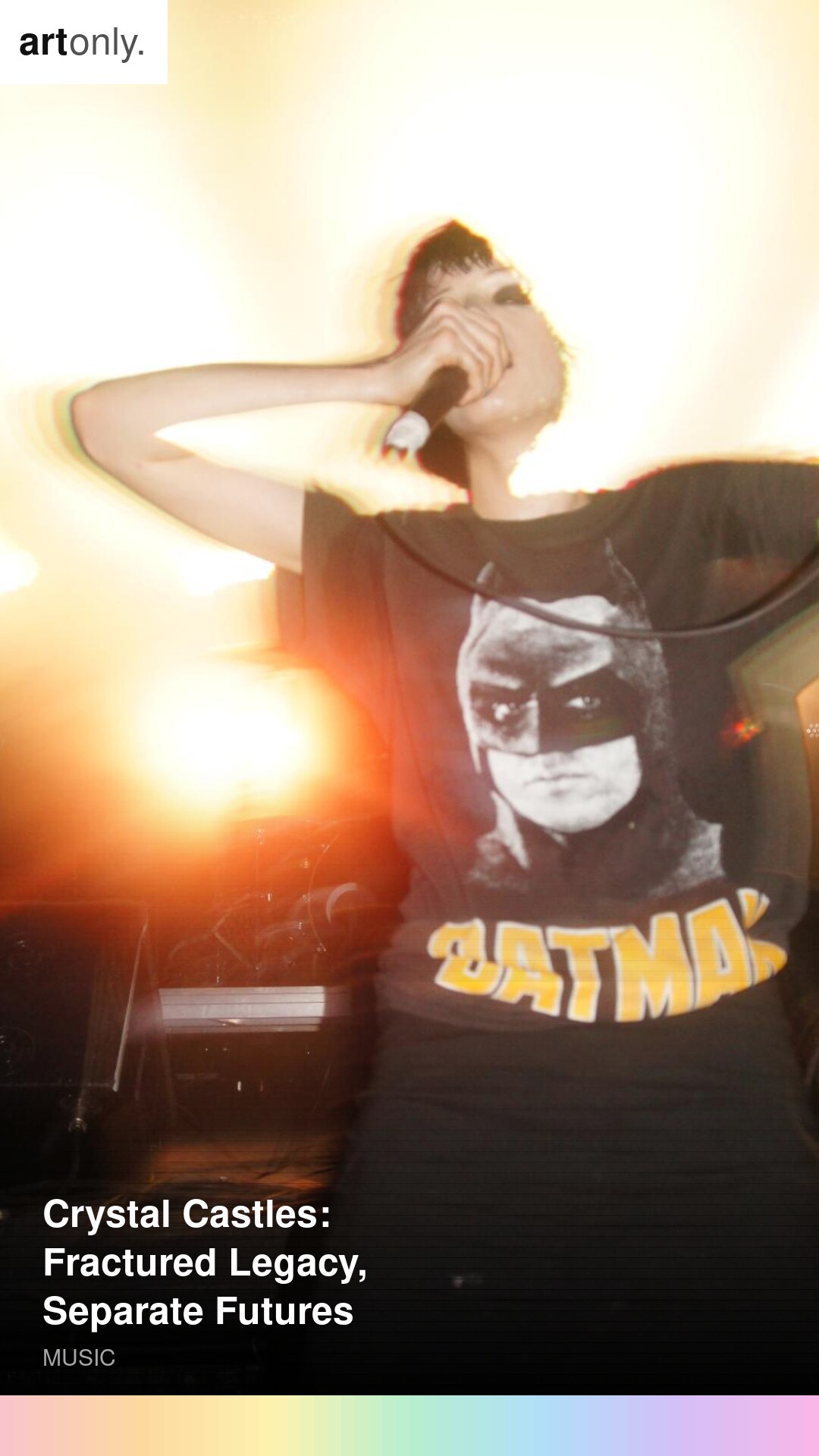
Live, this translated into shows that were chaotic in ways that felt genuinely dangerous rather than performed. Glass's stage presence, throwing herself through the audience, collapsing into the crowd, performing with an intensity that looked unsustainable, made the shows feel like events rather than concerts. That quality is rare. It is also, it turned out, not separable from the circumstances that produced it.
The Split
Alice Glass departed Crystal Castles in 2014, and the initial narrative was one of creative differences. Ethan Kath continued the project with new vocalist Edith Frances, releasing a fourth album in 2017 that was met with mixed reception. The sound was there, more or less, but the volatile chemistry that made Crystal Castles feel genuinely unpredictable was gone.
Then, in late 2017, Alice Glass published a statement alleging years of physical, sexual, and psychological abuse by Kath during their time together. The allegations were devastating and detailed. Kath denied them and briefly pursued legal action, but the case was dropped. The court of public opinion was less ambiguous. Venues cancelled shows. The project effectively ceased to exist in any meaningful public capacity.
Alice Glass: Rebuilding
Alice Glass has spent the years since her departure building a solo career that is both a continuation of and departure from her Crystal Castles work. Her debut solo album PREY//IV was released in February 2022 through her own Eating Glass Records, the title a deliberate echo of Crystal Castles' numbering system, reclaiming the discography on her own terms. She explained at the time that she considered herself the most consistent songwriter on the Crystal Castles records, and the album title PREY//IV acknowledged that this was her fourth full release.
The album comprised 13 tracks of music that retained the aggression and electronic abrasion that defined the duo, filtered through a perspective that is unmistakably her own. Reviewers at NME called it a creative reclamation. The description is accurate. The production was sharp and modern, leaning into industrial and hyperpop textures while maintaining the raw vocal intensity that made her performances so compelling. Subsequent releases have shown an artist who is not interested in nostalgia, who is actively evolving rather than retreating to what made her famous.
Beyond the music, Glass has become an outspoken advocate for survivors of abuse in the music industry. Her willingness to speak publicly about her experiences helped catalyze broader conversations about power dynamics in electronic music, a scene that has historically been reluctant to confront its own problems. The advocacy and the music are of a piece. Neither softens the other.
Ethan Kath: The Silence
Kath has largely disappeared from public life. There have been no significant musical releases, no public statements, no apparent attempt to revive the Crystal Castles name. The project's social media accounts have gone dormant. The legacy of Crystal Castles now exists in a complicated space: the music remains powerful, influential, and widely loved, but it is impossible to separate from the allegations that ended the project.
This is a tension that the music industry has never resolved and probably never will. How do you engage with art that shaped your taste, that soundtracked formative moments in your life, when the circumstances of its creation were allegedly abusive? There is no clean answer.
The Legacy
Crystal Castles influenced an enormous amount of music. The intersection of noise, pop melody, and electronic production that they pioneered can be heard in everything from 100 gecs to the broader hyperpop movement. Their first two albums remain touchstones for anyone making music that wants to be beautiful and broken at the same time. The production approach, treating the human voice as raw material for distortion, using compression as an expressive rather than corrective tool, refusing the distinction between beautiful sounds and ugly ones, showed a generation of producers what the aesthetic ceiling of noise-pop could be.
The hyperpop lineage is the most direct. The way 100 gecs and their followers bury melody in digital artifacts, process emotion through technical degradation, make music that is simultaneously abrasive and moving, this is Crystal Castles' inheritance, taken further in directions that Kath and Glass themselves didn't go.
But legacy is not just about influence. It is also about accountability, about what happens when the mythology of a band collides with the reality of the people inside it.
Alice Glass is making music on her own terms. The Crystal Castles catalog exists in a liminal state, loved and complicated simultaneously. And the conversation about what we owe artists versus what we owe the truth continues, as it should, without easy resolution.