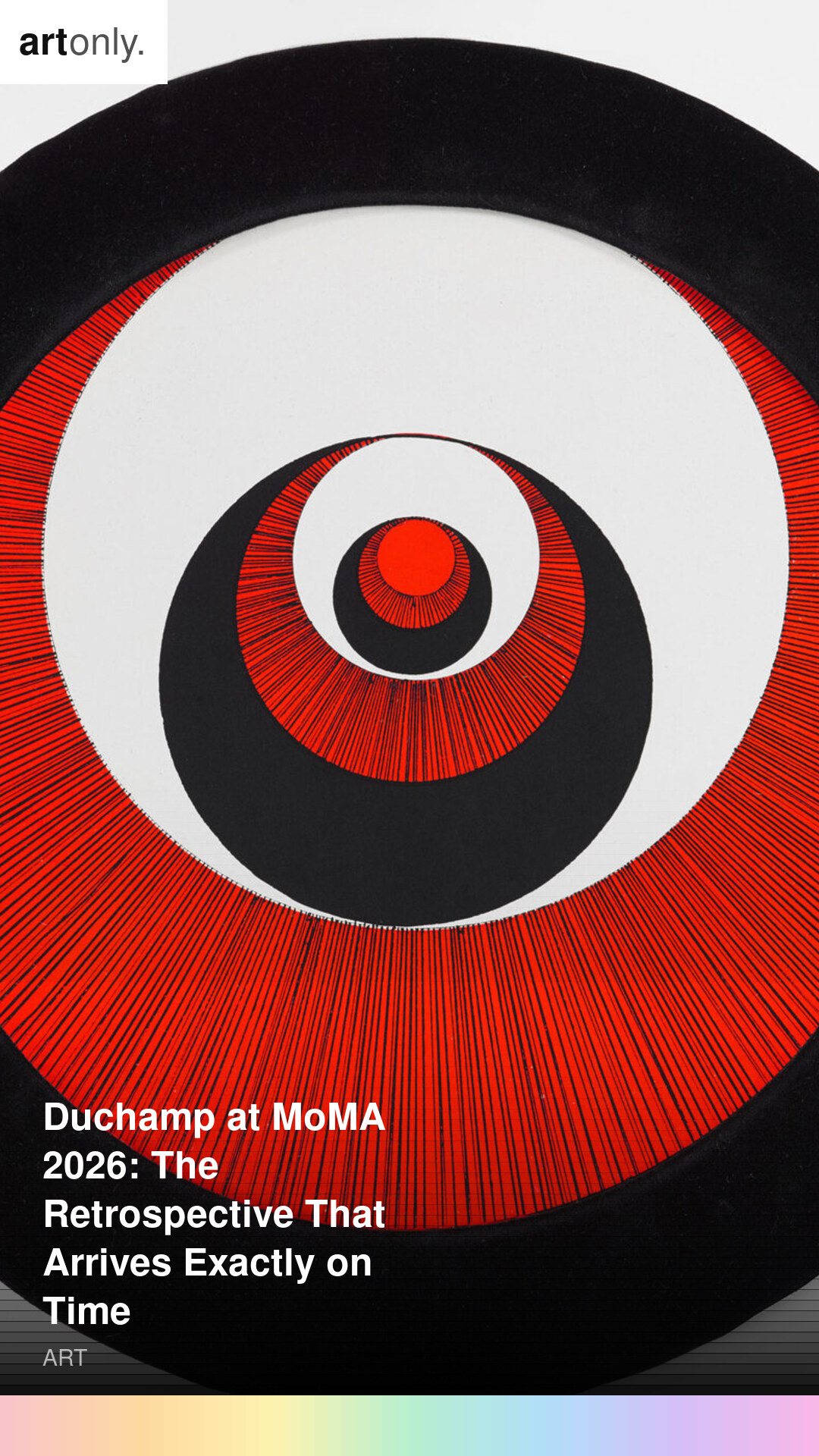
When MoMA opens Marcel Duchamp's first major North American retrospective in over fifty years on April 12, you could be forgiven for thinking the museum is trafficking in nostalgia. Nearly 300 works. Six decades of output. The man has been dead since 1968. But anyone who thinks this show is a backward glance is missing the point entirely, and probably missing why Duchamp matters more right now than he has at any point since the readymades first detonated the art world in 1917.
We are living through the most serious and publicly contested debate about authorship in the history of art. AI systems generate images in seconds. The question of whether those images constitute art, and who, if anyone, made them, is no longer academic. It is a legal dispute, an ethical crisis, and a cultural emergency. Into this precise moment arrives a retrospective dedicated to the man who spent his entire career asking a single, devastating question: what makes something art at all?
Duchamp did not answer that question. He weaponized it. His readymades, a bicycle wheel, a bottle rack, a urinal signed R. Mutt and submitted to a New York exhibition in 1917, were not provocations for their own sake. They were philosophical instruments. By selecting an object and designating it art, Duchamp demonstrated that the concept of art exists entirely outside the object itself. Art is not a physical property. It is a social and institutional agreement, a frame we choose to apply. That argument, which scandalized the art establishment of 1917, is now the central argument in every boardroom, courtroom, and editorial meeting where AI image generation is being debated.
From Nude Descending to Etant Donnes
The MoMA show, co-organized with the Philadelphia Museum of Art and curated by Ann Temkin, Michelle Kuo, and Matthew Affron, traces Duchamp from the 1912 Nude Descending a Staircase, his early engagement with Cubism and motion that scandalized the Armory Show, all the way to Etant donnes, the tableau he worked on in secret for twenty years and revealed only after his death. That arc is not a career of stylistic development in the conventional sense. It is a sustained philosophical investigation into the nature of making, seeing, and meaning.
Etant donnes, which will not travel from Philadelphia but whose presence looms over this entire show, is the most unsettling major work in the Western canon. You peer through a hole in a wooden door to see a diorama of a nude woman lying in a landscape, one arm raised holding a gas lamp. The work is erotic, clinical, theatrical, and completely inexplicable. It refuses every interpretive framework you bring to it. Duchamp spent two decades making something that looks like nothing else and means nothing he chose to explain. That silence is the point.
The Boites-en-Valise as Manifesto
The centerpiece of the MoMA presentation is the most ambitious mounting of the Boites-en-Valise ever assembled. These are portable suitcases containing miniature reproductions of Duchamp's own works, tiny facsimiles of the readymades, the Large Glass, the paintings, packaged as a kind of self-curated retrospective in a box. Duchamp began making them in the 1930s and continued for decades, producing dozens of editions.
The Boites-en-Valise are almost impossible to overstate as an idea. Duchamp was not just reproducing his work. He was questioning the uniqueness of the art object at the same moment Walter Benjamin was writing about mechanical reproduction. He was making commentary on his own legacy before he had fully established one. He was treating his output as raw material for a new work, collapsing the distinction between the original and the copy in a gesture that anticipated everything from appropriation art to digital remix culture to the current debates about AI training data. The Boite is a work about works. It asks what survives when the object is miniaturized and relocated, what the art was to begin with if it survives at all.
Authorship Is the Question We Cannot Escape
The AI art debate has a structural similarity to the readymade controversy that nobody has stated clearly enough: in both cases, the argument is about whether selection and intention constitute authorship. Duchamp selected a urinal and called it Fountain. An AI user selects a prompt and calls the output their work. The difference is not as obvious as it seems. Duchamp had taste, context, intention, and a fully developed artistic philosophy. The question is whether those things are necessary conditions for authorship, or whether they are merely the usual conditions.
Duchamp himself would have refused to settle this. He was a chronic refuser of settlement. He gave up painting for chess, insisted he was lazy, claimed to be post-retinal, meaning he wanted art to engage the mind rather than the eye, and spent his life undermining every position he appeared to occupy. What he left behind is not a body of work in any conventional sense. It is a set of questions so precisely formulated that they become more urgent with every technological development that changes who or what can make a thing.
Why This Show, Now
Museum retrospectives often feel like institutional housekeeping, a major figure gets the grand treatment, the catalog is published, the touring exhibition hits three cities, and the artist is safely installed in the canon. This show is categorically different. The Duchamp retrospective arrives at a moment when his central preoccupations are not historical curiosities but live controversies. What counts as art? Who counts as an artist? Is intention necessary? Is skill? Is novelty? These are questions being argued in real time by artists, technologists, lawyers, and critics, and Duchamp argued all of them first and more rigorously than almost anyone since.
You should see this show not because Duchamp is important to art history, though he is. You should see it because he is the most useful thinker available to anyone trying to navigate the present. His work is a toolkit for the moment we are in. The retrospective opens April 12 at MoMA and runs through August 22, 2026, before traveling to Philadelphia in the fall. This is not a museum honoring the past. This is a museum handing you an instrument you need right now.