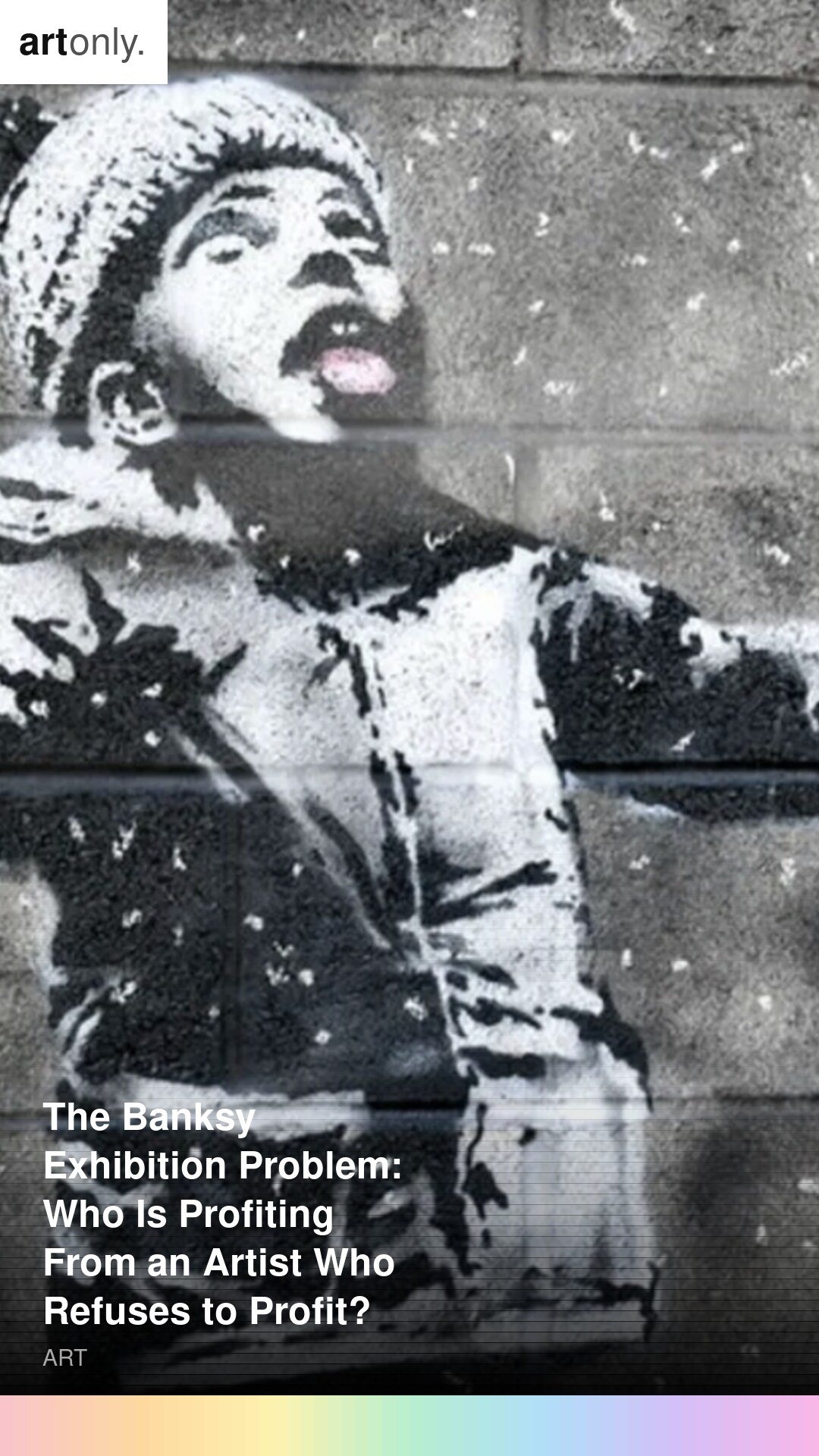
There is a Banksy exhibition in your city right now. Or there will be soon. It will have a slick website, a gift shop, an entry fee of thirty to forty dollars, and absolutely no involvement from Banksy himself.
This is not speculation. This is the state of the contemporary art world in 2026, where the most anti-commercial artist alive has become the subject of a global touring industry worth millions, none of which he sanctioned, none of which he controls, and none of which he profits from.
Banksy's own website carries a standing warning: there has been a recent spate of exhibitions bearing his name, none of which are consensual. His authentication body, Pest Control Office, has issued repeated public notices, including an October 2025 statement specifically disavowing an upcoming London show. The artist was never asked. He did not contribute.
The shows keep coming.
The Two Types of Fake
Not all unauthorized Banksy exhibitions are created equal, and the distinction matters.
The first category contains authentic works. Shows like The Art of Banksy, which has toured Toronto, Chicago, Boston, Melbourne, Tel Aviv, and dozens of other cities, source real authenticated pieces from private collectors. The works are genuine. The certificates from Pest Control are real. The exhibition itself is not. Nobody asked Banksy. The irony of charging admission to see the work of an artist whose entire practice is rooted in free public access is apparently lost on the organizers.
The second category is more brazen. Shows like The Mystery of Banksy: A Genius Mind, which has toured over thirty-six cities across nine countries and drawn over 3.5 million visitors, contain zero original works. Every piece is a reproduction. Recreated graffiti on fabricated walls made to look like concrete. The same is true of the Banksy Museum in New York, founded by Hazis Vardar, which charges around thirty dollars to see replicas of 160 works in a recreated street environment.
In Seoul in 2024, an exhibition displayed 150 works but only 27 were originals. The rest were reproductions. Visitors demanded refunds. The organizers eventually agreed to issue them. In Manila, Banksy Universe opened at The M venue with Pest Control publicly confirming Banksy had no involvement whatsoever.
The Legal Paradox
Banksy faces a unique disadvantage in fighting back: suing requires revealing his identity, which he has spent decades protecting. This creates a legal vacuum that exhibition organizers exploit with impunity.
The one time Pest Control did take legal action was in Milan in 2019, when Banksy: A Visual Protest opened at the MUDEC Museum featuring seventy unauthorized works. The court ruling was mixed. Using Banksy's name to promote the exhibition was deemed permissible as informational. But selling merchandise, notebooks, postcards, bookmarks bearing his artwork was ruled trademark infringement and ordered to stop.
It was a partial victory at best, and it has not deterred anyone.
The Milan precedent is instructive because it reveals the precise shape of the problem. Organizers can legally use his name. They cannot legally sell his imagery. That boundary is easy to respect and equally easy to violate in practice, because enforcement requires Pest Control to monitor every exhibition in every city and mount individual legal challenges each time. The economics favor the organizers. They are many; he is one.
The Scale of What Has Been Built
The unauthorized Banksy exhibition industry is genuinely vast. The Mystery of Banksy alone has operated in cities across Europe, North America, South America, Asia, and Australia. The Art of Banksy has run similar circuits. Smaller regional shows crop up constantly, some lasting weeks, others running for months in converted warehouses and shopping mall spaces. Ticket revenue from these shows, collectively, almost certainly runs into the tens of millions of dollars annually.
None of this money reaches Banksy. None of it was agreed to. The industry has constructed a commercial infrastructure around a body of work specifically designed to resist commercial infrastructure. It is a parasitic relationship, and the host has no legal mechanism to end it without destroying the anonymity that defines his practice.
The gift shop is the purest expression of the contradiction. In every authorized space where Banksy's work has appeared, his position on merchandise has been clear: the commercialization of his imagery is exactly what his art critiques. Unauthorized exhibitions sell tote bags and posters and postcards of Girl with Balloon in their lobbies. The irony is not subtle. The organizers don't appear to notice it, or don't care.
How to Know What You Are Looking At
Pest Control Office remains the sole authentication body for Banksy's commercial works. Their system is elegantly analog: authenticated works receive a Certificate of Authenticity that includes half of a torn fake ten-pound note, the Di Faced Tenner, with a handwritten ID number matching the other half held by Pest Control.
But there is a critical limitation. Pest Control only authenticates commercial works: limited-edition prints, canvases intended for sale. Street art on walls, doors, traffic cones, and other surfaces is generally not authenticated. This means the very works most commonly reproduced in unauthorized exhibitions, the stencils on walls, the Girl with Balloon, the flower thrower, exist in a verification gray zone.
The website banksyunofficial.com actively tracks and documents unauthorized exhibitions worldwide. If a show claims Banksy's endorsement, it is false. He has never authorized any exhibition. Full stop.
The Philosophical Question
There is a deeper tension here that goes beyond commerce. Banksy built his career on the principle that art should be free, public, and uncommodified. His street works were gifts to cities, interventions in public space that anyone could see without a ticket. His shredding of Girl with Balloon at auction was a direct attack on the art market's machinery.
But the unauthorized exhibitions have turned that anti-commercial philosophy into a product. They have taken work that was meant to be free and put a price tag on it. They have commodified the refusal to commodify. And because Banksy cannot fight back without destroying the anonymity that makes him Banksy, there is no mechanism to stop it.
The question for the public is not complicated: if you attend one of these shows, know what you are paying for. You are paying for reproductions, or at best for authentic works shown without the artist's knowledge. You are not supporting Banksy. You are supporting an industry that exists precisely because he cannot prevent it.
Whether that transaction feels acceptable is a question only you can answer.