I've been thinking about Promises since it came out in early 2021, and I'm still not sure I've found the right way to talk about it. It's a record that resists the critical instruments I usually reach for. It's too patient for most of the vocabulary of electronic music. It's too electronic for most of the vocabulary of jazz. It's too quiet and too still for the vocabulary of ambient. It inhabits a space that it seems to have created for the purpose of inhabiting, and the effect of listening to it, properly listening, without other tasks, without a window you're simultaneously looking out of, is unlike most musical experiences I've had.
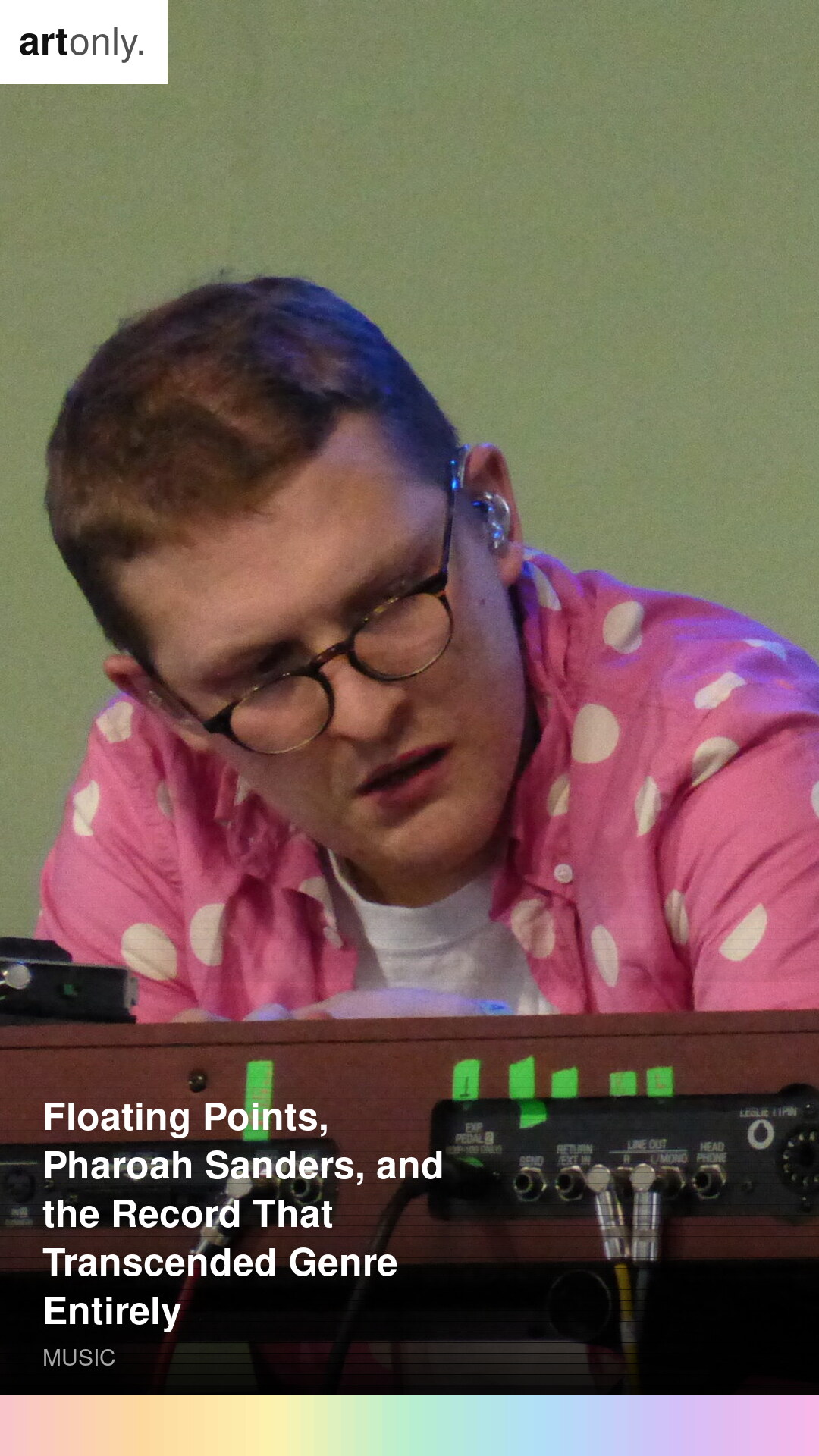
Sam Shepherd, who records as Floating Points, has been making music I've admired for years, Elaenia is a genuinely great album, but nothing prepared me for what he and Pharoah Sanders and the London Symphony Orchestra made together. The collaboration seems impossible when you describe it: an electronic producer known for club music, a jazz saxophone legend who played with Coltrane, an orchestra. The impossibility dissolves almost immediately once you're inside the music. It just sounds like itself.
Pharoah Sanders at Eighty
Pharoah Sanders was born in 1940 and he died in September 2022, eight months after I'm going to say this recording was the thing most in my head. I want to note that, because it matters. Promises is a document of a man in his eighties making music that sounds like it comes from the deepest part of what music can do. His saxophone doesn't appear until several minutes into the album, the production builds slowly, the LSO strings and woodwinds and Sam Shepherd's electronic architecture constructing something that needs time to settle before the saxophone arrives, and when it does, when Sanders finally plays, the effect is extraordinary. You feel the entire weight of a life lived in music arriving with him.
He plays with the kind of economy that only great age and great experience produce. Nothing wasted. Every note chosen with a care that doesn't announce itself as care. There are long silences. There are moments where he seems to be listening to the music as much as making it, his saxophone entering and receding like a tide. The collaboration between Shepherd's production and Sanders's playing is so symbiotic that you stop being able to separate them. It sounds like one mind with two instruments.
What the LSO Brings
The London Symphony Orchestra's role in Promises is worth examining separately from the two named artists, because it is doing something specific that neither Shepherd nor Sanders could achieve alone. The orchestral writing is spare, this is not a film score or a jazz orchestra piece in the conventional sense. The strings function more like drones and textures than melodic statements, creating a harmonic space that the saxophone and electronics can inhabit rather than compete with.
Shepherd's training as a neuroscientist who completed a PhD at University College London is not irrelevant here. He understands how sound affects the nervous system at a level most producers do not, and the construction of Promises reflects that understanding. The record does not build toward climaxes in the conventional sense. It modulates sustained states. The orchestral writing is precisely calibrated to maintain a particular emotional temperature across the album's thirty-eight-minute duration, creating conditions in which the saxophone can say what it needs to say without the listener having to work to receive it.
The single-movement structure, the album is one continuous piece titled with nine variations of the word "promises", means the orchestral texture never resets. It accumulates. By the time Sanders plays his most extended passages, the listener has been prepared by nearly twenty minutes of orchestral architecture. The readiness is engineered, and it works.
On Listening Without Agenda
The thing that Promises taught me, or reminded me of, is the value of listening without agenda. I mean this in the literal sense: sitting with music and allowing it to move at whatever pace it moves, not trying to extract information or find the moment where the melody comes back in or identify what genre this is. Pure reception. The album is thirty-eight minutes and I've listened to it beginning to end many times without the thirty-eight minutes ever feeling long. It has its own time signature and you enter it by agreeing to forget yours.
There are records I play to show people what I care about. Promises is different. I play it when I want to be changed slightly by something beautiful, when I want to remember what it is that music can do at its most essential, when I want to feel the specific emotional frequency of something old and wise speaking to something new and searching, and both of them finding a language they share.
Pharoah Sanders is gone now. The record remains. I keep coming back to it.
The record keeps doing something to me that I can't reduce to a description of what it contains. I've sat with it in grief and in contentment and in the peculiar numbness that arrives between the two, and it functions in all three states, not by being neutral but by being large enough to contain multiple emotional readings. The music that can do that is very rare. Most music stakes out a specific emotional territory and offers it to listeners who are in the right territory to receive it. Promises seems to work on a different principle, something more like a space you can bring different things into and have them met differently each time. Pharoah Sanders understood this. You can hear it in the way he plays, not with a single emotion but with an attention to what the moment requires, which changes as the record changes, which changes as you change. This is music made by people who have been listening for a very long time, and it sounds like it.