The Long Game
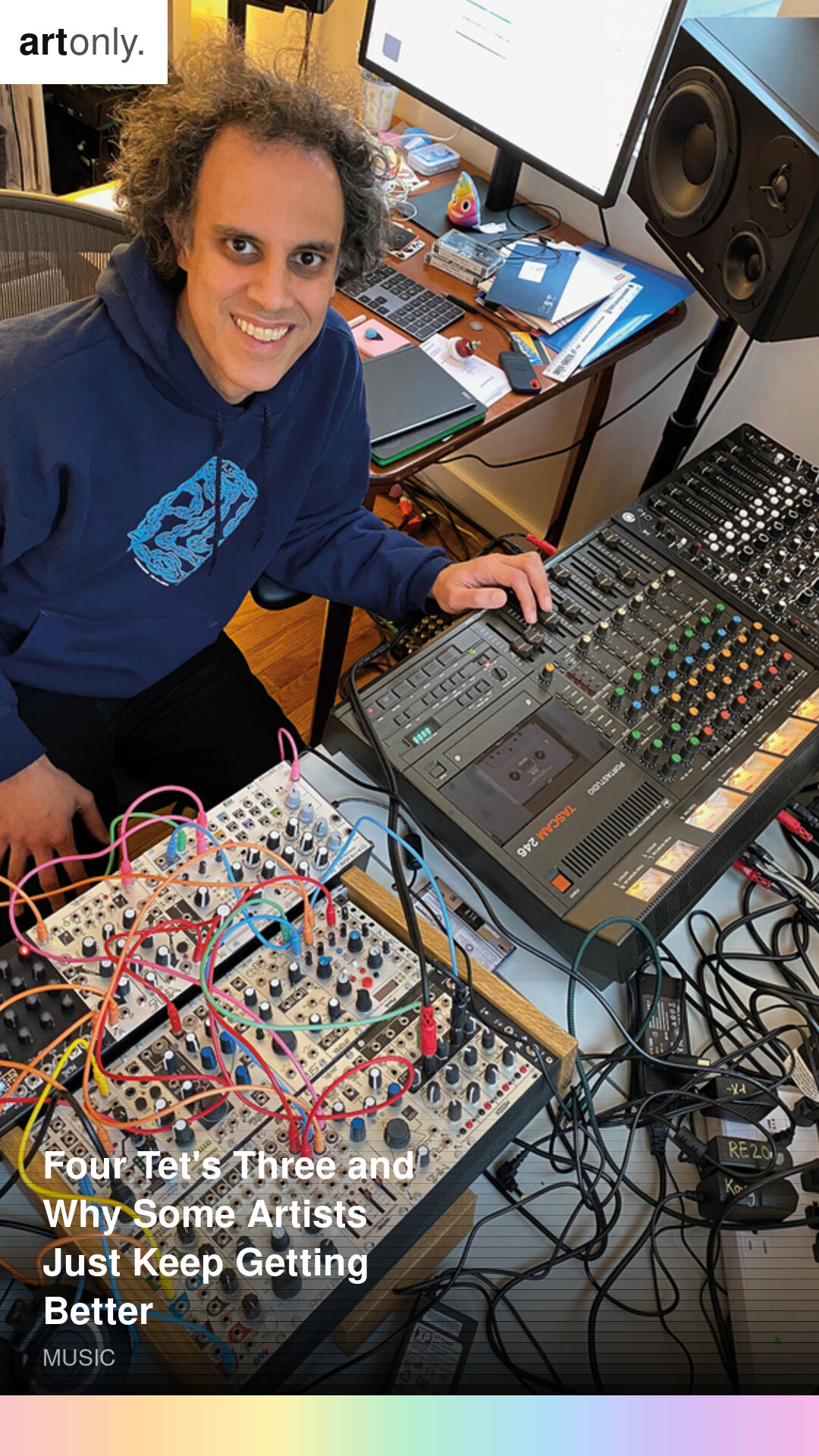
Kieran Hebden has been making music as Four Tet for over twenty years. Twenty years of consistent, evolving, often surprising work, a body of output that spans from the broken-beat intimacy of the early records through collaborative albums and DJ mixes and live performances that have gradually become their own form of artistry. Most artists don't sustain this. Most artists find a mode and stay in it, or lose the thread, or start repeating themselves in ways that feel like diminishment rather than development. Hebden keeps surprising me and I don't entirely know why.
Three came out in 2023 on his own label and it is, I think, his best record in a decade. That's a claim I make carefully, knowing his discography and knowing how much I've valued different parts of it at different times. But there's something about Three that feels like integration, like a record that has absorbed everything he's learned and arrived somewhere that feels both new and deeply recognizable.
The title refers to the three tracks, each of which is substantial, the shortest is eleven minutes, the longest nearly thirty. This is not ambient music in the passive sense, not music for sleeping or not-listening. It demands attention while not explicitly requesting it. It rewards the kind of listening where you let yourself follow the sound and notice where it leads.
What Electronic Music Can Be
I've been trying to articulate what Hebden does that most electronic producers don't, and the closest I can get is this: he makes music that breathes. There's a quality of organic process in Four Tet productions, samples that are chopped and arranged until they achieve something that sounds less like manipulation and more like growth, rhythms that develop over long periods in ways that feel inevitable in retrospect but surprising in real time.
The three pieces on this record have that quality amplified. They move through phases and moods across their runtime in ways that map to something like emotional experience, accumulation, release, return. The longest piece does something in its final section that I've listened to probably thirty times and still can't entirely predict. Every time it happens it feels slightly different.
This is partly about the relationship between repetition and variation, which is the central formal question of most electronic music and which Hebden has been working on since the beginning. But it's also about trust, the trust between artist and listener that's required for a thirty-minute piece to hold its shape, the willingness of both parties to commit to a duration that contemporary attention economics conspire against.
The Sample as Composition Tool
Hebden's sample practice on Three deserves specific attention because it is doing something that the vocabulary of sampling often obscures. The samples are not quotations from other music. They are not references to cultural touchstones. They are materials: fragments of sound, often barely recognizable as their source, cut and rearranged and processed until they become something new.
This is the tradition of musique concrete applied to contemporary electronic production, and it produces a different relationship between the music and its own origins than most sample-based work. You hear textures and timbres that carry an emotional weight their source material didn't have, that have been transformed by the cutting process into something the original recording couldn't have predicted. The samples are not where the music comes from. They are what the music is made of, which is a different thing.
The three tracks on the record each demonstrate this at different scales. The shortest track uses a relatively small number of elements, which makes the transformation of each element audible. The longest track layers so much material that the sources dissolve entirely into texture. Both approaches work because Hebden understands what he is building and knows when to stop adding.
The Aging Question
There's something I find genuinely moving about an artist in their forties making work that's still curious, still developing, still interested in new formal problems. The cultural discourse around music tends to be organized around youth, discovery, emergence, debut, and the story of what happens afterward is told less frequently.
Hebden's career after forty is one of the more interesting stories in electronic music precisely because he's refused the options that are usually available at that stage: the legacy act, the nostalgia tour, the pivot to commercial work. He keeps making records. He keeps DJing in rooms that are full of people half his age who came to hear him. He keeps working on whatever problem is interesting to him right now.
Three sounds like the work of someone who has nothing to prove and therefore can do anything. That freedom, the freedom that comes from having already established something durable, from not needing the record to do anything other than be exactly what it is, produces a different quality of music than ambition or anxiety.
The record also makes a case, through its existence and its reception, that there is an audience for this kind of duration and this kind of patience in electronic music. Three has found listeners who stay with it, who return to it, who report the same experience of finding new things inside familiar sections on the fifteenth listen. That audience is not enormous but it is attentive, and an attentive audience is what music of this kind deserves and requires.
I keep coming back to it. Weeks into listening to it. Still finding something new.
Three is the record of someone who has spent twenty years working on a set of problems and has found, in this particular configuration of solutions, something worth sharing. The length, the patience, the formal confidence, all of it signals a maker who knows exactly what they're doing and has chosen to do exactly this, nothing more and nothing less.
Some artists just keep getting better. Kieran Hebden is one of those artists. I don't take that for granted. I don't think he does either.