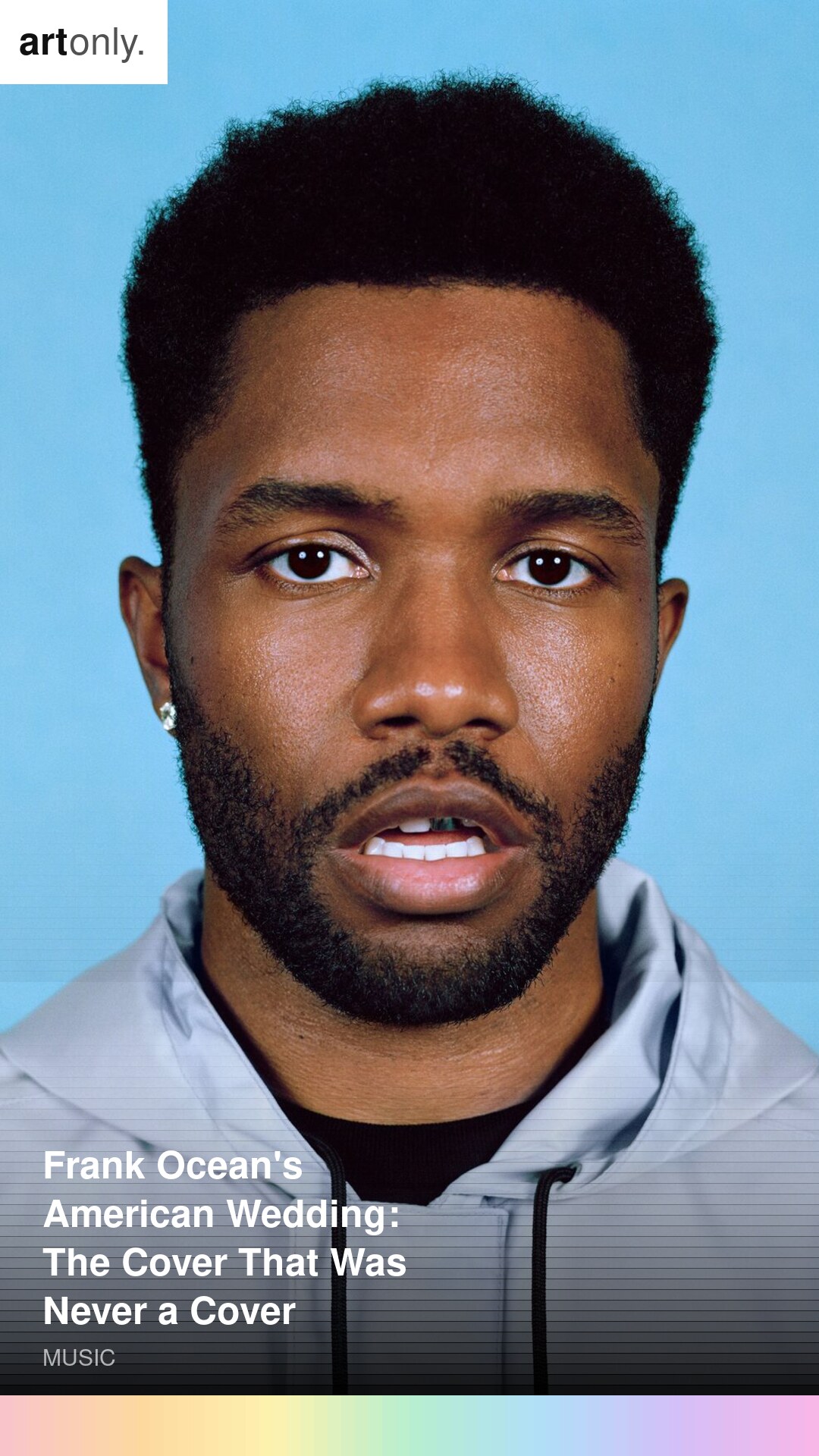
In 2011, before Channel Orange made him one of the most important artists of his generation, Frank Ocean released Nostalgia, Ultra as a free mixtape. Buried in that project was a track called American Wedding, a song that took the instrumental foundation of the Eagles' Hotel California and rebuilt it into something entirely its own.
It was not a sample. It was not a remix. It was Frank Ocean singing completely original lyrics over a live re-recording of one of the most famous chord progressions in rock history. He turned a song about hedonism and disillusionment in 1970s California into a devastating narrative about a doomed marriage, about watching love collapse in real time at a wedding ceremony.
The Eagles were not amused.
The Lawsuit That Never Was
Don Henley and the Eagles threatened legal action, and the song was pulled from commercial platforms. It never appeared on a proper album. It exists now in the gray zone of the internet: YouTube uploads, SoundCloud rips, fan archives. A masterpiece in exile.
What made the situation legendary was Frank's response. When asked about the legal threat, he was characteristically unbothered. He liked it. The threat, the controversy, the idea that his reimagining was powerful enough to make rock royalty nervous. There was no apology, no public retreat, no carefully worded statement from a publicist. Just a young artist who understood that the best art makes people uncomfortable.
The legal mechanics here are worth understanding. Hotel California's distinctive chord sequence, built around a descending harmonic progression that defines the song's mood, is among the most legally contested in rock history. The Eagles have pursued infringement claims aggressively across decades. But a live re-recording rather than a direct sample creates different legal terrain, you are not lifting someone's recording, you are re-performing an arrangement, which complicates the infringement analysis. The threat from Henley was less about certainty than about resources: challenging it would cost Frank far more than retreating.
Why It Works
American Wedding works because Frank did not try to improve upon Hotel California. He ignored it. He took the musical architecture and built a completely different house. His lyrics are raw and narrative, unfolding like a short story. The wedding guests, the champagne, the slow realization that the ceremony is a performance of love rather than the thing itself.
His vocal performance is unguarded in a way that his later, more produced work sometimes obscures. There is a crack in his voice during the bridge that sounds like genuine grief. It is the kind of moment that cannot be manufactured, that happens when a singer is inside a song rather than above it.
The track also proved something important about Frank Ocean's artistry early on: he understood that the line between homage and originality is not a wall but a membrane. Great artists have always built on what came before them. The question is whether you bring something new through the door. Frank brought a cathedral.
The choice of Hotel California as the vehicle is itself editorial. Henley's original is about a certain kind of American excess, the California dream as trap, pleasure as prison, wealth as spiritual vacancy. Frank took that same harmonic container and filled it with a different kind of American story: the dream of marriage, the performance of commitment, the collapse of one person's promised life. The two songs are in conversation, and the conversation is about what America promises and doesn't deliver.
The Mixtape as Laboratory
Nostalgia, Ultra as a whole was Frank Ocean demonstrating, to himself as much as anyone, what he could do with borrowed material. The mixtape contains samples and interpolations and re-recordings from Coldplay, MGMT, Radiohead, Gonjasufi, and others, all transformed into something that sounds entirely like Frank Ocean. This is a formal argument about creative identity: the artist is not the notes he plays but what he does with them.
American Wedding is the clearest statement of that argument on the tape. It is also the most legally vulnerable, which is why it disappeared from platforms while the rest of the mixtape remained accessible in various forms. The Eagles enforced their claim. Frank accepted the removal and moved on. The song exists in its exile, passing between listeners through unofficial channels, which gives it a quality of contraband, the thing the industry tried to suppress that keeps circulating anyway.
Nostalgia, Ultra as a complete document repays attention now for what it reveals about his process at the beginning: the ear for transformation, the willingness to use borrowed material as a starting point rather than an endpoint, the understanding that the most interesting creative act is not originality from nothing but originality achieved by what you do with what already exists.
Where Is Frank Ocean Now
This is the question that has defined the second half of Frank Ocean's career as much as any song he has made. After Blonde in 2016, widely considered one of the greatest albums of its decade, Frank retreated into a silence so total it became its own kind of mythology.
There have been fragments. A Coachella headlining set in 2023 that was divisive. Scattered loosies and features. A luxury jewelry brand. A Homer radio show on Apple Music that surfaced and vanished. But no album. No tour. No sustained presence.
The theories multiply. He is perfecting something. He has moved beyond music. He is processing grief after the death of his younger brother Ryan in 2020. He simply does not want to do this anymore. All of these could be true simultaneously.
What remains undeniable is the void. In an era where artists release content constantly to maintain relevance, Frank Ocean's absence has only increased his gravitational pull. Every new R&B artist is measured against him. Every introspective album is compared to Blonde. He has become the standard by doing nothing at all.
Someone, somewhere, please tell us where Frank Ocean is. Not because we are owed anything. But because the music he made suggested a conversation that feels permanently mid-sentence.
Listen to American Wedding on YouTube