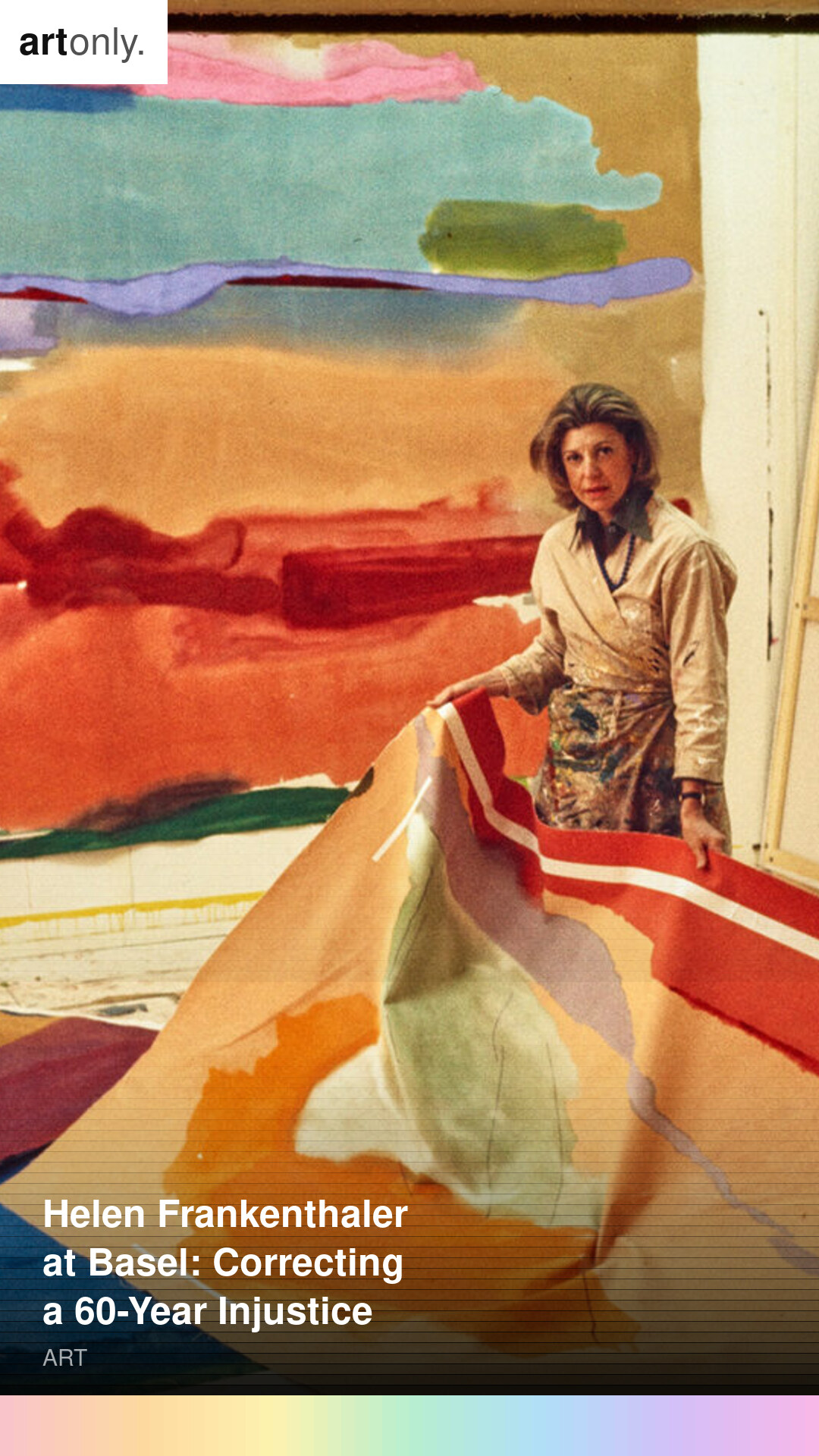
In 1952, a 23-year-old painter named Helen Frankenthaler laid an unprimed canvas on the floor of her New York studio, thinned her oil paint to a near-liquid consistency, and poured it directly onto the surface. The paint sank into the raw canvas fibers rather than sitting on top, producing color fields of extraordinary luminosity and depth, stained into the fabric of the work rather than applied over it. The painting was called Mountains and Sea. It was one of the most significant technical innovations in American art history, and it changed the course of painting.
The painters who came next, Morris Louis and Kenneth Noland, both of whom made direct pilgrimages to Frankenthaler's studio after seeing Mountains and Sea, built entire careers on the technique she invented. Louis became a canonical figure of Color Field painting. Noland is in every major survey text. Frankenthaler, the originator, spent decades being described as a bridge figure, a transitional artist, someone important mostly because of what she enabled in others. That construction is one of the more insidious forms of institutional sexism in art history: crediting the method to those who used it rather than to the person who discovered it.
The Kunstmuseum Basel's exhibition opening April 18 is the largest European show ever devoted to Frankenthaler. More than 50 paintings and 15 works on paper, spanning six decades of output, curated by Anita Haldemann. It is the first institutional solo exhibition of her work in Switzerland. It is, put plainly, overdue by approximately forty years.
What the Work Actually Does
Frankenthaler's paintings are not easy to write about because the experience of them is largely physical. The soak-stain technique produces color that seems to emanate from within the canvas rather than resting on its surface. You are not looking at paint applied to a support. You are looking at a surface that has been transformed at its molecular level. The distinction is not trivial. It changes the relationship between the viewer's eye and the work in ways that are difficult to articulate and impossible to reproduce in reproduction.
The scale matters enormously. Frankenthaler worked large, often enormously large, because she understood that the relationship between a body and a canvas is a formal element of the work itself. Standing in front of a Frankenthaler is a different physical experience from standing in front of a Rothko or a de Kooning. The color moves differently. The edges, often ragged, often ambiguous, staining off into unpainted canvas, create a sense of incompleteness that is not a flaw but a feature. The work refuses to be contained.
The Basel exhibition traces Frankenthaler's dialogue with the Old Masters she studied throughout her career, from Titian's handling of atmosphere and light to Monet's late Water Lilies. This is a crucial corrective to the tendency to read her work purely within the New York school context. Frankenthaler was a deeply educated painter who engaged seriously with the history of Western painting. The soak-stain technique was not a rejection of tradition. It was an attempt to find a new technical solution to ancient problems about light, color, and depth.
The Abstract Expressionist Boys Club
Frankenthaler studied with Hans Hofmann, was in a relationship with critic Clement Greenberg when her career was beginning, and was embedded in the social world of Abstract Expressionism from its center. She was there. She was producing major work in the same moment as Pollock, de Kooning, Kline, and Franz Kline. But the story of Abstract Expressionism as it has been told, institutionalized, and marketed is overwhelmingly a story about men.
Lee Krasner had to spend decades escaping Pollock's shadow. Joan Mitchell was consistently undervalued relative to her male contemporaries despite producing paintings that match anyone from that generation. Grace Hartigan, Elaine de Kooning, and dozens of others were sidelined by the market, the critics, and the institutions. Frankenthaler's case is particularly instructive because the erasure was not simply neglect. It was active reassignment, her technique handed to others as if she had merely been a stepping stone.
The market has begun to correct this. Frankenthaler's auction records have climbed significantly in the last decade as collectors and institutions have recognized what serious students of the period always knew. But the critical and institutional rehabilitation has lagged behind. A show of this scale at a museum of the Kunstmuseum Basel's standing is exactly the kind of reassessment that moves the needle.
What Basel Gets Right
The decision to show over 50 works across six decades is the right decision. Frankenthaler's career is not well understood if you only encounter the canonical early works. She continued developing, taking risks, shifting her approach across materials and scale throughout her life. The late works are underknown and essential. Her engagement with printmaking and woodcut in her later years produced some of the most formally inventive work in her catalog, and it receives almost none of the attention given to the paintings.
The dialogue with Old Masters framing, tracing Titian, Monet, and others through Frankenthaler's engagement with them, is a smart curatorial choice that refuses to ghetto-ize her work within the American abstraction narrative. It situates her in a longer history of painters solving perennial problems in painting. That is where she belongs.
The Kunstmuseum Basel exhibition runs from April 18 through August 23, 2026. If you are within range of Basel this summer, this is not optional viewing. This is one of those exhibitions that will look, in retrospect, like the moment serious attention finally landed where it should have landed decades ago. Helen Frankenthaler invented something. The least the art world can do is show up and look at it.