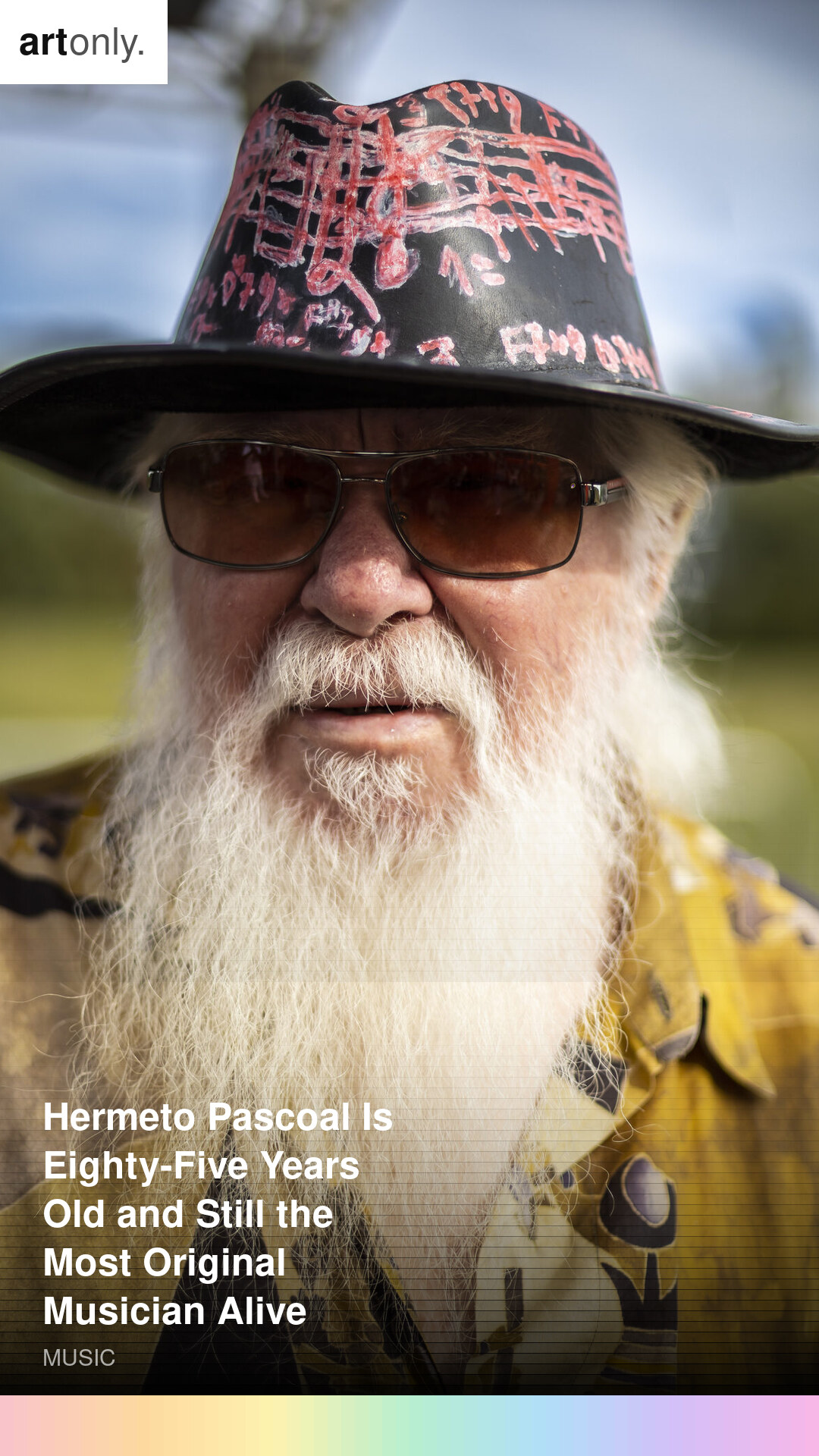
I want to be careful with the word genius because it gets overused to the point of meaninglessness and because it tends to close off understanding rather than open it up. If someone is a genius, you don't have to think too hard about how they do what they do; it's just a quality they have, ineffable, received at birth. Hermeto Pascoal resists that framing even as he seems to invite it. What he does is genuinely extraordinary, and I think the extraordinariness is explicable. It comes from somewhere: from a life lived in deep proximity to sound, from a philosophy about music that is more radical than most people realise. But every time I try to explain it I feel the explanation running short.
He's been making music since before I was born, before most of the people who will read this were born, and he has never repeated himself and never stopped developing. That is almost without precedent. Most musicians, even great ones, find their peak and maintain it, or decline from it. Pascoal seems to be on a different curve entirely, one that continues past the expected horizons. There is something almost alarming about this.
The Universe as Instrument
The famous Pascoal fact, the one everyone reaches for, is that he has recorded music using a pig, using teapots, using children singing in a kitchen, using radio frequencies, using anything that makes sound. This gets reported as eccentricity or whimsy, and I think that framing is wrong. It's a philosophical position. If music is organised sound, and the world is full of sound, then the world is full of music waiting to be organised. Pascoal didn't discover this. John Cage thought about it too, in a very different register. What Pascoal brings that Cage didn't is melody, an almost supernatural ear for pitch, for the harmonic possibilities within any sound source, that allows him to make music out of the world rather than just theory out of the world.
The difference matters. Cage's work can feel austere, cerebral, primarily interesting as proposition. Pascoal's work is physically exhilarating. When he extracts a melody from a teapot, the teapot has a melody. It is not a demonstration that teapots could theoretically be musical. It is actual music. The gap between those two outcomes is the gap between a philosophical position and a gift.
His Brazilian roots, the absorption of choro, of frevo, of the folk musics of the northeast, of African rhythms that arrived in Brazil through centuries of violence and transformed into something complex and syncretic, give his work a warmth and rhythmic vitality that purely conceptual music often lacks. He understands pleasure. He understands that the body needs to be included, not just the mind.
The Brazilian Lineage
Pascoal was born in 1936 in Lagoa da Canoa, a small town in Alagoas in northeastern Brazil. He was albino and largely blind from childhood, which shaped his relationship to sound in ways that are not easily summarized. He did not read music through notation. He read it through listening, through direct encounter, through a relationship to sound that bypassed the abstraction of the written score.
His connection to Miles Davis in the early 1970s is one of the significant moments in the history of Brazilian music meeting American jazz. He appeared on Davis's "Live-Evil" and the encounter left its mark on both artists. Davis recognized in Pascoal someone operating on a different plane of musical imagination, someone who could not be categorized within the existing structures of jazz or Brazilian music or anything else.
The group Pascoal has led for decades, built around his wife Aline Morena and a core of Brazilian musicians who have absorbed his approach over years of playing together, functions as a laboratory for his ideas. It is not a backing band. It is a collective of musicians who have learned to inhabit the musical philosophy that Pascoal has been developing his entire life.
On Longevity and the Refusal of Repetition
I think about Pascoal when I think about what it means to have a career in music. Most careers follow a recognisable arc. The early work establishes the sound, the middle work refines and deepens it, and then there's some period of diminishment, gradual or sudden, as the original impulse exhausts itself or the world moves on. Pascoal seems not to have got this memo. His recent work doesn't sound like a man maintaining a legacy. It sounds like a man who still has things he wants to say.
Part of this, I think, is the philosophical framework. If you believe, as Pascoal seems to, that music is everywhere, that any sound can be organised into something meaningful, then you will never run out of material. The world keeps making new sounds. The day keeps producing new events. There is always something to work with.
I've been playing his records to people who think they don't like jazz or Brazilian music or experimental anything, and watching their resistance dissolve about two minutes in, because the music is too alive and too playful to be rejected. It goes directly for the part of you that responded to music before you had categories for it. It finds the child who heard a sound and thought: I want to hear more of that. That child is still in there. Pascoal keeps finding them.
I've been playing his music to people who have never heard it and watching the moment when they stop trying to categorise it and simply listen. That moment, when the categorical impulse gives up and pure reception begins, is where the music is waiting for you. Pascoal has been making music for that moment his entire career. The music is patient. It knows you'll get there eventually.
His live performances, which have been a continuous practice across more than six decades, operate differently from the records. The records document specific configurations of his ideas. The performances generate new ones in real time, the ensemble responding to each other and to the audience and to whatever Pascoal decides to do with the sounds he finds in the room. The gap between the recorded work and the live work is wide enough that fans of one often arrive at the other as a separate discovery. Both are worth having.