The Swamp and What It Hides
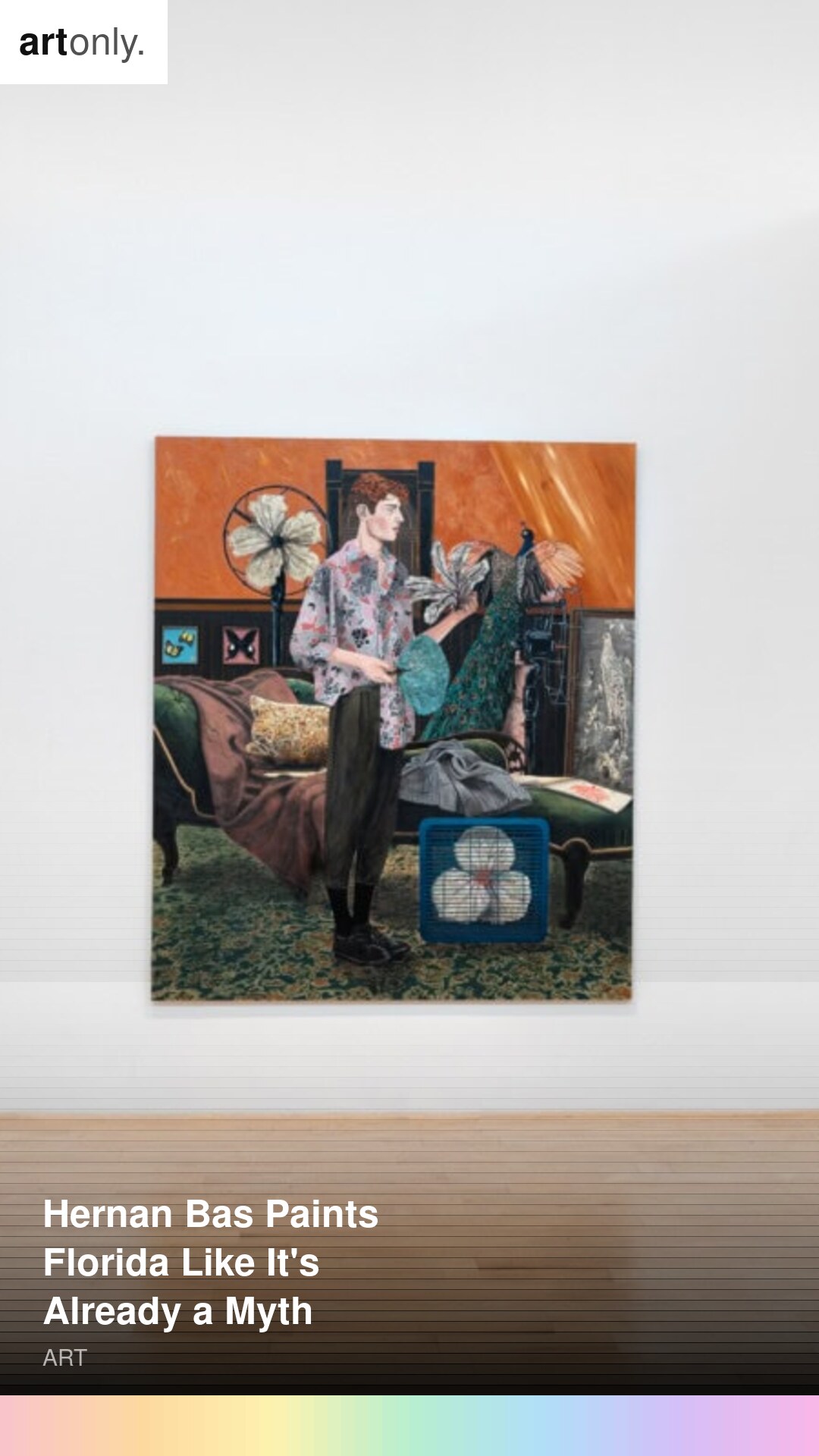
Florida is a place that doesn't need embellishment to be strange. The heat, the flatness, the subtropical excess of the vegetation, the particular quality of light filtered through humidity, the sense that beneath the tourist surface is something older and more ominous: all of this is already there, already more than enough for any artist with eyes. Hernan Bas was born in Miami and has spent his career painting Florida in ways that find the mythological in the material, the dark in the familiar.
Bas is known primarily for paintings that depict young male figures in lush, slightly menacing natural environments: boys in forests, in swamps, in interiors overgrown with vegetation, in situations that are ambiguous in a specifically queered way. The figures carry a quality of vulnerability and of something else, something that isn't quite threat but isn't safety either. The environments they inhabit are beautiful and potentially dangerous.
His recent work extends this into territory that feels increasingly like Florida mythology: the state as imagined landscape, as accumulation of anxieties and beauties, as place that has been the site of so many American stories that it has developed its own symbolic weight. The paintings feel like they're taking place in a dream version of a real place, in the Florida that imagination constructs from the materials of the actual Florida.
What Southern Gothic Means Now
The Southern Gothic tradition, Flannery O'Connor, Carson McCullers, the literary and artistic lineage that finds the grotesque and the spiritual entangled in the American South, is often discussed as a historical thing, as a mode that belonged to a particular moment in American culture. Bas's work suggests it's a contemporary mode as well, that the conditions that produced Southern Gothic haven't resolved but have evolved.
Florida-Gothic might be more accurate for Bas's specific territory. The vegetation is different, the light is different, the history is different from the Deep South that the literary tradition drew from. But the underlying qualities, the sense of something beneath the surface, the presence of heat and decay and beauty in close proximity, the way the environment seems to participate in the human drama rather than merely contain it, are present and intensified.
The queer dimension of his work is integral rather than incidental. The boys in his paintings carry a desire and a vulnerability that has specific meaning in a cultural context where queer desire has historically been something concealed, something practiced in hidden environments, something that found its expression in the marginal spaces of the landscape. The swamp is the closet. The forest is the place where the thing that can't happen elsewhere happens.
The paintings have a stillness that makes the potential violence more, not less, present. The figures are not in crisis. They're waiting. That waiting is the painting's tension.
The Botanical Dimension
Bas paints plants with the same attention he pays to figures, which is a position that most painters do not take. The vegetation in his work is not background. It is character. The specific plants matter: carnivorous plants, invasive species, subtropical flora that pushes against the built environment with the relentlessness of something that does not acknowledge property lines or human priorities.
Florida's plant life is, objectively, aggressive. The climate grows things fast and large. Vines consume buildings. Roots crack concrete. The subtropical landscape has a quality of encroachment that aligns perfectly with Bas's thematic concerns: the civilized surface maintained against the pressure of something wilder and older. His paintings make the botanical drama explicit. The plants are always winning.
This botanical attention gives his work a scientific specificity that prevents the symbolism from becoming heavy-handed. He is not using plants as metaphors. He is painting particular plants in particular environments, and the metaphorical resonance follows from the specificity rather than being imposed upon it.
The Already-Myth
I say Florida is already a myth because the accumulation of stories and images that have been attached to it has reached the density that produces mythological feeling. Theme parks, hurricanes, political circus, environmental crisis, the specific quality of light and heat and water: Florida has been narrativized so thoroughly that visiting it or painting it requires navigating through layers of prior representation.
Bas navigates these layers with the specific authority of someone who grew up inside the landscape he's painting. The myth he's making is made from knowledge, not from imagination alone.
The paintings are genuinely beautiful. The beauty is not innocent. Both of those things are true simultaneously, and the painting holds them both.
The swamp keeps appearing in his work as the territory that contains everything the surface of Florida disavows: the darkness, the danger, the history that development has tried to bury under asphalt and theme parks. In the paintings it's always right there, always adjacent to the figures, always threatening to encroach.
The Market and the Work
Bas has achieved a position in the contemporary art market that is unusual for a painter whose work deals explicitly with queer subjectivity and gothic unease. His paintings sell well at auction and through galleries, which says something about how the market's relationship to queer art has shifted over the past two decades, and also about the quality of the work itself.
The market success has not changed the paintings. They remain strange, difficult, committed to their specific territory. Bas has not made the adjustments that market success sometimes pressures artists toward, the shift toward larger, brighter, more immediately legible works. He keeps painting what he paints. That persistence is its own statement.
Bas turns Florida into myth not by making it exotic but by looking at it until it reveals what it was always doing. The state has been mythologizing itself aggressively for decades. Bas finds the actual myth beneath the promotional one. It's older, stranger, and more honest.
The recent work has moved toward increasingly specific Florida histories: the Cuban exile community, the Haitian diaspora, the Seminole Nation, the layers of settlement and displacement that lie beneath the strip malls and resort developments. These are not subjects he approaches from the outside. They are part of the landscape he grew up in, the specific cultural texture of Miami and South Florida that the tourist version of the state consistently erases. His painting restores what the official Florida image suppresses.