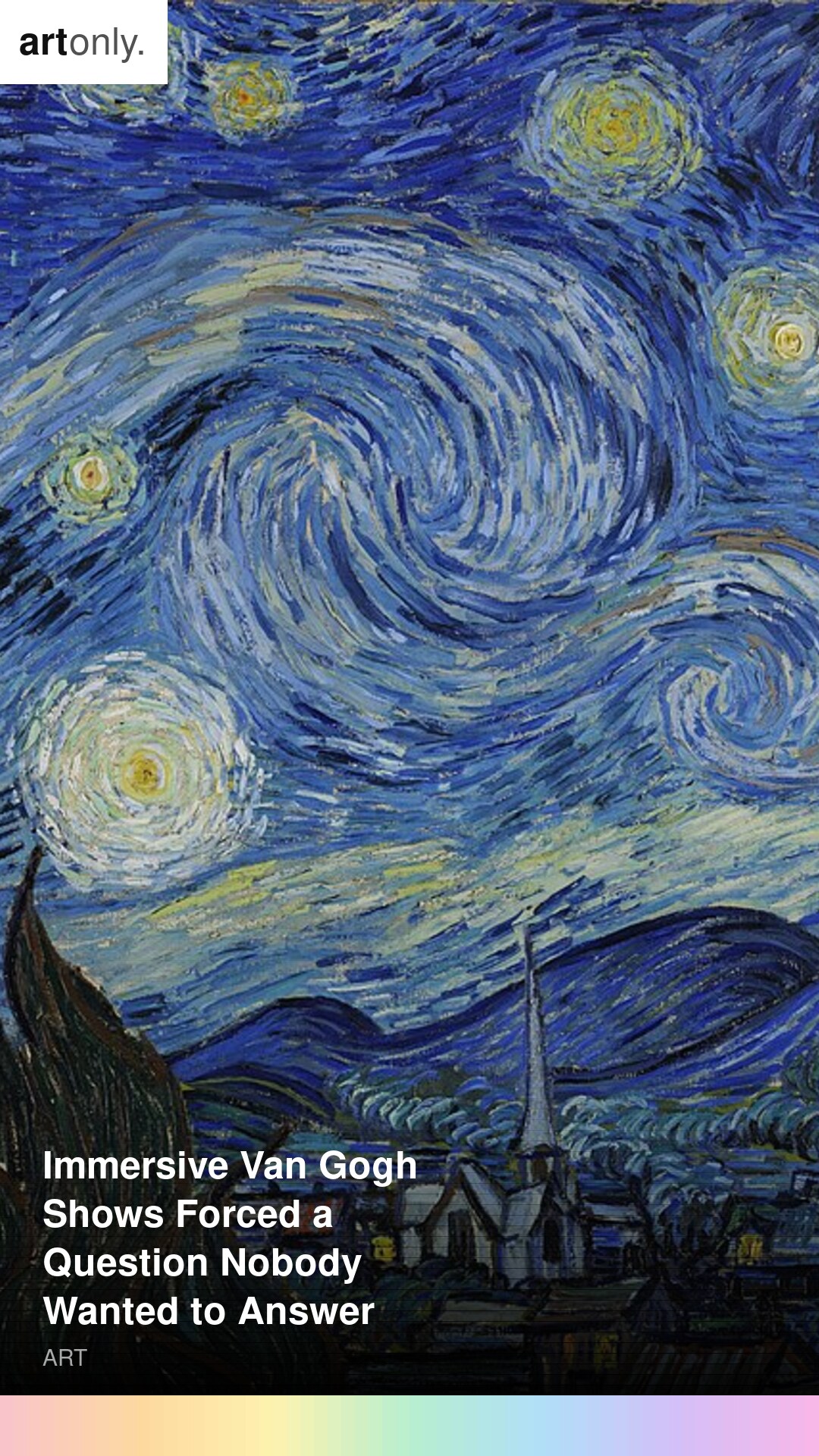
By 2023, immersive Van Gogh exhibitions had proliferated to the point of absurdity. Multiple competing companies were staging variations on the same concept in cities worldwide, projecting the Dutch master's paintings onto warehouse walls while visitors walked through swirling digital starry nights. Tickets sold in enormous quantities. Art critics were furious. And the public did not seem to care about the distinction between experiencing art and being entertained by it.
At peak saturation, there were at least four different Van Gogh immersive experiences touring simultaneously: Immersive Van Gogh, Van Gogh: The Immersive Experience, Beyond Van Gogh, and Meet Vincent van Gogh. They occupied converted warehouses, old railway stations, purpose-built tents in parking lots. The competition between them produced a kind of format war that would have been comic if it weren't also genuinely revealing about the appetite for this kind of experience.
The Case Against
The critical objections were straightforward and largely valid. These exhibitions removed paintings from their physical context, eliminated the intimacy of standing before an actual canvas, and replaced contemplation with spectacle. The brushwork that makes Van Gogh's paintings extraordinary, the thick impasto, the visible labor of each stroke, was invisible in digital projection. What remained was color and composition stripped of materiality, which is to say, stripped of much of what makes painting painting.
The paintings Van Gogh made are objects. Their objecthood matters. The weight of the paint, the physical record of the gestures that deposited it, the scale of the actual canvases relative to the human body standing before them: all of this is information. A projection onto a wall sixteen times the size of the original is not a bigger version of the painting. It is a different thing entirely, and the difference is not a technical limitation to be engineered around. It is the point.
There is also the question of what Van Gogh himself would have made of the proceedings. An artist who suffered profoundly and made work of extraordinary psychological intensity, whose paintings are inseparable from that suffering and that intensity, projected onto warehouse walls with ambient electronic music and instagrammable setups for selfies: the mismatch between the work and its presentation was jarring in ways that the critical consensus understood but the ticket buyers ignored.
The Case For
The counterargument was equally straightforward. Millions of people who would never visit the Van Gogh Museum in Amsterdam were engaging with these works for the first time. Children who might never develop an interest in art history were standing in rooms filled with projected sunflowers and feeling something. The exhibitions functioned as gateway experiences, and gatekeeping art appreciation seemed like a losing proposition in a culture already struggling with declining museum attendance.
This argument has real force. The Van Gogh Museum in Amsterdam requires a flight, a hotel, a museum budget, and a calendar that allows for international travel. These are not trivial barriers. The immersive shows, whatever their limitations, were in Des Moines and Tampa and Calgary. They were accessible in the straightforward logistical sense, which is a genuine advantage that the critical objections tend to underweight.
The question of whether engagement that happens through a spectacularized, dematerialized version of a work constitutes genuine engagement with that work is worth taking seriously without resolving it in the direction of snobbery. People who felt something in those warehouse rooms felt something. Whether what they felt was connected to what Van Gogh made is uncertain. Whether that connection is necessary for the experience to have value is a further question.
The Institutions' Problem
The immersive shows exposed a specific failure of the traditional museum model. The Van Gogh Museum itself, the Musee d'Orsay, the institutions that hold the actual paintings, have not been able to create an experience of Van Gogh's work that reaches the audiences the immersive shows reached. This is partly a resource problem and partly an imagination problem.
Traditional museums present Van Gogh's paintings in rooms with good lighting and informative wall text and trained docents available for guided tours. This is not a bad way to present paintings. It is a way that requires the visitor to arrive already interested, already equipped with the patience and attention that serious looking demands. The immersive shows met people at a different point: before the interest had formed, before the attention had been cultivated.
Whether meeting people at that point is the institution's job is a genuine question. The museums that have experimented with more accessible formats have often faced criticism from within the field for compromising their educational integrity. The immersive shows faced no such criticism because they made no claim to educational integrity. Their honesty about being entertainment freed them to reach people that the institutions, constrained by their own seriousness, could not.
The Real Question
The immersive Van Gogh phenomenon exposed a deeper tension in the art world about accessibility versus integrity. Traditional institutions have spent decades talking about expanding their audiences while maintaining exhibition practices that can feel exclusionary. The immersive shows, for all their commercial crassness, demonstrated that massive audiences exist for visual art when the presentation meets people where they are.
No Easy Answers
Whether these exhibitions constitute art, entertainment, or something in between is ultimately less interesting than what their success reveals about the gap between how institutions present art and how the public wants to experience it. That gap is real, it is growing, and projection mapping is not going to close it.
What might close it is institutions willing to reconsider what they are actually offering and to whom. The immersive Van Gogh shows did not create the appetite they served. They found an appetite that already existed and that traditional institutions had failed to feed. That failure is the question nobody in those institutions wants to answer directly.
The specific choice of Van Gogh is also worth examining. He is the most famous painter in the world by several measures, the one whose name generates the most recognition across the widest range of demographics. The immersive show operators chose him deliberately. His name alone would sell tickets before anyone knew what the experience involved. The question of whether the experience did justice to the work was secondary to the question of whether the name would move units. It did. And the people who went did not, in large numbers, go on to visit galleries or museums in the months that followed. The gateway theory has not been well supported by the evidence.