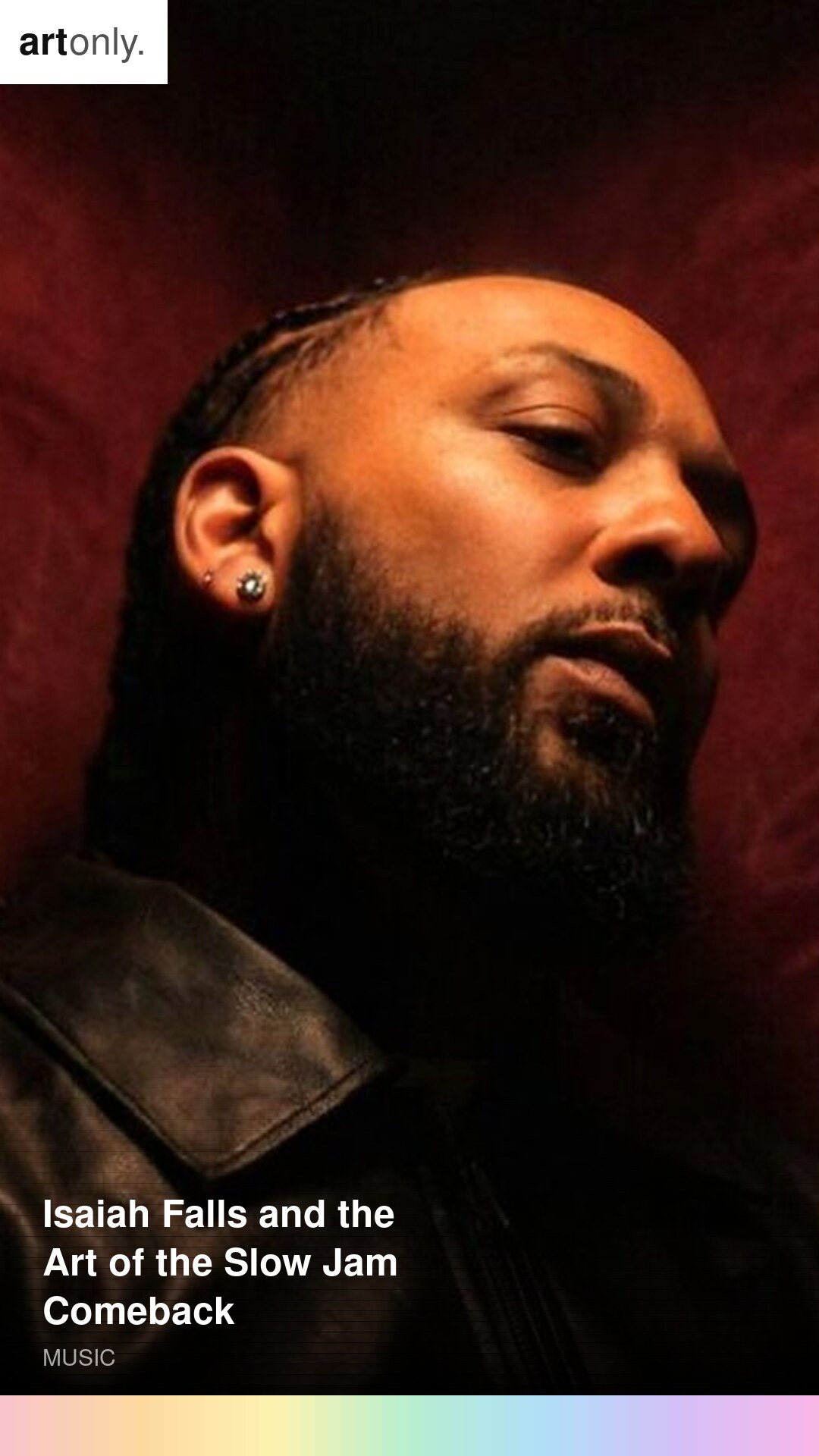
"What's your fantasy / I'll take you there / No time to spare." The lyric lands like a whisper in a crowded room, unhurried in a world that never stops rushing. Isaiah Falls released "Taboo" in March 2026, and it does something that most contemporary R&B has forgotten how to do: it takes its time.
At two minutes and forty-five seconds, the track does not overstay. Caramel-smooth production sets an intimate mood without ever reaching for spectacle. No vocal runs designed for TikTok clips. No trap-soul drums competing for attention. Just Falls, his co-production, and a melody that does not apologize for wanting what it wants.
The Florida Frequency
Isaiah Falls is the youngest of seven siblings, raised in Orlando by parents who were Christian artists and music executives. Both sets of grandparents are pastors. He taught himself to produce on FL Studio at fourteen, started releasing music in 2017, and committed full-time in 2019. His influences tell the whole story: Justin Timberlake and OutKast on one side, Kirk Franklin and Cleo Sol on the other, with Trick Daddy and Kodak Black providing the low-end Florida DNA that runs through everything he makes.
That last part matters. Falls is not making throwback R&B from a vacuum. His music carries the specific gravity of Florida, the humidity as emotional register, the Southern swagger redirected from bravado into warmth. "A lot of my music sounds so low," he has said, "like a late-night drive." He is right. The frequency is sub-bass and confession, 808s and bedsheets.
The Christianity in his background is audible without being explicit. The same sincerity that gospel demands, the refusal to perform feeling you do not actually have, runs through his secular material. When he sings about desire, it carries the same total commitment that devotional music requires. The sacred and the sensual do not conflict in the Florida tradition he draws from. They have always occupied the same frequency.
What the Slow Jam Requires
The slow jam as a form has specific demands that contemporary R&B production frequently sidesteps. It requires patience from the producer, the willingness to let space exist, to resist filling every bar with activity. It requires a vocalist who can sustain intensity across a track that does not offer the energy boosts of a hook-heavy structure. It requires a listener willing to receive rather than just consume.
Falls meets all three requirements. His production on "Taboo" is disciplined in ways that are not currently fashionable. The low end is present and warm but not aggressive. The hi-hats are sparse. The melodic elements have room to breathe. This is not minimalism as aesthetic choice. It is confidence in the song itself, the belief that the melody and the vocal carry enough weight that production density would only get in the way.
The vocal performance on "Taboo" is his best documented evidence that this confidence is warranted. He stays in a narrow dynamic range for most of the track, building tension not through volume or runs but through the quality of restraint. The moments where he opens up are earned because of what came before them.
The Arc of Patient Ambition
Trace the career and the pattern becomes clear. The 2023 debut EP The Private Room was exactly that, purely a songwriter's exercise, no drums, no ambition beyond intimacy. In 2024, Drugs n' Lullabies expanded the scope with twelve tracks and a breakthrough single, "Florida Baby," which has accumulated over twenty-five million Spotify streams. Billboard named him their R&B/Hip-Hop Rookie of the Month that September.
Then came LVRS Paradise (Side A) in May 2025, nine tracks, twenty-one minutes, distributed through Roc Nation, featuring Ambre, Odeal, and Joyce Wrice. A North American and European tour followed, including Montreal Jazz Festival, Paris, Amsterdam, and Berlin. The Lucky You EP arrived in October with SiR, Alex Isley, Chase Shakur, and Joyce Wrice again. Each project is a studied extension of the same principle: restraint as power.
The Roc Nation distribution is worth noting. It provides infrastructure without imposing aesthetic direction, which is exactly what Falls needs at this stage. He has built enough of an audience through the independent releases to arrive at that arrangement with leverage. The career has been managed with unusual patience for an artist his age, each project consolidating the previous one rather than trying to leapfrog it.
The Productive Tension
But restraint has its limits. Shatter the Standards noted that Falls sometimes "settles for the first draft of an idea rather than pushing through to something sharper." The songs are warm and sincere, and sometimes too careful. "Taboo" lives right at this edge. It is effortless in a way that reads as confident, but whether it cuts deep enough to stay with you past the second listen is a question worth sitting with.
That tension, between patience as strength and patience as avoidance, is what makes Falls genuinely interesting rather than merely pleasant. He has promised that LVRS Paradise (Side B) will be "a lot more grown, a lot more sexy... like a glass of red wine." If "Taboo" is the signal of intent, the follow-through is the story worth watching.
The slow jam has always been an argument about time, that desire is better served when it is not in a rush. Isaiah Falls believes that. Whether he can push that conviction into something truly cutting is the gap between very good and essential. He is closer than most.
The collaboration choices across LVRS Paradise (Side A) are instructive. Joyce Wrice, SiR, Alex Isley, Ambre: all of them work in R&B spaces adjacent to but not identical to Falls's. None of them are chosen for audience overlap or co-sign value. They are chosen because they understand the temperature he is working at. The features feel like conversations rather than appearances. That instinct for collaboration, finding people who share the frequency rather than people who extend the brand, is one of the more reliable indicators of an artist with a long career ahead.